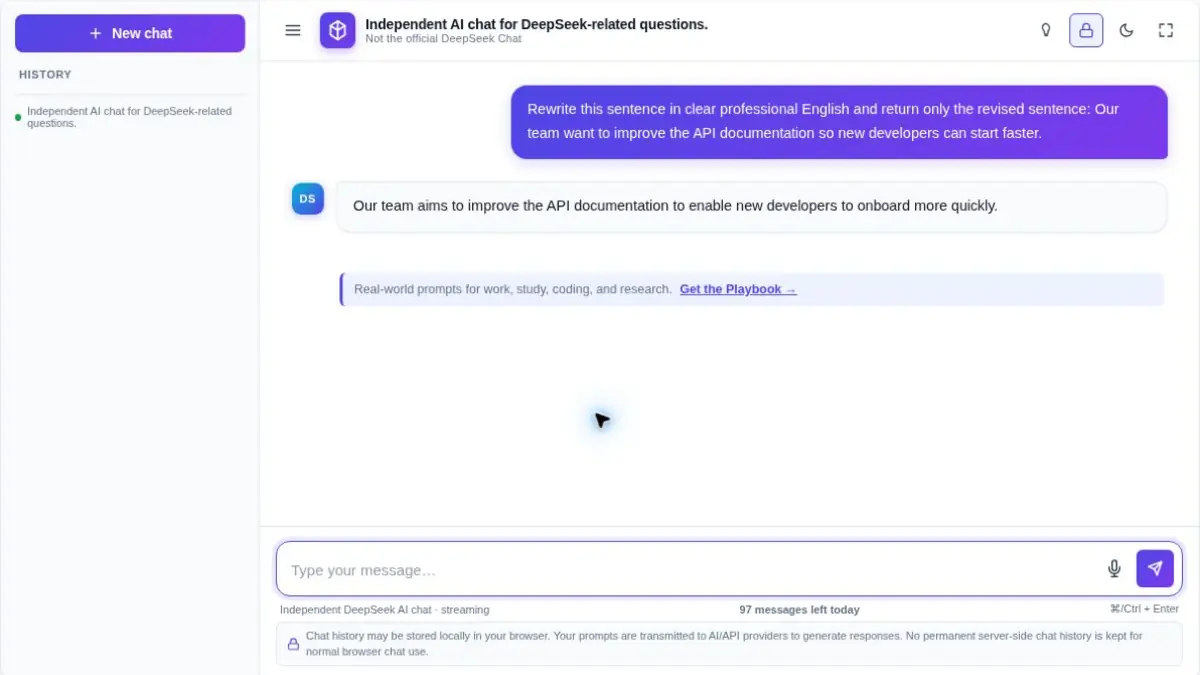
DeepSeek Features
DeepSeek is a family of open-weight large language models developed by DeepSeek AI, designed for advanced reasoning, coding, and large-scale language understanding. These models are known for their strong natural language capabilities, powerful reasoning abilities, and developer-friendly design. Some DeepSeek models (such as DeepSeek-V3) use a Mixture-of-Experts architecture with hundreds of billions of parameters, activating only a subset of experts for each query to improve computational efficiency. This architecture enables DeepSeek models to deliver high performance while using resources more efficiently. Below we explore the core capabilities of DeepSeek and how they support real-world applications.
This page explains the capabilities of DeepSeek AI models. Deep AI Chat is an independent documentation resource and does not provide the DeepSeek service.
Natural Language Understanding
DeepSeek demonstrates strong natural language understanding, allowing it to interpret and generate human-like text with context and nuance. Fine-tuning with human feedback has made the model adept at following instructions and producing helpful, coherent responses in conversation. It has demonstrated strong performance across a variety of language understanding benchmarks, indicating its ability to interpret complex queries and documents effectively.
Example: Ask DeepSeek to explain a technical concept in simple terms or to rewrite a paragraph for clarity, and it will understand the request and produce a clear, contextually appropriate answer. For instance, given the question “What causes thunderstorms, and how can we stay safe during one?”, DeepSeek can comprehend the multi-part query and respond with a well-structured explanation about thunderstorm formation and safety tips.
Why it matters: Robust natural language understanding lets DeepSeek serve as an intuitive AI assistant. Users can interact with it as they would with a knowledgeable human – by asking questions or giving instructions in plain language. The model’s ability to accurately interpret user intent and the subtleties of language ensures that its answers are relevant and trustworthy. This capability underpins use cases ranging from customer support chatbots to research assistants, where understanding context and intent is critical.
Reasoning Capabilities
One of DeepSeek’s standout features is its advanced reasoning capability. Unlike models that only rely on pattern matching, DeepSeek can perform logical inference and step-by-step problem solving. In fact, the DeepSeek-R1 variant was specifically designed as a reasoning-centric model, designed to perform multi-step reasoning internally before producing a final answer. This means DeepSeek can tackle complex tasks like mathematical proofs, coding challenges, or strategic planning by breaking them down into logical steps. It goes beyond surface-level answers – it can “explain its work” in arriving at a conclusion, much like a human reasoning through a problem.
Example: If you ask DeepSeek a multi-step math question or a logical puzzle, it will analyze the problem methodically. For instance, given a question like “If a company’s profits grow 5% each month, what is the annual growth rate?”, DeepSeek can reason through the compounding calculation step by step to arrive at the correct answer, rather than guessing. Similarly, for a question such as “Plan an itinerary that accounts for weather, travel time, and sightseeing preferences,” the model can logically organize the requirements and propose a sensible plan with explanations for each choice.
Why it matters: Strong reasoning skills make DeepSeek useful for tasks where simple question-and-answer interactions are not sufficient. By reasoning through problems, the model can produce more accurate and structured responses. This capability is valuable in real-world workflows—from debugging complex code to supporting data-driven decision making—because the model can provide not only an answer but also the reasoning behind it. As a result, professionals can better evaluate the reliability of the output in areas such as financial analysis, scientific research, and other domains that require critical thinking. In several public benchmark evaluations, DeepSeek reasoning models have demonstrated competitive performance with leading frontier AI systems.
Long Context Processing
DeepSeek excels at handling long context inputs. Some DeepSeek models support long context windows of up to around 128K tokens, enabling the model to process large documents or long conversations, enabling the model to process large documents or long conversations. In practical terms, this means the model can ingest extremely large documents or lengthy conversations without losing track of details. Many other LLMs have context windows in the tens of thousands of tokens (or less), but DeepSeek’s architecture allows it to efficiently manage much larger texts. It maintains coherence over long inputs, which is crucial for tasks like document analysis or understanding extended dialogues.
Example: You could provide DeepSeek with an entire research report or a book chapter and ask for a summary or analysis, and it will consider the content in full. For instance, a user might feed a 100-page policy document into the model and request a condensed executive summary. DeepSeek can process the entire document in one go and generate an organized summary that captures all key points, rather than having to break the text into chunks. Another example is in coding: a developer can input thousands of lines of source code, and DeepSeek will be able to navigate the whole codebase to answer questions or generate new code sections in context.
Why it matters: Long context processing enables more realistic and efficient workflows. Professionals no longer need to manually split up long materials – DeepSeek can handle them in a single session. This capability is particularly valuable for reviewing large knowledge bases, legal contracts, or multi-log datasets where context from earlier in the text is important for understanding later parts. By keeping the entire context, the model reduces information loss and repetition, leading to more coherent and accurate outputs. In collaborative conversations (like lengthy email threads or chat histories), DeepSeek can remember earlier details even far back in the transcript, making it an effective assistant for continuous discussions or troubleshooting sessions that span many turns.
Code Generation and Debugging
Another core strength of DeepSeek is its code generation and debugging capability. Trained on large amounts of programming data, DeepSeek can generate code in multiple languages such as Python, JavaScript, C++, and others based on natural language instructions. The model can also assist with identifying bugs, suggesting fixes, and improving existing code.
DeepSeek coding models have demonstrated strong performance on programming benchmarks such as HumanEval and other code-generation evaluations. In practice, this makes DeepSeek useful as a coding assistant—similar to having a knowledgeable pair programmer or code reviewer available to help write, analyze, and improve code.
Example: A developer could ask, “Write a function in Python that sorts a list of dictionaries by a given key,” and DeepSeek will generate a correct and well-structured Python function to accomplish this. If given a piece of code that isn’t working, for example a snippet with a logical error or bug, DeepSeek can analyze the code, point out the error, and provide a corrected version. It can even explain the fix, e.g. “The issue was an off-by-one error in the loop; here’s the corrected code…”. In one scenario, developers have used DeepSeek to automate code reviews and improvements, where the model identifies potential problems and suggests optimizations in real-time.
Why it matters: Automating coding tasks can dramatically boost developer productivity and reduce errors. DeepSeek’s capabilities mean that routine programming tasks – writing boilerplate code, translating pseudocode to actual code, or catching common bugs – can be offloaded to the AI. This allows developers to focus on higher-level design and logic. In team settings, it can standardize code quality by providing consistent suggestions and catching issues early. For businesses, this translates to faster development cycles and fewer software bugs making it to production. By serving as an AI coding assistant, DeepSeek effectively shortens the feedback loop in development, leading to more efficient engineering workflows.
Multilingual Abilities
DeepSeek is designed to operate across multiple languages, enabling it to understand and generate text beyond English. Trained on diverse multilingual data, the model can interpret user queries, analyze documents, and produce responses in several languages. It also demonstrates strong translation capabilities, allowing users to convert text between languages while preserving meaning and context. For example, DeepSeek can interpret a question written in French and generate a response in English, or summarize content written in Spanish or Arabic. These multilingual capabilities make DeepSeek useful for international research, cross-language communication, and global knowledge workflows.
Example: If a user interacts with DeepSeek in Chinese, the model can respond in the same language or translate the query into another language while preserving meaning and context or translate the query into English while preserving the meaning. For instance, a prompt in Spanish like “Resúmeme los resultados del informe anual de la empresa.” will be correctly understood, and DeepSeek might output a concise summary of the company’s annual report in Spanish. Alternatively, one could ask DeepSeek to translate a paragraph from German to English – it will produce an accurate and context-aware translation, often capturing nuances that generic translation tools might miss.
Why it matters: In our globalized environment, the ability to operate across languages is crucial. DeepSeek’s multilingual abilities mean it can be used by non-English speakers in their native language, making AI assistance more accessible worldwide. It also enables cross-language workflows: for example, an English-speaking analyst could use DeepSeek to digest information from a Chinese research paper, or a customer support bot powered by DeepSeek could handle queries in multiple languages on the fly. This versatility reduces the need for separate language-specific models or translations, streamlining processes like international research, global customer service, and multilingual content creation. By delivering high-quality results in many languages (including handling translations with notable quality), DeepSeek helps break down language barriers in professional and everyday tasks.
Document Analysis
DeepSeek has the capability to perform in-depth document analysis, extracting insights and summaries from large volumes of text. With its combination of long context handling and language understanding, the model can ingest documents (reports, articles, logs, etc.) and answer questions about them or summarize their content. Users have leveraged DeepSeek to gather and synthesize information from multiple sources – for example, researching an industry topic by having the model read various articles and highlight key points. In essence, DeepSeek can act as a smart reader that digests documents and provides the important details back to you.
Example: Imagine you have a 50-page financial report. Instead of reading it end-to-end, you can ask DeepSeek: “What were the main drivers of growth mentioned in this annual report?” The model will analyze the entire document and return a summary of the growth drivers, complete with context. It can enumerate sections like revenue growth, cost-cutting, market expansion, etc., derived from that report. In another scenario, if given a lengthy legal contract, DeepSeek can highlight the critical clauses – e.g., renewal terms, obligations, penalties – saving hours of manual skimming. It’s also useful for unstructured data analysis: feed in a log file or a customer feedback list and prompt DeepSeek to identify common issues or trends, and it will comb through the text to find relevant patterns.
Why it matters: Automating document analysis can significantly improve productivity in knowledge-driven roles. Professionals like analysts, lawyers, researchers, or executives often deal with information overload. DeepSeek helps by quickly summarizing and extracting what matters from lengthy texts, which aids in faster decision-making. It can ensure you don’t miss important details buried in a document, as the AI will surface key information or anomalies upon request. In real workflows, this means tasks like due diligence, literature review, or incident analysis can be completed more efficiently and consistently. By trusting DeepSeek to do the heavy lifting in reading and analyzing documents, teams can focus on interpreting results and taking action, rather than losing time in the initial information-gathering phase.
Knowledge Synthesis
Beyond processing single documents, DeepSeek shines in knowledge synthesis – the ability to combine information from various sources or domains into a coherent, unified answer. Thanks to its extensive training on diverse text (from web pages to books), DeepSeek possesses a broad base of factual and contextual knowledge. It can draw connections between concepts and fill in gaps, providing well-rounded explanations or creative solutions that integrate multiple areas of expertise. Essentially, DeepSeek can serve as a research analyst that not only retrieves information but also weaves it together to form new insights.
Example: If you ask a complex question like, “How do climate change and technological innovation together impact agricultural productivity?” answering it requires synthesizing knowledge from environmental science, technology trends, and economics. DeepSeek can handle this by pulling relevant points it knows about each domain – e.g. climate impacts on crop yields, examples of agricultural tech innovations, economic data on productivity – and formulating a comprehensive answer that addresses the intersection of these factors. In another example, consider providing DeepSeek with two different articles (say one on healthcare policy and another on AI in medicine) and asking it to summarize the key ideas from both and how they relate. The model will merge the content and present a summary that highlights the relationship between policy and AI technology in healthcare, something that requires understanding and combining both sources of information.
Why it matters: Modern problems often span multiple fields of knowledge. DeepSeek’s ability to synthesize information means it can be a powerful tool for interdisciplinary research, strategic planning, or any scenario where you need to see the “big picture.” It saves users from having to manually collate facts from different places – the model can integrate them on the fly. For professionals, this leads to deeper insights: for instance, management can get a quick briefing on a topic that covers technical, financial, and social angles all at once, aiding well-informed decision making. In creative work, knowledge synthesis can spark new ideas by connecting disparate concepts. Ultimately, this capability turns DeepSeek into more than just an information lookup tool; it becomes a collaborator that provides synthesized knowledge and perspectives that might not be obvious from any single source.
Developer Capabilities via API
DeepSeek is not only powerful in its capabilities but is also designed to be developer-friendly and accessible through APIs. Several DeepSeek models have been released with permissive open-weight licenses, allowing developers to run them locally or deploy them within their own infrastructure. This flexibility enables teams to integrate DeepSeek into software applications, developer tools, and AI-powered systems.
Official APIs and documentation allow developers to send prompts to the model and receive generated outputs programmatically. As a result, DeepSeek’s capabilities—such as natural language understanding, reasoning, and code generation—can be integrated directly into custom workflows and applications. Additionally, the open-weight nature of several DeepSeek models allows for deeper customization, including fine-tuning on domain-specific datasets or adapting deployments for specialized environments.
Example: A company could use DeepSeek’s API to build a custom customer support chatbot that can understand user inquiries and pull information from product manuals to answer questions. In this setup, when a customer asks, “How do I reset my device?”, the backend calls DeepSeek with the customer’s question plus relevant documentation, and the model returns a helpful step-by-step answer. In another scenario, a software team might integrate DeepSeek into their IDE (Integrated Development Environment) so that as developers write code, the model can provide on-the-fly suggestions, autocomplete code, or even generate unit tests based on function descriptions. Developers have also used DeepSeek in workflow automation – for example, feeding it tasks from a project management system and letting it draft initial proposals or reports, which humans then refine. All of this is facilitated by the flexibility of DeepSeek’s API and its compatibility with existing developer tools and platforms.
Why it matters: The API access and open nature of DeepSeek empower developers to apply the model’s capabilities in endless ways. Rather than being locked behind a single interface or a proprietary platform, DeepSeek can be woven into custom applications, whether on the cloud or on-premise. This lowers barriers for innovation: startups and organizations can incorporate a state-of-the-art LLM into their products without prohibitive costs or restrictions. It also means data control – sensitive data can be processed with self-hosted instances of DeepSeek if needed, addressing privacy concerns. Overall, the developer-focused features ensure that the model’s strengths (NLP, reasoning, etc.) can directly translate into real-world solutions, from intelligent document processing pipelines to interactive AI assistants within software. DeepSeek’s integration capabilities via its API make it a versatile component in modern AI-driven systems, and its growing community support is an added bonus for continuous improvement and collaboration. For those looking to explore further or implement DeepSeek in their projects, the official API documentation and guides provide a wealth of information to get started.
Disclaimer: Deep AI Chat is an independent resource and is not affiliated with DeepSeek.
More questions: FAQ
Next steps: Start chatting • DeepSeek hub • Models • API guide • Contact