DeepSeek V4 is a model family, not one unchanged model. As of September 19, 2026, the official API catalog lists DeepSeek-V4-Pro-0813 and DeepSeek-V4.1-Flash. V4-Pro remains available; V4.1-Flash replaced the original V4-Flash hosted model.
Both current models offer a 1M-token context and up to 384K output tokens. V4.1-Flash costs less and accepts images; V4-Pro is text-only. Downloads depend on the exact checkpoint, and no official V4 knowledge-cutoff date is published. “V4 preview” and “Flash 0731” describe earlier releases.
Short answer
| Question | Answer |
|---|---|
| What V4 is today | V4-Pro remains available. The current Flash replacement is V4.1-Flash, released September 10, 2026. |
| Current API models | deepseek-flash serves V4.1-Flash; deepseek-v4-pro serves V4-Pro-0813. |
| What was retired | V4-Flash 0731 and V4-Flash Vision Exp were retired on September 10, 2026. The legacy Flash name now reaches V4.1-Flash. |
| Can I download it | Yes, for published checkpoints, including V4-Pro-0813. Check the official model card; API availability alone does not establish a download. |
| Knowledge cutoff | DeepSeek does not publish an official knowledge-cutoff date for V4 models. |
| Cheapest way to try it | The official chat is free. For current Flash chat, look for V4.1-Flash rather than the retired 0731 release. See the DeepSeek chat options. |
DeepSeek V4 today: V4-Pro, V4.1-Flash, and what happened to V4-Flash
V4-Pro is still available, while the original V4-Flash hosted model has been replaced by V4.1-Flash. The important distinction is between a model’s release name and the API identifier used to request it.
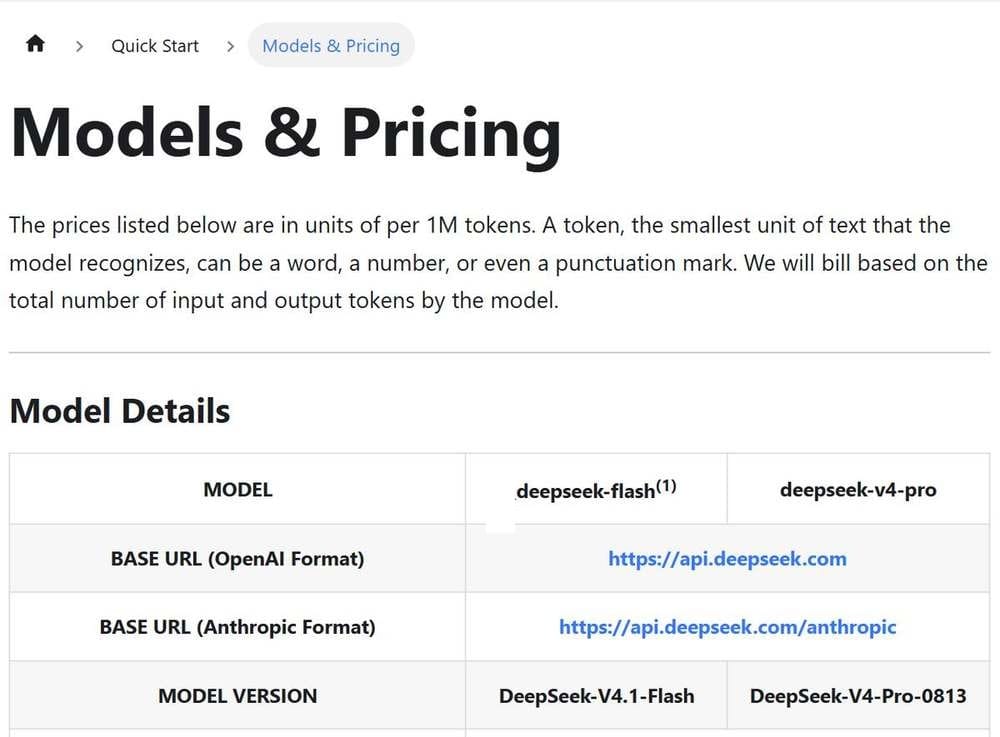
The identifier deepseek-v4-pro currently serves DeepSeek-V4-Pro-0813. The identifier deepseek-flash serves DeepSeek-V4.1-Flash. An older application sending deepseek-v4-flash can still receive a response, but that response comes from V4.1-Flash at Flash prices—not from the retired July release. DeepSeek documents this behavior in its API quick start.
V4-Pro’s status caused additional confusion. DeepSeek first announced that Pro requests would be routed to V4.1-Flash from September 14, 2026, then reversed that plan. Its corrected change log says V4-Pro API service continues with billing unchanged.
For a new integration, use the current identifiers rather than relying on compatibility aliases. For the successor model’s dedicated guide, see DeepSeek V4.1-Flash.
V4 Pro vs Flash vs V4.1-Flash
The current choice is between text-only V4-Pro and the lower-priced, image-capable V4.1-Flash; V4-Flash 0731 is no longer a separate hosted option. Compare the active models on your own tasks rather than assuming “Pro” guarantees a better answer.
The following comparison uses the current model specifications, with retired status taken from the change log. It describes the hosted API, not the requirements of a downloaded checkpoint.
| Specification | V4-Pro | V4-Flash 0731 | V4.1-Flash |
|---|---|---|---|
| Positioning | Current text-only alternative to evaluate against Flash. | Earlier Flash release; retired September 10, 2026. | Current Flash option for lower token prices and image input. |
| Context | 1M tokens. | No separate current hosted specification applies: this model is retired. Its legacy API name now uses V4.1-Flash. For historical or self-hosted specifications, check the official 0731 model card. | 1M tokens. |
| Maximum output | 384K tokens. | 384K tokens. | |
| Images | Not supported; text only. | Native image input: JPEG, PNG, GIF, and WebP. | |
| Thinking | Thinking and non-thinking modes; thinking enabled by default; low, high, and max effort. | Thinking and non-thinking modes; thinking enabled by default; low, high, and max effort. | |
| Concurrency limit | 500. | 2,500. | |
| Price | Higher than current Flash; see the dated pricing table below. | Lower than V4-Pro; see the dated pricing table below. |
Both current models support JSON output and tool calls. V4.1-Flash accepts up to 1,024 input tokens per image; supported formats and image handling are documented in the Vision guide.
Context length, output length, and concurrency measure different things. Context is the working token budget, output is generated text, and concurrency concerns simultaneous requests—not a guaranteed response speed. The Chat Completions reference also makes clear that input and generated tokens must fit within the context limit; do not budget 1M input tokens plus another 384K output tokens.
Every V4 release, dated
The V4 timeline begins with the April preview and leads to two current API models, with both original Flash hosted releases retired. The dates below follow DeepSeek’s official change log and release announcements.
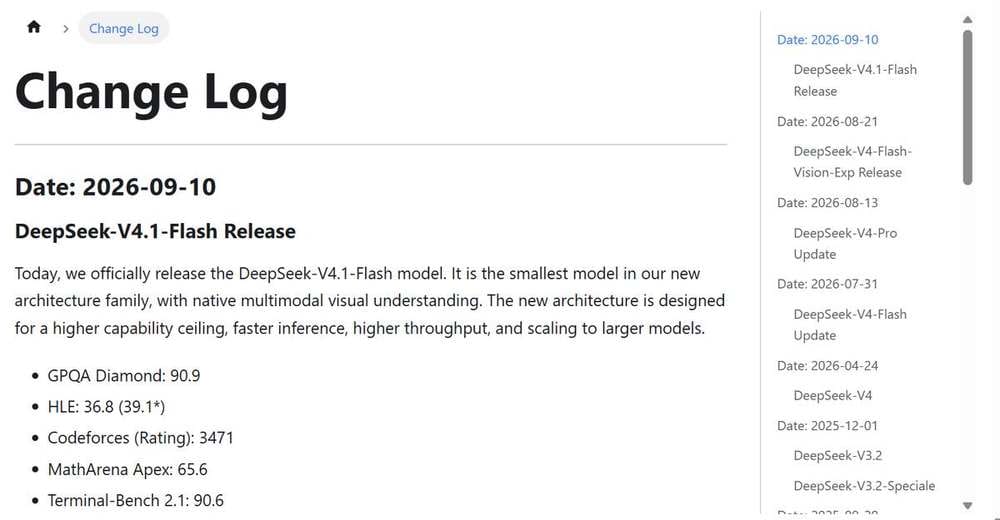
April 24, 2026 — DeepSeek V4 preview
The V4 preview announcement introduced the Pro and Flash family. Historical preview: “DeepSeek V4 preview” is not a separate model identifier in the current two-model catalog. Do not treat preview-era comparisons as measurements of the current releases.
July 31, 2026 — DeepSeek-V4-Flash-0731
The “0731” name identifies the July 31 Flash release. Retired from the hosted API on September 10, 2026. Sending the old deepseek-v4-flash identifier now reaches V4.1-Flash, not this checkpoint.
August 13, 2026 — DeepSeek-V4-Pro-0813
The August 13 release is the version currently served by deepseek-v4-pro. Still available as of September 19, 2026. Its release-specific model card distinguishes it from the earlier Pro preview.
August 21, 2026 — V4-Flash Vision Exp
DeepSeek introduced this experimental vision release on August 21. Retired on September 10, 2026. For new hosted image-input requests, use V4.1-Flash through deepseek-flash rather than building around the experimental release name.
September 10, 2026 — DeepSeek-V4.1-Flash
V4.1-Flash became the current Flash model, with native image input, under deepseek-flash. The original V4-Flash and V4-Flash Vision Exp hosted models were retired on the same date.
September 14, 2026 — canceled Pro routing deadline
This was the proposed date for routing V4-Pro requests to V4.1-Flash, not a completed shutdown. DeepSeek reversed the plan and retained Pro with billing unchanged. The corrected notice does not separately date the reversal itself.
Can you download DeepSeek V4?
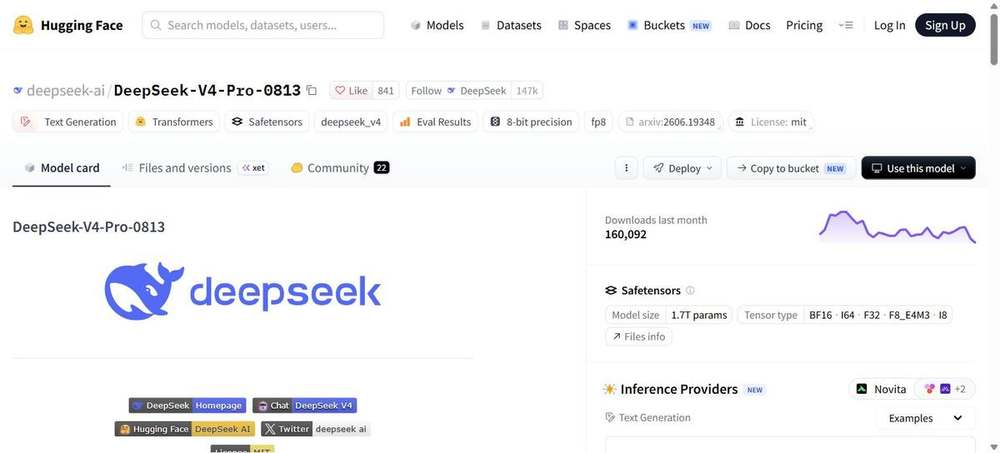
Yes, specific V4 checkpoints have published weights, but there is no single download that represents every V4 release. Start with DeepSeek’s verified repositories and match the exact model name to its official model card.
The following release-specific cards publish weights and identify the MIT license. These are model repositories, not downloads of the consumer chat application.
| What you are looking for | Official model card | Important distinction |
|---|---|---|
| DeepSeek V4 Pro download | DeepSeek-V4-Pro-0813 | Check the August release specifically rather than assuming a Pro preview repository is identical. |
| DeepSeek V4 Flash 0731 download | DeepSeek-V4-Flash-0731 | The hosted release is retired; that does not mean its published repository has disappeared. |
| Current Flash model weights | DeepSeek-V4.1-Flash | This is the current Flash replacement, not the original V4-Flash checkpoint. |
Hosted API availability does not automatically mean the same model is downloadable. Conversely, a downloadable older checkpoint does not mean DeepSeek still serves that checkpoint under a familiar API name. Check each access method separately.
- Confirm that the repository belongs to the verified deepseek-ai account.
- Match the release suffix and read the model card before downloading files.
- Check the repository’s license, file list, and deployment instructions.
- Record the repository revision and follow the instructions for the runtime you intend to use.
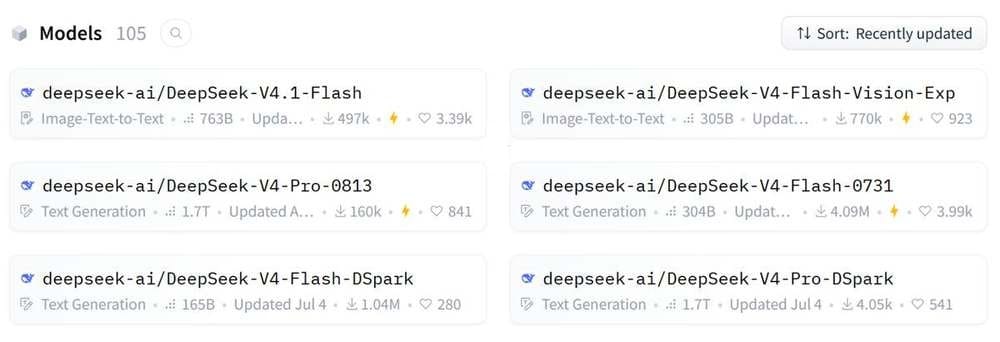
For parameter counts, download size, memory, and hardware requirements, check the official model card for the exact checkpoint. Do not estimate local requirements from the API context limit or from the word “Flash.” The DeepSeek system requirements guide explains what to inspect before choosing a local setup.
MIT-licensed weights and free chat are also separate from hosted API billing. A downloadable model still needs somewhere to run; downloading the official app is not the same as downloading model weights.
DeepSeek V4 knowledge cutoff
DeepSeek does not publish an official knowledge-cutoff date for V4 models, including V4-Pro. The published model specifications should not be supplemented with a guessed training date.
A release date is not a knowledge cutoff. Neither is the date embedded in a checkpoint name. A correct answer about a recent event also does not, by itself, establish when training data ended: the answer could depend on search, supplied context, or instructions outside the user’s message.
Three prompts to test observable knowledge
Use a fresh conversation for each prompt. Disable search where the interface allows it, attach no documents, and do not paste this article into the test. Record the selected model and test date.
Prompt 1 — earlier release knowledge: “Without browsing, using tools, or reading uploaded files, list the DeepSeek model releases you know from April, July, and August 2026. Give a release name and date only when you are confident. Otherwise say ‘I don’t know.’”
Prompt 2 — September release knowledge: “Using only your built-in knowledge, what did DeepSeek announce on September 10, 2026? Do not browse or use tools. Separate facts you know from uncertainty, and do not infer an answer from today’s date.”
Prompt 3 — knowledge of a reversal: “Without browsing or using tools, was the planned September 14, 2026 change to DeepSeek V4-Pro carried out or reversed? Say ‘I don’t know’ rather than guessing. Do not claim that your answer proves your training cutoff.”
After saving the answers, compare them with the dated official change log. Correct answers show that the tested setup can answer those questions. Incorrect answers show a limitation on those questions. Neither result establishes an official cutoff date.
For work requiring current facts, provide dated primary sources and ask the model to distinguish what those sources say from any unsupported background knowledge.
Using V4 in the chat and the app
The official DeepSeek chat is free to use, and no paid consumer subscription is listed as of September 19, 2026. API charges are separate; the “Pro” model name should not be read as evidence of a paid consumer plan.
Use the official DeepSeek chat in a browser, or reach the official app through DeepSeek’s website. Downloading model weights is not necessary just to try a hosted conversation.
- Open the official chat or app and follow any sign-in prompts.
- Check the available mode labels before starting a conversation.
- Try a task you can evaluate, such as rewriting a paragraph while preserving its facts, then compare another mode using the same prompt.
Another option is Chat-Deep.ai’s free DeepSeek chat: it runs in the browser without an account, allows 50 messages per day overall, and offers the current models through Fast and Pro modes. Follow the mode allowances displayed in the chat.
For a “DeepSeek V4 Flash chat,” the current replacement to look for is V4.1-Flash. For an exact programmatic model selection, use the documented API identifier rather than asking a chatbot to identify itself.
DeepSeek V4 API: model IDs, endpoints, thinking modes, migration notes
Use deepseek-flash for V4.1-Flash and deepseek-v4-pro for V4-Pro-0813. Both current models support OpenAI-compatible access, the OpenAI Responses API, and Anthropic-format compatibility, as listed in the official catalog.
| Interface | Base URL | Request format |
|---|---|---|
| OpenAI-compatible Chat Completions | https://api.deepseek.com | Send Chat Completions requests to /chat/completions. |
| OpenAI Responses API | https://api.deepseek.com | Use the Responses request format documented by DeepSeek. |
| Anthropic-compatible access | https://api.deepseek.com/anthropic | Use Anthropic-format requests rather than a Chat Completions request body. |
The base URLs and Chat Completions route follow DeepSeek’s API quick start. For setup and integration guidance, see the DeepSeek API guide.
Python requests for Flash and Pro
Install the Python package with pip install openai, then set the environment variable DEEPSEEK_API_KEY to your DeepSeek API key. This example makes one request to each model; running both means two billable API requests, not free chat messages.
import os
from openai import OpenAI, OpenAIError

api_key = os.getenv("DEEPSEEK_API_KEY")
if not api_key:
    raise RuntimeError("Set DEEPSEEK_API_KEY before running this example.")

client = OpenAI(
    api_key=api_key,
    base_url="https://api.deepseek.com",
)

messages = [{
    "role": "user",
    "content": (
        "Explain why a model release date is not its knowledge cutoff. "
        "Keep the answer brief."
    ),
}]

try:
    flash = client.chat.completions.create(
        model="deepseek-flash",
        messages=messages,
        reasoning_effort="high",
        extra_body={"thinking": {"type": "enabled"}},
    )
    print("V4.1-Flash:", flash.choices[0].message.content)

    pro = client.chat.completions.create(
        model="deepseek-v4-pro",
        messages=messages,
        reasoning_effort="high",
        extra_body={"thinking": {"type": "enabled"}},
    )
    print("V4-Pro:", pro.choices[0].message.content)

except OpenAIError as exc:
    raise SystemExit(f"DeepSeek API request failed: {exc}") from exc
Thinking and non-thinking modes
Thinking is enabled by default on both current models. The supported reasoning-effort levels are low, high, and max. With the OpenAI SDK, DeepSeek’s Thinking Mode guide places the thinking switch inside extra_body, as shown above.
To request non-thinking mode, change the thinking type to disabled and omit reasoning_effort. Keep the mode and effort consistent when comparing models; otherwise, you are changing more than the model itself. “Max” is an effort setting here, not a third model identifier.
Migration checklist
- Replace the legacy Flash identifier: new code should send deepseek-flash, not deepseek-v4-flash.
- Retest existing Flash integrations: an accepted legacy identifier now reaches a different model, not the retired 0731 release.
- Keep Pro when required: the announced September 14 rerouting was reversed; Pro remains available with billing unchanged.
- Route images correctly: V4.1-Flash accepts image input; V4-Pro is text-only.
These migration rules follow the current change log. Keep API keys in server-side configuration, and test structured outputs and tool calls before deploying a model change.
DeepSeek V4 API pricing
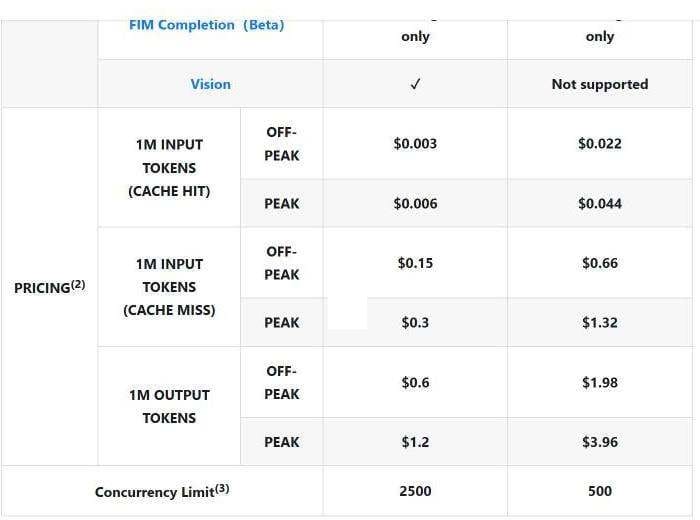
V4.1-Flash has lower token prices than V4-Pro, and both models cost twice as much during the published peak windows. The following rates reproduce DeepSeek’s Models & Pricing schedule as of September 19, 2026.
All amounts are in US dollars per 1M tokens as of September 19, 2026. Cached input, uncached input, and output have separate rates.
| Model and period | Input: cache hit | Input: cache miss | Output |
|---|---|---|---|
| deepseek-flash: off-peak | $0.003 | $0.15 | $0.60 |
| deepseek-flash: peak | $0.006 | $0.30 | $1.20 |
| deepseek-v4-pro: off-peak | $0.022 | $0.66 | $1.98 |
| deepseek-v4-pro: peak | $0.044 | $1.32 | $3.96 |
Peak versus off-peak hours
Peak hours are 01:00–04:00 and 06:00–10:00 UTC, Monday through Friday. All other hours are off-peak. Convert these UTC windows to your scheduling timezone before planning work; do not interpret them as local clock times.
How cache hits affect the bill
A cache hit receives the cached-input rate rather than the uncached-input rate. It does not make generated output free. Use the reported token usage rather than assuming that an entire repeated prompt qualifies for the cache-hit price.
Calculate each category separately: cached input tokens, uncached input tokens, and output tokens, each multiplied by its applicable per-token rate. For a broader explanation of chat access versus developer charges, see DeepSeek pricing.
FAQ
V4 is available, but free chat, paid API access, downloadable weights, and retired releases are different things. These answers summarize the distinctions that matter when choosing an access method.
is deepseek v4 free
The official chat is free to use, with no paid consumer subscription listed as of September 19, 2026. API usage is billed separately. Published weights have their own licenses, and running downloaded weights is separate from using free hosted chat.
is deepseek v4 out
Yes. The V4 preview was announced on April 24, 2026. As of September 19, 2026, the current API catalog lists V4-Pro-0813 through deepseek-v4-pro and V4.1-Flash through deepseek-flash. The original V4-Flash hosted release is retired.
v4 vs r1
For a new integration, begin with the current catalog’s V4-Pro and V4.1-Flash options. R1 is not one of its two listed model IDs. A meaningful comparison requires an exact R1 checkpoint and identical test tasks; the family names alone do not establish which will work better for you.
is v4 open source
DeepSeek publishes selected releases as open weights under the MIT license. The linked official model cards confirm this for V4-Pro-0813, V4-Flash-0731, and V4.1-Flash. Check the exact repository rather than assuming every hosted release or experimental variant has the same downloadable counterpart.
does v4 support images
V4-Pro is text-only. The current Flash model, V4.1-Flash, accepts JPEG, PNG, GIF, and WebP images, with up to 1,024 input tokens per image. V4-Flash Vision Exp was retired; use deepseek-flash for new image-input integrations.
what is deepseek flash 0731
DeepSeek-V4-Flash-0731 is the July 31, 2026 Flash release. It was retired from DeepSeek’s hosted API on September 10, 2026. The legacy deepseek-v4-flash identifier now reaches V4.1-Flash, while the separate 0731 model card documents the published checkpoint.
is deepseek v4 pro discontinued
No, not as of September 19, 2026. DeepSeek reversed its plan to route Pro requests to V4.1-Flash from September 14. The corrected official notice says V4-Pro API service continues with billing unchanged.
how big is deepseek v4
There is no single size for the whole family. Both current API models offer 1M context and 384K maximum output, but those are token-capacity limits—not parameter counts, download sizes, or memory requirements. For those measurements, check the official model card for the exact checkpoint.
Sources and verification
This page uses DeepSeek’s official model catalog, API documentation, release history, and release-specific Hugging Face model cards. Hosted model status and downloadable checkpoint details are treated separately.
- DeepSeek Models & Pricing — Last verified: September 19, 2026.
- DeepSeek API Docs: Your First API Call, Chat Completions, Thinking Mode, Vision, Responses API, and Anthropic-format compatibility — Last verified: September 19, 2026.
- DeepSeek Change Log and V4 Preview Release announcement — Last verified: September 19, 2026.
- DeepSeek’s verified Hugging Face repositories and the V4-Pro-0813, V4-Flash-0731, and V4.1-Flash model cards — Last verified: September 19, 2026.
- DeepSeek official website, chat, and app access pages — Last verified: September 19, 2026.
Chat-Deep.ai is an independent guide and is not affiliated with DeepSeek.