Category Comparison

DeepSeek AI Comparisons: How DeepSeek Stacks Up Against Leading AI Models

How does DeepSeek compare to the world’s leading AI models? This section provides detailed, developer-focused comparisons between DeepSeek and the major frontier AI platforms — ChatGPT, Claude, Google Gemini, and Grok.

Each comparison examines architecture, deployment options, reasoning capabilities, pricing, and practical use cases. All articles are based on publicly documented information and are updated regularly to reflect the latest model releases.

DeepSeek’s current flagship, V3.2, is a 685-billion-parameter open-weight model released under the MIT License. It offers self-hosting capability, transparent chain-of-thought reasoning, and API pricing starting at $0.28 per million input tokens — making it one of the most cost-effective frontier models available.

All Comparisons

DeepSeek vs ChatGPT

A comprehensive comparison of DeepSeek V3.2 and ChatGPT (GPT-5.4). Covers access methods, subscription plans (Free through Pro at $200/month), built-in tools like Codex and Deep Research, pricing differences (DeepSeek is 9-24x cheaper), and the fundamental divide between open-weight self-hosting and OpenAI’s managed cloud platform.

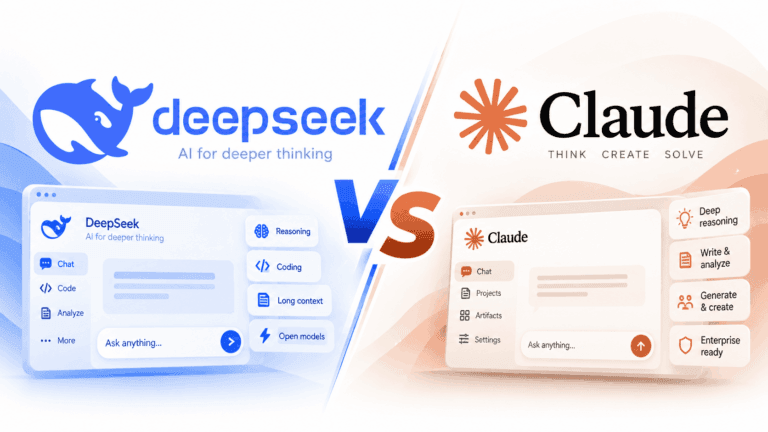
DeepSeek vs Claude AI

A developer-focused architectural comparison with Anthropic’s Claude Opus 4.6. Examines reasoning transparency (DeepSeek’s visible chain-of-thought vs Claude’s adaptive thinking), deployment models, Claude’s agent teams and enterprise tooling (Excel, PowerPoint, Cowork), 1M token context windows, and the 18-60x pricing gap between the two platforms.

DeepSeek vs Google Gemini

An analysis of how DeepSeek’s open-weight architecture differs from Google’s managed Gemini 3.1 Pro service. Covers context windows (128K vs 1M tokens), multimodal capabilities, native tool integration, the role of Google’s Gemma 4 open model, reasoning exposure differences, and detailed API pricing comparisons.

DeepSeek vs Grok

A technical comparison with xAI’s Grok (now a SpaceX subsidiary). Covers Grok 4.20’s 4-agent collaboration system, the 2M token context window, rapid learning architecture, autonomous tool execution vs DeepSeek’s developer-mediated function calling, and the open-weight vs proprietary divide.

Quick Comparison Matrix

The table below provides a high-level overview of how DeepSeek compares to each platform across key dimensions. For detailed analysis, see the individual comparison articles linked above.

Feature DeepSeek V3.2 ChatGPT (GPT-5.4) Claude (Opus 4.6) Gemini (3.1 Pro) Grok (4.20)
Open-Weight ✅ MIT License ❌ Proprietary ❌ Proprietary ❌ Proprietary ❌ Proprietary
Self-Hosting ✅ Full support
Context Window 128K 256K-400K 1M (beta) 1M 2M
Reasoning Transparent CoT Adaptive (hidden) Adaptive (hidden) Thought summaries Toggleable (limited)
Input Price /M $0.28 $2.50 $5.00 $1.25 $2.00
Output Price /M $0.42 $10.00 $25.00 $5.00 $6.00
Built-in Tools Function calling 60+ connectors Agent Teams, Excel Search, Code, Files Web, X, Code
Multimodal Text (VL separate) Text + Image + Voice Text + Image Text + Image + Audio + Video Text + Image + Voice
Fine-Tuning ❌ (Gemma only)

Why DeepSeek Stands Out

Across all four comparisons, several themes consistently emerge as DeepSeek’s unique advantages:

Open-Weight Availability: DeepSeek is the only frontier model in this comparison that releases full model weights under a permissive open-source license. This enables self-hosting, fine-tuning, and complete infrastructure control — capabilities that no closed model can match.

Transparent Reasoning: DeepSeek’s reasoning_content field provides structured, inspectable chain-of-thought output. While competitors offer various forms of reasoning modes, none expose the full reasoning trace as directly and programmatically as DeepSeek does.

Cost Leadership: At $0.28/$0.42 per million tokens, DeepSeek is 5-60x cheaper than competing frontier models on API pricing. Self-hosting eliminates per-token costs entirely. For cost-sensitive projects and high-volume applications, this advantage is transformative.

No Vendor Lock-in: With MIT-licensed weights, you own the model permanently. Changes in vendor pricing, terms of service, or business direction do not affect your deployment. This independence is critical for long-term projects and regulated industries.

Ready to explore? Try DeepSeek through our chat interface, review the API documentation, or browse our model guides to get started.

Frequently Asked Questions

What is the best alternative to ChatGPT?

DeepSeek V3.2 is one of the strongest ChatGPT alternatives available. It achieves gold-medal results on international math and coding competitions, offers transparent reasoning, and costs 9-24x less than ChatGPT’s API. Its open-weight MIT License also allows self-hosting for maximum privacy and control.

Is DeepSeek free?

Yes. DeepSeek’s web chat is free without requiring an account. The API offers 5 million free tokens on signup, after which pricing starts at $0.28 per million input tokens. Self-hosting the open-weight model under MIT License has zero licensing costs.

Which AI model is cheapest?

Among frontier models, DeepSeek V3.2 offers the lowest API pricing at $0.28/$0.42 per million input/output tokens. This is cheaper than Gemini 3.1 Pro ($1.25/$5.00), Grok 4.20 ($2.00/$6.00), ChatGPT GPT-5.4 ($2.50/$10.00), and Claude Opus 4.6 ($5.00/$25.00). See our pricing page for full details.

Can I self-host DeepSeek?

Yes. DeepSeek releases its model weights on Hugging Face under the MIT License. You can download and deploy them on your own hardware or cloud infrastructure. This is a unique advantage — ChatGPT, Claude, Gemini, and Grok are all proprietary and cannot be self-hosted.

Which AI model has the largest context window?

As of April 2026, Grok 4 Fast offers 2M tokens, Gemini 3.1 Pro and Claude Opus 4.6 both support ~1M tokens, ChatGPT offers 256K-400K depending on plan, and DeepSeek V3.2 supports 128K tokens. For most practical applications, 128K tokens is more than sufficient.

DeepSeek vs ChatGPT

DeepDeek-vs-Chatgpt

DeepSeek and ChatGPT are two of the most capable AI chatbots available today. ChatGPT, developed by OpenAI, became a household name after its launch in late 2022. DeepSeek, developed by the Chinese AI research company DeepSeek AI, has emerged as…