DeepSeek and ChatGPT are two of the most capable AI chatbots available today. ChatGPT, developed by OpenAI, became a household name after its launch in late 2022. DeepSeek, developed by the Chinese AI research company DeepSeek AI, has emerged as a powerful alternative with a fundamentally different approach to access and availability.
Both can answer questions, write content, help with coding, and carry on conversations. But they differ significantly in how you access them, what they cost, and how much control you have over the technology.
This article compares DeepSeek and ChatGPT based on publicly documented information as of April 2026. We focus on access methods, features, pricing, and availability — not on benchmarks or “which is better” judgments.
What Is DeepSeek?
DeepSeek is an advanced large language model system developed by DeepSeek AI, a research company based in China. It belongs to the latest generation of AI assistants capable of natural language understanding, reasoning, coding, and more. The current flagship model is DeepSeek V3.2, released in December 2025.
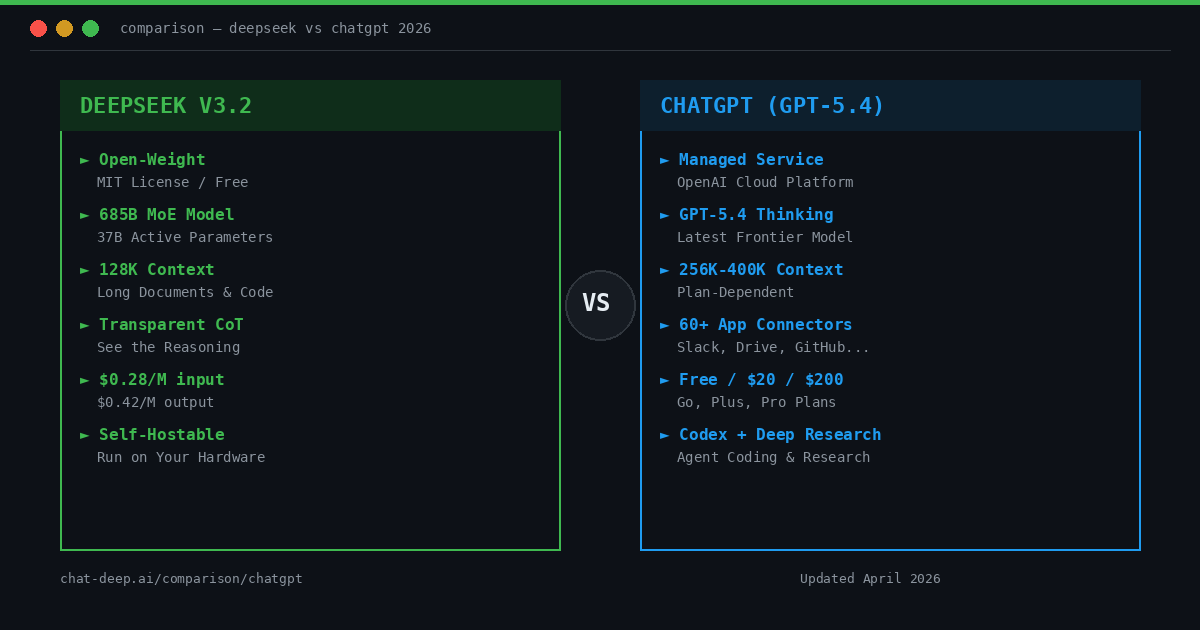
V3.2 is a 685-billion-parameter model that uses a Mixture-of-Experts (MoE) architecture, activating only 37 billion parameters per token. This efficient design means it delivers frontier-class intelligence while keeping inference costs manageable. It supports a 128K token context window and achieved gold-medal results on both the 2025 International Mathematical Olympiad and International Olympiad in Informatics.
V3.2 also introduced DeepSeek Sparse Attention (DSA), a fine-grained attention mechanism that reduces the computational cost of processing long contexts while preserving output quality. This makes it practical to work with lengthy documents, large codebases, and extended conversation histories.
A distinguishing feature of DeepSeek is that its models are released under the MIT License as open-weight. This means anyone can download the model weights from Hugging Face and run them on their own hardware — no subscription, no API fees, no vendor dependency. This is fundamentally different from ChatGPT, which is only available through OpenAI’s cloud.
Users can access DeepSeek through multiple channels: an official web chat, mobile apps for iOS and Android, a developer API, or self-hosted deployment. The web chat allows basic use without an account, making it one of the most accessible AI chatbots available.
DeepSeek’s V3.2 unifies standard chat and reasoning into a single model. Developers can toggle an optional reasoning mode that shows the AI’s step-by-step thinking process. When enabled, responses include a reasoning_content field showing exactly how the model arrived at its answer — invaluable for verifying logic in math, coding, or analytical tasks.
DeepSeek also provides an open developer platform with an OpenAI-compatible API, making it easy for developers to integrate DeepSeek into existing applications with minimal code changes. The API pricing is among the lowest in the industry at $0.28 per million input tokens. You can check the latest rates on our pricing page.
What Is ChatGPT?
ChatGPT is an AI chatbot developed by OpenAI and released to the public in November 2022. It is built on OpenAI’s GPT series of models and has evolved rapidly through 2025 and 2026. As of April 2026, ChatGPT runs on the GPT-5.4 Thinking model (released March 5, 2026) as its most capable tier, with GPT-5.3 Instant serving as the fast everyday model.
The GPT-5 family represents a significant leap from previous models. GPT-5 was launched in August 2025 as OpenAI’s first natively multimodal model, and has since been refined through GPT-5.1, 5.2, 5.3, and 5.4 iterations — each improving specific capabilities. Older models like GPT-4o were fully retired in February 2026.
ChatGPT gained rapid popularity due to its versatility and polished interface. Hundreds of millions of people use it weekly for drafting emails, debugging code, answering general knowledge questions, brainstorming ideas, creative writing, tutoring, and much more.
In 2026, ChatGPT has evolved from a simple chatbot into a full platform. Key capabilities include:
- Codex — an agentic coding tool for software development
- Deep Research — multi-source research synthesis
- Computer Use — the model can operate computers and navigate interfaces
- ChatGPT for Excel — builds and analyzes spreadsheets inside Excel
- ChatGPT Voice — natural voice conversations
- 60+ app connectors — integrations with Slack, Google Drive, GitHub, SharePoint, and more
- Image understanding — can analyze uploaded images and screenshots
- Record Mode — meeting transcription and summarization
Unlike DeepSeek, ChatGPT is a closed, proprietary service. The underlying GPT-5.x models are not available for download or self-hosting. All usage goes through OpenAI’s managed cloud infrastructure.
Access Methods and Platform Differences
How you access each AI is one of the biggest differences between them.
Account Requirements
DeepSeek: The official web chat allows basic use without creating an account. Heavy usage or API access requires a free account signup. There are no subscription fees for the chat interface.
ChatGPT: Using ChatGPT generally requires signing in with an OpenAI account. OpenAI has experimented with limited no-login access in certain regions, but the standard experience assumes a logged-in user. Saved history, paid plans, and API access all require an account.
Web, Mobile, and Desktop
Both offer web interfaces and mobile apps. ChatGPT has a polished official web interface with chat history, personalization settings, and Custom GPTs. It provides desktop apps for macOS and Windows, and mobile apps for iOS and Android. In 2026, ChatGPT also launched in CarPlay for hands-free voice conversations while driving, and supports Record Mode for meeting transcription.
DeepSeek has an official web chat and mobile apps for iOS and Android. The interface is straightforward and user-friendly. Independent web interfaces like Chat-Deep.ai also provide access to DeepSeek models with additional features, expanding access options beyond DeepSeek’s official apps.
In terms of platform coverage, both systems serve web, mobile, and API channels. The key distinctions are that DeepSeek’s web chat does not force a login upfront, ChatGPT offers a broader set of native apps (desktop, CarPlay), and DeepSeek’s open-weight availability creates a third access path — self-hosted deployment — that ChatGPT does not offer at all.
API Access for Developers
Both systems allow integration into applications via APIs, but the setup and cost differ significantly.
DeepSeek’s API is designed to be OpenAI-compatible, meaning developers can swap in DeepSeek’s endpoint with minimal code changes in existing applications. You register for a free account to get an API key. Pricing is pay-as-you-go at very low rates: $0.28 per million input tokens and $0.42 per million output tokens. Cached inputs cost just $0.028/M (90% discount). DeepSeek also offers a generous free tier with 5 million tokens on signup — enough for thousands of API calls for evaluation purposes.
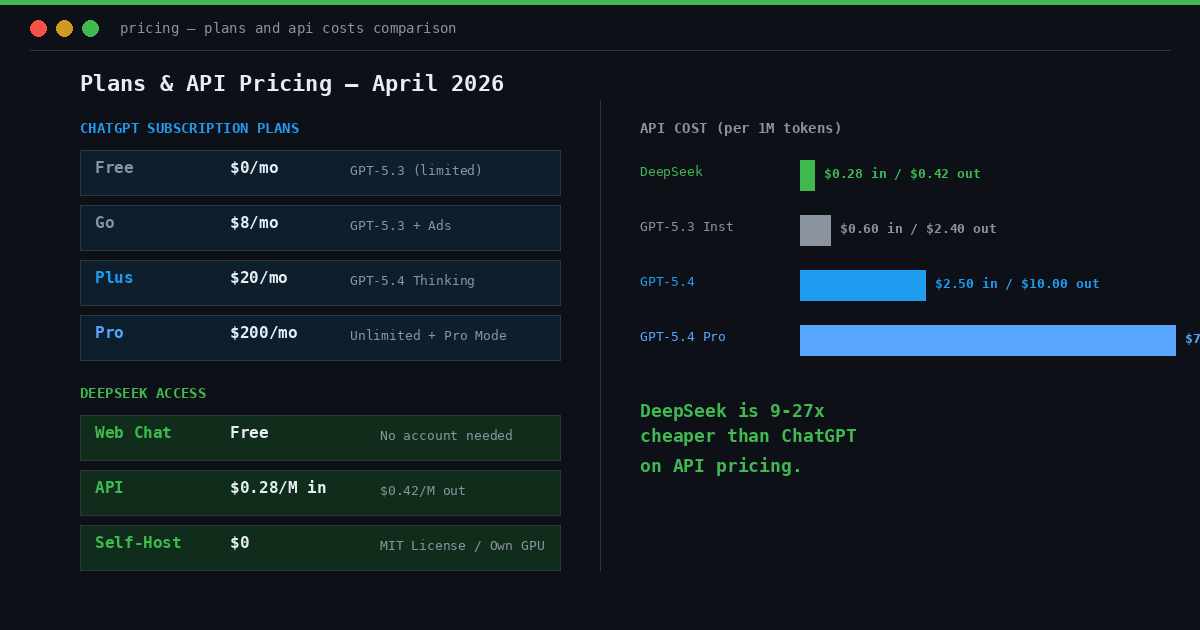
ChatGPT’s API (via OpenAI) requires a developer account with billing enabled. Pricing varies significantly by model: GPT-5.3 Instant starts at approximately $0.60/$2.40 per million input/output tokens, while GPT-5.4 costs $2.50/$10.00. GPT-5.4 Pro mode is priced even higher. The API is a paid service with usage-based billing managed entirely through OpenAI’s cloud infrastructure.
In essence, both provide well-documented APIs for developers, but DeepSeek’s is significantly cheaper and offers an open-source alternative if you prefer to run the model yourself. ChatGPT’s API provides access to the latest GPT-5.x features and tools but at a higher price point with no self-hosting option.
Self-Hosting: The Biggest Difference
This is the most fundamental architectural difference between the two systems.
DeepSeek has released its model weights under the MIT License. Organizations can download the weights from Hugging Face and deploy them on their own infrastructure — on-premises, in a private cloud, or even on air-gapped networks with no internet access. This enables full control over data, privacy, and customization, including fine-tuning on domain-specific data.
Self-hosting is facilitated by community tools and guides. Developers can run DeepSeek with frameworks like vLLM for high-throughput inference, use one-click cloud deployment templates, or set up OpenAI-compatible API endpoints so existing applications can call DeepSeek with minimal code changes. The community has also created distilled smaller versions (down to a few billion parameters) that can run on consumer-grade GPUs.
ChatGPT is delivered exclusively as a managed service by OpenAI. The underlying GPT-5.x models are not available for self-hosting. All usage flows through OpenAI’s cloud. For organizations with strict data sovereignty requirements — particularly in healthcare, finance, defense, and government — this is a significant limitation. DeepSeek is the clear option when data must remain on your own servers.
Pricing and Plans
Pricing is one of the starkest differences between DeepSeek and ChatGPT.
ChatGPT Plans (April 2026)
ChatGPT now offers six subscription tiers:
- Free ($0/month) — Access to GPT-5.3 with limited messages. Includes ads as of February 2026.
- Go ($8/month) — More messages and uploads than Free. Still includes ads. No access to GPT-5.4 Thinking or Codex.
- Plus ($20/month) — Ad-free. Access to GPT-5.4 Thinking (up to 3,000 messages/week), Deep Research (10 runs/month), Codex, and all tools. This is the most popular paid plan.
- Pro ($200/month) — Unlimited GPT-5.4, access to GPT-5.4 Pro mode with maximum reasoning compute. Designed for power users and researchers.
- Business ($25/user/month) — Team workspace with admin controls, SOC 2 compliance, and data not used for training by default.
- Enterprise (custom pricing) — Extended context (250 pages), SCIM, analytics, domain verification, 24/7 support, and SLAs.
A notable change in February 2026: OpenAI introduced advertising on the Free and Go tiers. According to OpenAI, ads are clearly labeled and do not influence ChatGPT’s answers, but they are present in the interface. The Plus plan ($20/month) and above are ad-free. This change means that the truly “free” ChatGPT experience now comes with advertisements — a significant shift from ChatGPT’s original ad-free experience. OpenAI’s head of product has also publicly indicated that the current pricing structure may not last forever, with projections suggesting Plus could rise to $44/month by 2029.
DeepSeek Pricing
DeepSeek’s pricing model is simpler and dramatically cheaper:
- Web chat — Free, no subscription required. No ads.
- API — $0.28 per million input tokens, $0.42 per million output tokens. Cached inputs: $0.028/M (90% discount). Free tier: 5 million tokens on signup.
- Self-hosted — $0 in licensing fees (MIT License). You pay only for your own hardware and compute costs.
To put this in perspective: DeepSeek’s API is roughly 9x cheaper on input and 24x cheaper on output compared to ChatGPT’s GPT-5.4 API. Even against the more affordable GPT-5.3 Instant, DeepSeek remains significantly cheaper. For high-volume applications, this difference translates to thousands of dollars in monthly savings.
A concrete example: an application generating 50 million output tokens per month would cost approximately $500 on GPT-5.4 but only $21 on DeepSeek’s API. Self-hosting DeepSeek would eliminate per-token costs entirely, leaving only infrastructure expenses. You can estimate specific costs using the DeepSeek API Cost Calculator and view full pricing details on the pricing page.
Features and Capabilities
Both are general-purpose AI assistants with significant overlap, but their feature sets differ in important ways.
General Capabilities
Both DeepSeek and ChatGPT can handle a wide range of tasks: answering questions, writing content (articles, emails, stories), assisting with code, language translation, brainstorming, summarization, and general problem-solving. For most everyday users, either AI functions as a capable general-purpose assistant.
ChatGPT’s GPT-5.4 Thinking is optimized for complex real-world work — spreadsheet creation, polished frontend code, slideshows, hard math, document understanding, and research that requires combining information from many web sources. It can think longer on hard tasks and keeps better track of what it has already done across long conversations.
DeepSeek V3.2 excels in structured reasoning, mathematics, and coding tasks. Its gold-medal performance on mathematical and programming olympiads demonstrates frontier-class capability that competes with the best proprietary models. The transparent reasoning mode lets users see exactly how the model approaches complex problems — a feature no ChatGPT tier currently offers at the same level of detail.
In practice, ChatGPT’s usage skews toward maximum convenience and breadth of integrated features, while DeepSeek is favored by users who value cost efficiency, reasoning transparency, and the freedom to customize or self-host.
Reasoning Modes
DeepSeek offers a unique transparent reasoning mode. When enabled, the model shows its step-by-step thinking in a separate reasoning_content field. This is like having a tutor show their work — you get both the answer and the full reasoning trace. Users can toggle this on or off depending on whether they want speed or analytical depth. The reasoning trace might show the model identifying the problem type, selecting an approach, working through intermediate steps, catching errors, and arriving at the final answer.
ChatGPT uses “adaptive thinking” in GPT-5.4, where the model automatically decides how much to reason based on query complexity. Users can select between “Instant” (fast, everyday responses via GPT-5.3) and “Thinking” (deeper reasoning via GPT-5.4) modes. Plus users can further choose between standard and extended thinking depth. The reasoning process is internal — you see a thinking indicator and may see an upfront plan, but not the detailed chain-of-thought tokens. GPT-5.4 can think longer on hard tasks without timing out and keeps better track of what it has already done.
Built-in Tools and Integrations
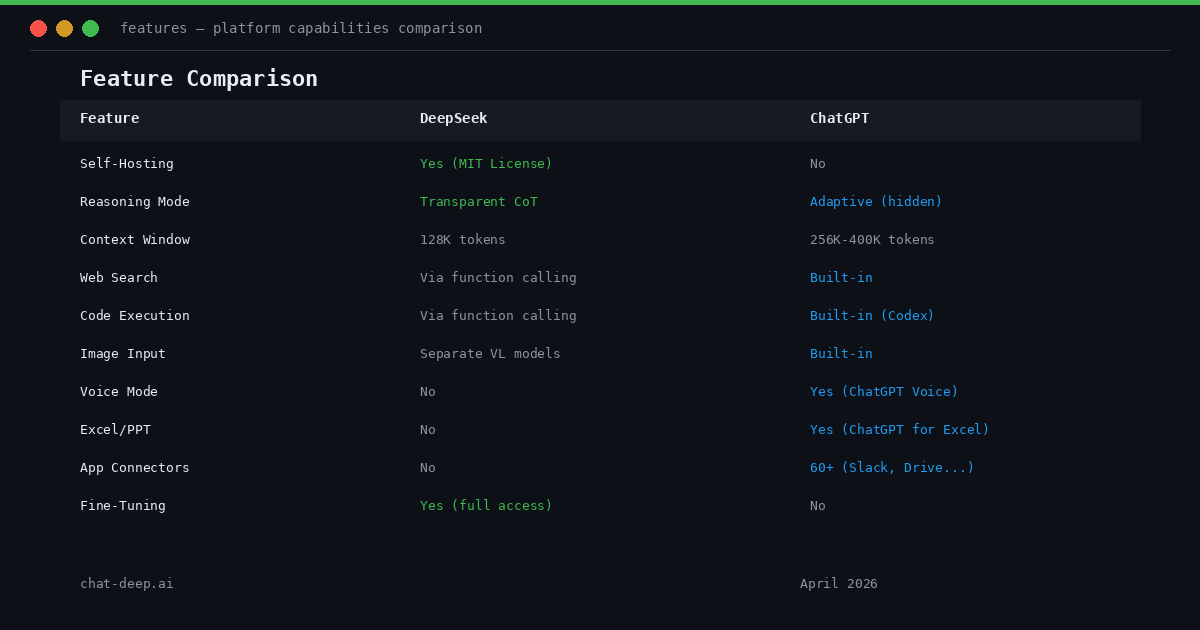
This is where ChatGPT has a clear advantage in breadth of features. ChatGPT in 2026 is a full platform with built-in web search, code execution (Codex), image understanding, voice mode (ChatGPT Voice), Deep Research for multi-source synthesis, ChatGPT for Excel for spreadsheet work, 60+ app connectors (Slack, Google Drive, GitHub, SharePoint, Atlassian, Salesforce, and more), Record Mode for meeting transcription, and even CarPlay support for hands-free conversations while driving.
These tools allow ChatGPT to support workflows far beyond basic text conversation. You can ask it to research a topic by searching the web, analyze a CSV file, execute code and show you the results, create a spreadsheet in Excel, or summarize a recorded meeting — all within the same chat interface.
DeepSeek focuses on its core language model capabilities. Its API supports function calling for tool integration, but developers must implement the tools themselves. There is no built-in web search, code execution, or app connector ecosystem. The trade-off is that DeepSeek’s approach gives developers full control over tool implementation, security sandboxing, and data flow — which is preferable in environments where you need to control exactly what the AI can access.
Context Window
DeepSeek V3.2 supports a 128K token context window, roughly equivalent to 80,000 words or hundreds of pages of text. This is achieved through the DSA sparse attention mechanism, which makes long-context processing efficient. For most practical applications — long conversations, document analysis, code review — 128K tokens is more than sufficient.
ChatGPT’s context depends on the plan and model. Plus users get 256K for reasoning tasks, Pro users get 400K, and Enterprise users have access to approximately 250 pages of context. While larger than DeepSeek’s in some configurations, the practical difference matters mainly for very long document analysis, multi-hour conversation histories, or extended multi-step agent workflows where maintaining full context is critical.
Customization and Fine-Tuning
DeepSeek allows full fine-tuning since the model weights are open. You can adapt the model to domain-specific vocabulary (medical, legal, financial), specialized tasks, or custom behavior patterns. The community has already created distilled versions, domain-specific fine-tunes, and specialized variants for tasks like theorem proving. If your application has unique requirements that generic models do not handle well, DeepSeek lets you train or prompt-tune the model to fit.
ChatGPT does not offer fine-tuning of its GPT-5.x models. Customization is limited to system prompts, Custom GPTs (pre-configured personas with specific instructions and knowledge), personality settings, and the personalization features within the app. While these options are useful for many use cases, they do not provide the same depth of customization available with an open-weight model.
Availability and Geographic Considerations
Regional Availability
ChatGPT is available in most countries worldwide but is not officially available in China and certain other regions. Availability depends on OpenAI’s list of supported countries, which may change over time. Users in restricted regions typically cannot sign up for or use ChatGPT’s official services without workarounds.
DeepSeek is available both within China and internationally. It has Chinese and English interfaces and launched globally accessible apps, indicating strong international presence. Because its models are open-weight, they can be deployed anywhere in the world by anyone with the hardware to run them — making DeepSeek accessible even in regions where no specific cloud service operates.
In terms of language support, both are multilingual. ChatGPT is widely used in English-speaking environments and supports many languages. DeepSeek demonstrates strong performance in both Chinese and English, with particularly fluent handling of Asian languages including Chinese, Korean, and Japanese.
Language Support
Both are multilingual. ChatGPT is widely used in English and supports many languages. DeepSeek demonstrates strong performance in both Chinese and English, reflecting its development background. For Asian language tasks, some users report that DeepSeek handles Chinese, Korean, and Japanese with particular fluency.
Licensing and Enterprise Use
DeepSeek’s MIT License means the model is available without restrictions for commercial use. Organizations can deploy it in-house for maximum data privacy — particularly important for healthcare, finance, defense, and other regulated industries. There are no licensing fees, no per-use charges beyond infrastructure costs, and no vendor dependency. If DeepSeek AI changed direction or shut down, the community could continue using and improving the existing open models.
ChatGPT is a closed service. Enterprises must use OpenAI’s infrastructure. OpenAI’s Enterprise plan promises not to train on client data and provides SOC 2 compliance, SCIM, domain verification, and data residency options. However, the model itself is not available for self-hosting. For organizations that need complete control over where and how AI runs, this is a limitation that DeepSeek does not have.
When to Choose Each
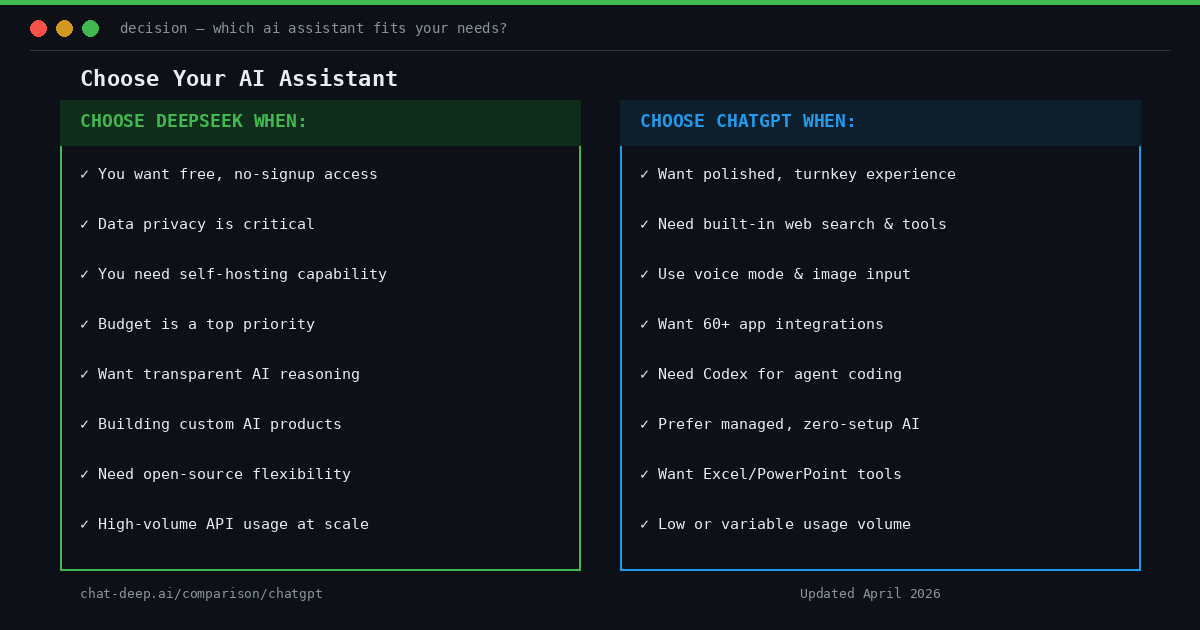
Choose DeepSeek When:
Cost is a priority. DeepSeek’s free web chat requires no subscription and has no ads. The API pricing ($0.28/$0.42 per million tokens) is 9-24x cheaper than ChatGPT’s GPT-5.4 API. Self-hosting eliminates per-token costs entirely — you pay only for your own hardware. For individuals, students, hobbyists, or budget-conscious teams, DeepSeek offers an advanced AI experience for effectively $0. Even at enterprise scale with millions of daily requests, DeepSeek’s cost structure remains dramatically more affordable than any ChatGPT plan.
Data privacy is critical. Self-hosting means your data never leaves your servers. No third-party cloud, no vendor data handling policies to worry about, no risk of data being used for model training. This is essential for healthcare organizations handling patient data, financial firms with proprietary trading strategies, legal teams with confidential client information, and government agencies with classified material. DeepSeek running on your own infrastructure provides a level of data isolation that no cloud-based service can match.
You want transparent AI reasoning. DeepSeek’s reasoning_content field shows exactly how the model thinks through a problem. This is invaluable for math verification, coding logic debugging, research validation, and any task where you need to understand why the AI gave a particular answer — not just what the answer is. No ChatGPT tier currently offers this level of reasoning visibility.
You’re building a product or custom solution. Open-weight models under MIT License give you full flexibility to customize, fine-tune, integrate, and redistribute without vendor dependency or licensing fees. You can create distilled versions for mobile or edge deployment, build custom inference pipelines, or modify the model architecture itself. This is the territory of developers, AI engineers, and technical founders building products that depend on AI as a core component.
You need high-volume, low-cost AI at scale. At 9-24x cheaper than ChatGPT’s API, DeepSeek is the clear choice for applications processing large volumes of requests. Self-hosting converts per-token costs to fixed infrastructure expenses, which become increasingly economical at higher volumes. For SaaS products, internal enterprise tools, or research pipelines that generate millions of tokens daily, DeepSeek’s economics are transformative.
If this comparison has already pushed you toward DeepSeek, the next step is choosing the right DeepSeek model rather than stopping at the brand level. Our DeepSeek model hub compares V3.2, R1, Coder, Math, VL, and other families so you can match the model to your actual use case and budget.
Choose ChatGPT When:
You want a polished, turnkey experience. ChatGPT’s interface is designed for maximum convenience — polished, accessible, and aimed at both technical and non-technical users. Open the app or website, start chatting. No setup, no configuration, no infrastructure needed. Features like saved conversation history, shareable chat links, Custom GPTs, and voice mode create a seamless experience.
You need built-in tools. Web search, code execution via Codex, Deep Research, image understanding, voice mode, Excel integration, 60+ app connectors — ChatGPT offers a complete ecosystem of tools that would take significant engineering to replicate with an open model. If you need your AI to search the web, analyze uploaded files, execute code, and create spreadsheets within a single conversation, ChatGPT provides that out of the box.
Enterprise features matter. SOC 2 compliance, SLA-backed reliability, admin controls, domain verification, SCIM provisioning, and data residency options make ChatGPT Business and Enterprise suitable for large organizations with formal compliance requirements. Having OpenAI as a vendor partner with formal accountability is important for some organizations.
Usage is variable or low-volume. ChatGPT’s pay-per-use model (or $20/month Plus subscription) is practical for individuals or teams with moderate, irregular usage. A small web app seeing a few hundred queries a day runs cheaply on ChatGPT, whereas maintaining GPU servers for DeepSeek self-hosting would be overkill. Similarly, if your usage spikes unpredictably, ChatGPT’s cloud scales automatically. For startups exploring the viability of an AI feature, ChatGPT reduces financial risk — if it does not pan out, you have not invested in infrastructure.
You value convenience over control. ChatGPT handles everything — model updates, scaling, safety guardrails, tool integrations, app connectors — so you can focus on your actual work rather than AI infrastructure. For non-technical users, creative professionals, students, and anyone who just wants helpful AI without thinking about deployment, ChatGPT’s turnkey approach is hard to beat.
Comparison Summary
| Aspect | DeepSeek (V3.2) | ChatGPT (GPT-5.4) |
|---|---|---|
| Developer | DeepSeek AI (China) | OpenAI (USA) |
| Current Model | V3.2 (685B MoE, 37B active) | GPT-5.4 Thinking / GPT-5.3 Instant |
| Account Required | No (basic web chat) | Yes (for most features) |
| Self-Hosting | Yes (MIT License) | No (proprietary, cloud-only) |
| Context Window | 128K tokens | 256K-400K (plan-dependent) |
| Reasoning | Transparent CoT (visible reasoning) | Adaptive thinking (internal) |
| Built-in Tools | Function calling only (developer-built) | Web search, Codex, Deep Research, Excel, Voice, 60+ connectors |
| Image Input | Via separate VL models | Built-in |
| Fine-Tuning | Yes (full weight access) | No |
| Free Tier | Web chat (no limits stated) + 5M API tokens | GPT-5.3 with tight limits + ads |
| Paid Plans | API: $0.28/$0.42 per M tokens | Go $8, Plus $20, Pro $200/month |
| Ads | None | Yes (Free and Go tiers since Feb 2026) |
| Available in China | Yes | No (officially) |
| Vendor Lock-in | None | High |
Conclusion
DeepSeek and ChatGPT represent two fundamentally different philosophies in AI.
ChatGPT is a polished, feature-rich platform backed by one of the world’s largest AI companies. In 2026, it has evolved far beyond a simple chatbot into a comprehensive workspace with agent coding, research tools, app integrations, voice mode, and enterprise compliance. Its strength lies in convenience, breadth of features, and a massive existing user community of hundreds of millions.
DeepSeek is an open, transparent, and remarkably cost-effective alternative. Its open-weight approach means you can use it for free, host it yourself, fine-tune it to your needs, and maintain full control over your data and deployment. V3.2’s gold-medal benchmark results prove it competes at the frontier of AI capability — at a fraction of the cost. No ads, no subscriptions, no vendor lock-in.
Your choice depends on your priorities. If you value plug-and-play convenience, built-in tools, and a large ecosystem of integrations, ChatGPT is excellent. If you value cost efficiency, data privacy, reasoning transparency, and the freedom to customize and self-host, DeepSeek is compelling.
Many users may find a place for both: using ChatGPT for one type of task and DeepSeek for another. ChatGPT for its rich tooling and polished experience, DeepSeek for its cost efficiency, privacy, and technical flexibility.
Your choice depends on your priorities. If you value plug-and-play convenience, built-in tools, and a large ecosystem, ChatGPT is excellent. If you value cost efficiency, data privacy, transparency, and the freedom to customize and self-host, DeepSeek is compelling.
The good news is that you do not have to choose blindly. You can try DeepSeek right now through our chat interface or explore the API documentation and model guides. Whether you are a developer looking for an open AI model to build on, or an everyday user seeking an alternative assistant, DeepSeek provides a powerful option alongside ChatGPT — each with its own unique approach.
Frequently Asked Questions
Is DeepSeek free to use?
Yes. DeepSeek’s web chat is free without requiring an account or subscription. The API offers 5 million free tokens on signup, after which pricing starts at $0.28 per million input tokens. Self-hosting is free under the MIT License — you only pay for your own hardware costs.
Is ChatGPT free to use?
ChatGPT offers a free tier with access to GPT-5.3 and limited messages. Since February 2026, the free tier includes ads. For full access to GPT-5.4 Thinking, Codex, Deep Research, and other tools, you need ChatGPT Plus ($20/month) or higher.
How much cheaper is DeepSeek than ChatGPT?
On API pricing, DeepSeek is approximately 9x cheaper on input tokens and 24x cheaper on output tokens compared to GPT-5.4. Against GPT-5.3 Instant, the gap is smaller but still significant. Self-hosting DeepSeek eliminates per-token costs entirely.
Can I self-host ChatGPT?
No. ChatGPT’s GPT-5.x models are proprietary and only available through OpenAI’s cloud. DeepSeek is the self-hostable option, with full model weights available under the MIT License on Hugging Face.
Is DeepSeek available outside China?
Yes. DeepSeek is available internationally with English-language interfaces. Its web chat, mobile apps, and API are accessible globally. The open-weight models can be deployed anywhere in the world.
Which is better for coding?
Both are strong. DeepSeek V3.2 achieved gold on the 2025 IOI (programming olympiad) and offers transparent reasoning for debugging. ChatGPT’s Codex is an agentic coding tool that can execute code and manage multi-file projects. Choose DeepSeek for cost efficiency and reasoning transparency; choose ChatGPT for integrated coding workflows with Codex.
Sources: DeepSeek API Documentation | OpenAI Model Release Notes | Hugging Face DeepSeek Models | ChatGPT Pricing