
DeepSeek facts rechecked August 24, 2026; comparison evidence retained from July 28, 2026: This comparison uses current first-party documentation plus a dated, reproducible DeepSeek text test. DeepSeek Vision Exp did not exist on the test date and was not run, so no current Vision quality result is inferred from that evidence. We did not have an authenticated Cohere production account for this revision, so Cohere capabilities are identified as documented specifications, not as independently measured results.
DeepSeek and Cohere overlap at the chat-model layer, but they are not interchangeable products. DeepSeek V4 is compelling when a development team wants low-cost reasoning, a one-million-token context window, OpenAI-compatible chat completions, image understanding through the experimental Vision model, or open model weights. Cohere is designed around enterprise retrieval: Command models sit beside Embed, Rerank, managed single-tenant Model Vault deployments, and private deployment options.
The practical answer is therefore more specific than “one model wins.” DeepSeek is the clearer value choice for many model-centric applications. Cohere is the more complete first-party stack when retrieval quality, deployment isolation, embeddings, reranking, or vendor-supported enterprise infrastructure determines the architecture. Teams should test both on their own documents and acceptance criteria before choosing.
DeepSeek vs Cohere: the short answer
| Requirement | Better starting point | Why |
|---|---|---|
| Lowest published token price | DeepSeek V4 | Flash and Vision Exp share DeepSeek’s lowest current listed rates; Pro is higher, but remains below Command A’s published token rates. |
| Very long prompt context | DeepSeek V4 | Flash, Pro, and Vision Exp each document a 1M-token context window; Command A documents 256K and Command A+ 128K. |
| Integrated enterprise RAG stack | Cohere | Command, Embed, Rerank, and deployment products are designed to work as one retrieval platform. |
| Image understanding with text output | Test both | DeepSeek Vision Exp and Cohere Command A+ both document image input. DeepSeek Vision is experimental and returns text rather than generated images; compare quality on the same image set. |
| Open-weight deployment flexibility | Depends | DeepSeek V4 is published under MIT terms; Command A+ is published under Apache 2.0. Hardware and serving requirements differ. |
| Private or single-tenant managed deployment | Cohere | Cohere documents both Model Vault and customer-managed private deployment paths. |
| Existing custom retrieval stack | Often DeepSeek | If embeddings, search, and reranking are already solved, DeepSeek can be a cost-efficient generation layer. |
What we tested, and what we did not
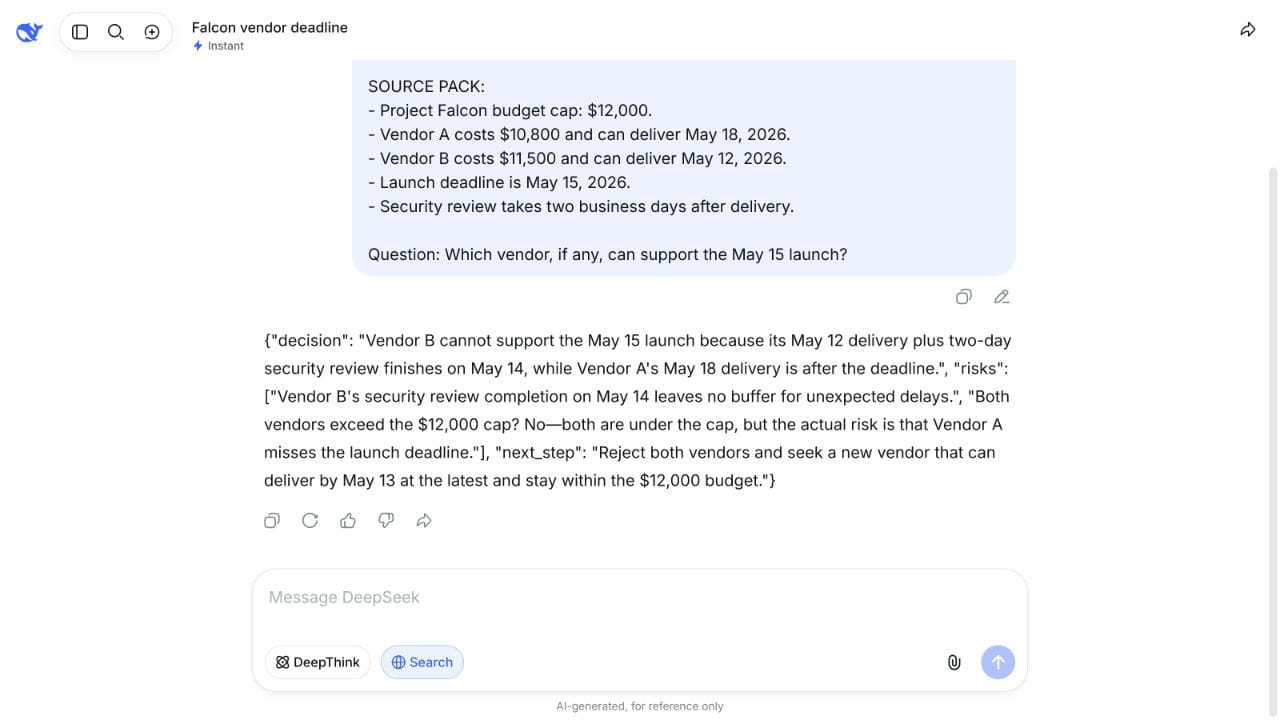
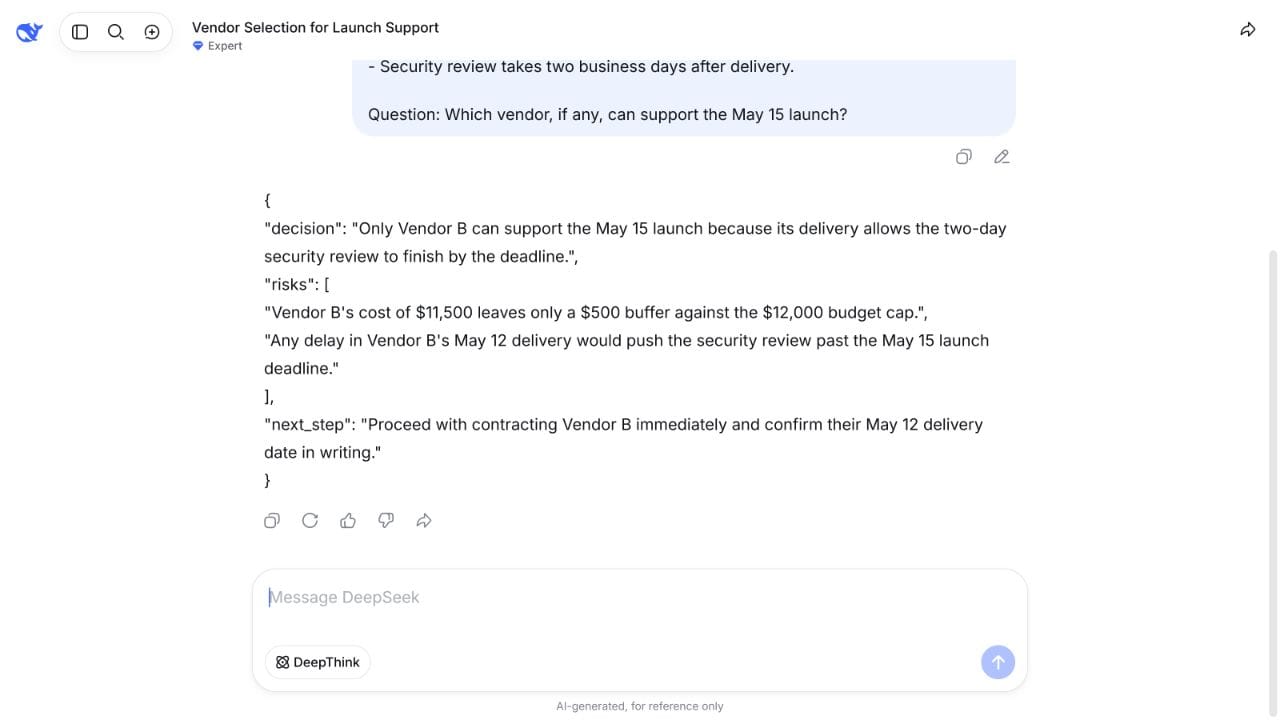
We ran one controlled decision-extraction task through the DeepSeek chat interface and API on July 28, 2026. The task required the model to follow a strict JSON format and correctly combine a delivery date, launch deadline, and two-business-day security review. We also queried the live DeepSeek models endpoint and checked the two legacy API aliases.
We did not run the prompt through Cohere. Consequently, this article does not award Cohere a quality score, latency result, or benchmark winner. Cohere model sizes, limits, prices, deployment features, and API behavior below come from the official pages linked in the sources section. This distinction matters: a documentation comparison can narrow a shortlist, but it cannot substitute for testing a company’s private corpus.
The reproducible source-grounded prompt
Use only the source pack below. Return valid JSON with exactly three keys:
decision, risks, and next_step. The decision must be one sentence.
risks must be an array of exactly two strings. next_step must be one sentence.

SOURCE PACK:
- Project Falcon budget cap: $12,000.
- Vendor A costs $10,800 and can deliver May 18, 2026.
- Vendor B costs $11,500 and can deliver May 12, 2026.
- Launch deadline is May 15, 2026.
- Security review takes two business days after delivery.

Question: Which vendor, if any, can support the May 15 launch?
The correct conclusion is Vendor B: it is within budget, arrives on May 12, and leaves two business days for review before the May 15 launch. Vendor A arrives after the deadline.
| Surface | Observed result | Operational lesson |
|---|---|---|
| DeepSeek Chat, Instant | Returned the requested JSON shape, but its decision was incorrect and contradicted the supplied dates. | Format compliance does not prove source-grounded correctness. |
| DeepSeek Chat, Expert | Returned the requested shape and selected Vendor B correctly. | Use the higher-reasoning route for decisions with interacting constraints. |
| V4 Flash API | HTTP 200; correct answer; 2,160 ms in this single run; 162 prompt tokens and 205 completion tokens, including 127 reasoning tokens. | Flash handled this small task, but one timing sample is not a speed benchmark. |
| V4 Pro API, 500-token cap | HTTP 200, but all 500 completion tokens were consumed by reasoning and the response ended with finish_reason: length before final content. | A low completion ceiling can suppress the final answer in thinking mode. |
| V4 Pro API, 1,600-token retest | HTTP 200; correct answer; 12,259 ms in this single run; 701 completion tokens, including 574 reasoning tokens. | Budget for both reasoning and the visible answer, then check the finish reason. |
A live GET /models request returned deepseek-v4-flash and deepseek-v4-pro on July 28, 2026. We also found that deepseek-chat and deepseek-reasoner still returned HTTP 200 and mapped to deepseek-v4-flash on that test date. These are historical compatibility observations, not a current catalogue or a promise that retired aliases remain available. DeepSeek released deepseek-v4-flash-vision-exp on August 21, making the current documented catalogue three model IDs. Production code should use current IDs, allowlist Vision when images are required, and monitor the provider’s change log.
Current models and API pricing
The table below separates Cohere’s established Command A API model from the newer Command A+. Combining them into a single “Cohere model” obscures meaningful differences in context, output length, modalities, architecture, access, and price presentation.
| Model | Published architecture / status | Context / max output | Input modalities | Published API price per 1M tokens |
|---|---|---|---|---|
| DeepSeek V4 Flash | 284B total / 13B active; Public Beta | 1M / 384K | Text | Off-peak / peak: $0.007 / $0.014 cache hit; $0.22 / $0.44 cache miss; $0.66 / $1.32 output |
| DeepSeek V4 Pro | 1.6T total / 49B active; GA | 1M / 384K | Text | Off-peak / peak: $0.022 / $0.044 cache hit; $0.66 / $1.32 cache miss; $1.98 / $3.96 output |
| DeepSeek V4 Flash Vision Exp | Experimental | 1M / 384K | Text and images in; text out | Same as Flash: $0.007 / $0.014 cache hit; $0.22 / $0.44 cache miss; $0.66 / $1.32 output |
| Cohere Command A | 111B parameters | 256K / 8K | Text | $2.50 input, $10 output |
| Cohere Command A+ | 218B total / 25B active sparse MoE | 128K / 64K | Text and images | Standard API documented as free within published limits; production Model Vault pricing is deployment-based |
Current DeepSeek API pricing (verified August 24, 2026): Peak pricing applies only Monday–Friday during 01:00–04:00 and 06:00–10:00 UTC; every other time, including all Saturday and Sunday in Beijing time, is off-peak. Flash and Vision Exp share off-peak / peak rates of $0.007 / $0.014 cache-hit input, $0.22 / $0.44 cache-miss input, and $0.66 / $1.32 output. Pro rates are $0.022 / $0.044, $0.66 / $1.32, and $1.98 / $3.96 in the same order. Vision images are billed as input tokens rather than through a separate image fee. Use the current pricing page and time-aware cost calculator for new budgets. Any dated test costs or arithmetic elsewhere on this page remain historical and have not been recomputed.
DeepSeek’s published rates make the token-cost difference easy to see. Cohere’s economics require more context. Command A has conventional token pricing. Command A+ documentation describes standard API access within rate limits, while production use is directed toward Model Vault or a commercial arrangement. Cohere’s public pricing page lists hourly and monthly Model Vault rows for Embed and Rerank deployments, but those rows are not a universal price card for every Command configuration.
Trial limits also affect a fair proof of concept. Cohere documents 20 requests per minute for Command A+ trial access and asks production customers to contact sales. Its trial keys generally carry a 1,000-call monthly limit for newer chat models, while Command A lists a 500-requests-per-minute production limit. Limits can vary by endpoint and account, so load tests should record the account tier and response headers.
Why Cohere is more than Command A
Cohere’s main architectural advantage is not simply a different language model. It is the availability of first-party retrieval components. Embed v4.0 can create vectors from text, images, and mixed document-like content, supports a 128K context window, and offers 256, 512, 1,024, or 1,536 dimensions. Rerank v4.0 can reorder retrieved candidates against a query, supports a 32,768-token context, and can work with structured content represented as YAML.
A typical Cohere pipeline can therefore use Embed for indexing and semantic retrieval, Rerank for improving the candidate order, and Command for grounded answer generation. The pieces have separate evaluation targets: retrieval recall, reranking relevance, answer faithfulness, latency, and total cost. Keeping those measurements separate is more useful than reporting one vague “RAG accuracy” number.
DeepSeek can still power an excellent retrieval-augmented system. It simply requires you to bring an embedding model, vector or hybrid search, optional reranker, document permissions, and observability. That can be an advantage when those components already exist or when avoiding a vertically integrated vendor is a priority. It can be a disadvantage when the team wants one supported retrieval stack with fewer integration boundaries.
Long context does not eliminate retrieval
DeepSeek’s 1M context can reduce chunking pressure and accommodate large source packs, but context capacity is not the same as dependable retrieval. Sending everything increases input processing, expands the material the model must discriminate, and may expose documents that a user was not authorized to see. Retrieval remains valuable for permissions, freshness, citations, and selecting a compact evidence set. Test a long-context route and a retrieve-then-rerank route on the same questions instead of assuming the larger window will win.
API compatibility and migration effort
Both providers reduce migration friction for teams familiar with OpenAI-style clients, but compatibility is not identical behavior. DeepSeek documents Chat Completions, a stateless Responses API, and an Anthropic-compatible Messages surface. Flash and Pro accept text; Vision Exp accepts text plus images and returns text. Images can be supplied by public URL, Base64, or reusable file_id, while the Files API is currently image-only rather than a general PDF, DOCX, or RAG-ingestion service. Thinking mode, JSON output, and tool calls are supported, but applications must preserve DeepSeek-specific message and streaming contracts. Its reasoning responses also require sufficient completion headroom, as our dated V4 Pro truncation test demonstrated.
Cohere documents an OpenAI compatibility API for Python, TypeScript, .NET, Java beta, and Go beta. It also documents intentional gaps. For example, its compatibility layer exposes only none and high for reasoning_effort; fields such as store, metadata, n, audio, service_tier, and parallel_tool_calls are unsupported. Cohere-specific controls are not all available through that layer.
Do not treat a changed base URL as a complete migration. Add contract tests for tool-call structure, streaming events, JSON-schema enforcement, finish reasons, usage accounting, retries, error objects, and multi-turn message preservation. Pin the exact model identifier rather than relying on a marketing family name.
Deployment, privacy, and governance
Cohere offers two enterprise deployment patterns that can materially change a procurement decision. Model Vault is described as a Cohere-managed, isolated, single-tenant environment with a target of at least 99.9% service availability. A zero-data-retention option states that prompts and outputs are not retained when enabled. Availability, region, model support, and contract terms still need confirmation; some capabilities are waitlisted.
Private deployments place models in a customer-controlled on-premises or virtual private cloud environment. Cohere says the customer manages the infrastructure, data stays in that environment, and network isolation is possible. None of those features automatically creates regulatory compliance. Identity, logs, backups, encryption, deletion, subprocessors, incident response, and data-processing terms must be evaluated for the actual deployment.
DeepSeek publishes MIT-licensed V4 weights, allowing teams with sufficient infrastructure to self-host and create their own isolation boundary. Self-hosting transfers responsibility for serving, patches, monitoring, abuse controls, and security to the operator. For hosted API use, review DeepSeek’s current terms and privacy documentation rather than assuming that an open-weight license governs the hosted service.
How to choose for a production workload
- Choose DeepSeek first when generation cost, 1M context, reasoning, open weights, an existing vendor-neutral retrieval stack, or experimental image understanding through Vision Exp is the priority.
- Choose Cohere first when first-party multimodal embeddings, reranking, managed single tenancy, private deployment, or a supported end-to-end enterprise RAG stack is the priority.
- Test both when the application answers high-value questions over private documents or images. Retrieval, grounding, and image-understanding quality can dominate headline model specifications.
- Consider a mixed architecture if governance permits it: Cohere Embed or Rerank can prepare evidence while another model performs generation. Measure extra latency, data movement, and vendor complexity before adopting this pattern.
A reproducible Cohere evaluation plan
Use this plan after obtaining a Cohere account. It is intentionally not presented as a completed test.
- Create a frozen, non-sensitive test corpus with document IDs, access-control labels, and verified answer passages.
- Define at least 50 representative text questions, including unanswerable, conflicting, outdated, multilingual, table-heavy, and permission-sensitive cases. Create a separate image set with verified labels and no private data unless the deployment terms permit it.
- Run the same text-only generation prompt through DeepSeek V4 Flash, V4 Pro, Command A, and Command A+. Run a separate matched image-understanding task through DeepSeek Vision Exp and Cohere Command A+; do not mix those results with the July 28 text test.
- Record exact model IDs, date, region, account tier, parameters, token use, latency, finish reason, raw output, image transport method, and image dimensions.
- Compare retrieval variants separately: the existing search stack; Cohere Embed v4.0; and each retrieval set with Rerank v4.0. Hold candidate count and answer prompt constant.
- Score citation support, answer correctness, refusal when evidence is absent, JSON validity, tool-call validity, image-grounding accuracy, retrieval recall, reranking relevance, p50/p95 latency, and end-to-end cost.
- Repeat enough runs to expose variance. Review a blinded sample with two evaluators and adjudicate disagreements.
- Test operational failure modes: rate limiting, timeouts, truncated reasoning, malformed or oversized images, failed image downloads, deleted files, permission changes, and provider outage.
- Choose the smallest configuration that meets the written acceptance thresholds; archive prompts and raw outputs so the result can be reproduced.
For a strict comparison, do not charge Cohere only for generation while charging DeepSeek for the complete retrieval pipeline, or vice versa. Include embedding refreshes, vector storage, reranking calls, model tokens, managed deployment fees, engineering effort, and observability in the same cost model.
Limitations of this comparison
- The live vendor-selection task is small and tests constraint reasoning plus structured output; it does not represent coding, multilingual, retrieval, safety, long-context, or image-understanding quality.
- The July 28 test predates DeepSeek Vision Exp. Vision was not tested, and the page makes no claim about its measured quality.
- Only DeepSeek was run live for the dated revision. Cohere results must be added after an authenticated, controlled run.
- The recorded latency values are single observations and must not be generalized into provider speed rankings.
- Published prices and access rules can change. Contracted enterprise pricing may differ from public pages.
- Model parameter counts and context limits do not predict application accuracy by themselves.
Frequently asked questions
Is DeepSeek better than Cohere?
Not universally. DeepSeek V4 offers unusually low published token prices, 1M context, and open weights; Vision Exp shares Flash pricing while adding image input with text output. Cohere offers a broader first-party enterprise retrieval and deployment stack. The better choice depends on whether model economics, image understanding, or integrated RAG and governance features dominate the workload.
What is the difference between Cohere Command A and Command A+?
Command A is the 111B, text-input model identified as command-a-03-2025, with 256K context and 8K maximum output. Command A+ is the newer command-a-plus-05-2026, a 218B-total/25B-active sparse MoE model with 128K context, 64K maximum output, and text-and-image input. Their access and pricing presentations also differ.
Does Cohere have better RAG support than DeepSeek?
Cohere has the more complete first-party RAG product line because it supplies generation, embeddings, and reranking. DeepSeek can generate grounded answers but normally relies on external embedding, search, and reranking components. “Better” still requires a corpus-specific retrieval test.
Can I use the OpenAI SDK with both providers?
Both document OpenAI-compatible paths, but neither should be assumed to match every OpenAI feature. Cohere publishes a specific list of unsupported fields, and DeepSeek has provider-specific reasoning and caching behavior. Use integration tests before migrating production traffic.
Which platform is cheaper?
For publicly listed token-based generation, DeepSeek V4 is far cheaper than Command A. Command A+ production economics may be deployment- or contract-based, and a full RAG cost comparison must also include embeddings, reranking, infrastructure, storage, and support.
Can Cohere or DeepSeek run privately?
Yes, through different routes. Cohere documents managed single-tenant Model Vault and customer-managed private deployments. DeepSeek publishes MIT-licensed V4 weights that teams can self-host. In either case, privacy and compliance depend on the actual architecture and contract, not the deployment label alone.
Official sources
- DeepSeek models and API pricing
- DeepSeek Vision guide
- DeepSeek Files API guide
- DeepSeek change log
- DeepSeek V4 Pro model card
- DeepSeek thinking mode
- Cohere Command A documentation
- Cohere Command A+ documentation
- Cohere Embed documentation
- Cohere Rerank best practices
- Cohere Model Vault
- Cohere private deployment overview
- Cohere OpenAI compatibility API
- Cohere rate limits
- Cohere pricing
Continue your evaluation
Review the current DeepSeek models, Vision Exp guide, and DeepSeek pricing, then use the DeepSeek API guide to reproduce the model-side test. For retrieval work, see our DeepSeek RAG and knowledge-base guide, context caching guide, and evaluation framework. Browse the AI comparison hub for related platform decisions.
Update log
- August 24, 2026: Added DeepSeek Vision Exp, its image and Files contract, current three-model limits and pricing, the weekday-only peak schedule, and a separate image-evaluation path while preserving the July 28 historical test and evidence.
- July 28, 2026: Rebuilt the comparison around DeepSeek V4 Flash/Pro, Cohere Command A/Command A+, then-current pricing and limits, enterprise RAG, deployment options, the dated DeepSeek API test, reproducibility, and explicit test limitations.