DeepSeek V3 is a cutting-edge large language model (LLM) developed by the Chinese AI startup DeepSeek.
Released in late 2024, this model represents DeepSeek’s third-generation LLM and is designed to rival top-tier systems like OpenAI’s GPT-4, Anthropic’s Claude, Google’s upcoming Gemini, and Meta’s LLaMA series.
It is a Mixture-of-Experts (MoE) model of unprecedented scale, boasting 671 billion parameters in total, with about 37 billion parameters actively used per token during inference.
In practical terms, DeepSeek V3 bridges the gap between open-source and proprietary AI, delivering GPT-4-level capabilities while remaining accessible to the developer community.
The model is fully open-source, with research papers and code available, reflecting DeepSeek’s mission of openness and its goal to narrow the gap between open and closed models.
Why does DeepSeek V3 matter to developers?
For one, it offers state-of-the-art performance in natural language understanding and generation without the restrictive licensing of closed models.
It can generate text, write and debug code, engage in complex conversations, and even handle very long documents – all at a level that competes with the best models available.
In the sections below, we’ll dive into the technical specifications of DeepSeek V3, its architecture, performance benchmarks against other leading models, and the features and use cases that make it especially attractive for developers.
Architecture and Technical Specifications

DeepSeek V3’s architecture and training regimen are what truly set it apart. Here are the key technical specs and innovations:
- Mixture-of-Experts (MoE) Architecture: DeepSeek V3 is built as a MoE transformer model, which means it contains many sub-model “experts” and activates a subset of them for each input. The model has 671B parameters total, but only ~37B are used per token thanks to this MoE design. This allows the model to be both powerful and efficient, leveraging different experts for different tasks. An advanced Multi-head Latent Attention (MLA) mechanism and the custom DeepSeek-MoE architecture (refined from V2) enable efficient expert routing and utilization.
- Innovative Training Techniques: The DeepSeek team introduced new methods to improve training efficiency and model quality. Notably, V3 uses an auxiliary-loss-free load balancing strategy for MoE, avoiding the usual extra loss term and thus minimizing any performance hit from balancing expert usage. They also employed a Multi-Token Prediction (MTP) training objective, meaning the model learns to predict multiple tokens in parallel, which boosts performance and enables faster inference via speculative decoding.
- Scale of Training Data: The model was pre-trained on a massive 14.8 trillion tokens of diverse, high-quality text. This dataset likely includes a mix of web pages, books, code repositories, and other sources in multiple languages. In fact, the base model was trained on raw web text and e-books without intentional synthetic data injection. Such a vast training corpus gives DeepSeek V3 a broad knowledge base in domains ranging from general knowledge and literature to programming and mathematics.
- Multi-Lingual and Code Abilities: By virtue of its training data, DeepSeek V3 supports multiple modalities of text, including natural language in both English and Chinese (and other languages) as well as programming code. The model has been tuned on code-intensive data, making it proficient at code generation and understanding. Evaluations show it excels in coding tasks and can work across languages, outperforming other models on both English and Chinese benchmarks. (Note that multimodal in this context refers to text and code; V3 is not an image or audio model. However, DeepSeek has hinted that future versions will incorporate multimodal support.)
- Long Context Window: A standout feature of DeepSeek V3 is its extended context length up to 128,000 tokens. This vastly surpasses the context window of most LLMs (GPT-4 offers 8K to 32K context, and many open models like LLaMA-2 are around 4K). A 128K context means V3 can ingest and reason about very large documents or multiple documents at once – for example, analyzing a full codebase or an entire book in one prompt. This opens up use cases like long document summarization, extensive conversations without losing earlier context, and complex multi-part reasoning.
- Efficient FP8 Precision: DeepSeek V3 was one of the first large models to use FP8 (8-bit floating point) mixed-precision training at scale. The team co-designed algorithms and hardware optimization to make FP8 training feasible, dramatically improving training speed and reducing memory usage without sacrificing model quality. This innovation, combined with MoE and engineering optimizations, allowed DeepSeek to train such a huge model at a fraction of the usual cost.
- Training Cost and Stability: Despite its gigantic size, DeepSeek V3’s training was highly efficient. The full training consumed about 2.788 million H800 GPU hours, roughly estimated at $5.6 million in cost, which is an order of magnitude lower cost than what’s reported for models like GPT-4. The pre-training phase (14.8T tokens) took ~2.664M GPU hours, and subsequent fine-tuning stages only ~0.1M more. Moreover, the training process was remarkably stable, with no catastrophic loss spikes or restarts needed – an impressive feat for such a large-scale run.
- Post-Training Alignment: After pre-training the base model, DeepSeek V3 underwent further tuning to cater to different use cases. There are two main variants:
- V3-Base: the raw pre-trained model (unaligned) primarily used for research and as a foundation for further tuning.
- V3-Chat: an instruction-tuned and RLHF (Reinforcement Learning from Human Feedback) aligned model, optimized for helpfulness and safe interaction. The Chat model was created by supervised fine-tuning on instructions and then applying RLHF, similar to how ChatGPT is built, making it suitable for conversational agents. This Chat version is the one that competes with models like GPT-4 in dialogue and follows user instructions effectively.
- Additionally, DeepSeek developed a specialized reasoning model series called R1 (with variants R1-Zero and R1), which focuses on chain-of-thought reasoning. Notably, DeepSeek V3 incorporated knowledge distilled from the R1 model – the team transferred reasoning patterns from their R1 long-form reasoning model into V3 during fine-tuning. This gives V3 enhanced logical reasoning and step-by-step problem-solving abilities (e.g. in math and code challenges) by leveraging the strengths of R1.
In summary, DeepSeek V3’s technical profile is that of a transformer-based MoE LLM, 671B parameters in size, trained on an unprecedented token dataset with novel training techniques (like FP8 precision and multi-token prediction).
It supports text and code as input/output modalities and can handle extremely long contexts.
These innovations result in a model that is both ultra-powerful and efficient, making it a game-changer in the open LLM arena.
Performance Benchmarks and Comparison

One of the most compelling aspects of DeepSeek V3 is its performance on benchmarks, which shows it not only leads other open-source models but also competes head-to-head with the best closed-source models.
Extensive evaluations were conducted across a variety of tasks – from language understanding and knowledge quizzes to coding, math, and reasoning problems.
The results are impressive: DeepSeek-V3 stands as the best-performing open-source model to date, and it exhibits competitive performance against frontier closed-source models.
To put this in perspective, let’s compare DeepSeek V3 with some well-known models on key benchmarks:
Performance of DeepSeek V3 (blue) vs other models on various benchmarks. Higher is better.
DeepSeek V3 often matches or exceeds leading models like GPT-4 (orange) and Claude (gray) on knowledge, coding, and math tasks.
- Knowledge and Reasoning (MMLU): On the English MMLU benchmark (a suite of academic exam questions), DeepSeek V3 scores about 88.5%, which is on par with or slightly above GPT-4’s performance on the same test It also edges out Meta’s large models (e.g., a hypothetical LLaMA 3 of similar scale) and Alibaba’s Qwen-72B in this category. In other subvariants like MMLU-Pro, Claude 3.5 had a small lead, but V3 was close behind, underscoring that V3’s knowledge is broadly comparable to the best generalist models.
- Code Generation: DeepSeek V3 excels at coding tasks. On the popular HumanEval programming test (coding problems that measure if the model can generate correct code), V3 achieves about 82.6% pass@1, slightly surpassing GPT-4’s ~80.5% on the same metric. It also outperforms other open models like Code-LLaMA and rival systems like Anthropic’s Claude in code writing benchmarks. Furthermore, on more challenging coding contests such as Codeforces, DeepSeek V3’s performance leaps far ahead – it reached roughly the 51.6<sup>th</sup> percentile, whereas GPT-4 was around the 23<sup>rd</sup> percentile on that scale. This indicates V3’s strength in complex problem-solving and algorithmic coding, likely aided by its huge parameter count and the incorporation of reasoning skills.
- Math and Logical Reasoning: Perhaps most striking is V3’s dominance in mathematical problem solving. On the MATH dataset (which contains high school and competition math problems), DeepSeek V3 achieved around 90% accuracy, whereas GPT-4 scored about 74-75%. It also dramatically outperformed others on the AIME 2024 math competition (39.2% vs GPT-4’s 16.0%) and related math benchmarks. These results suggest that the integration of the R1 reasoning model’s techniques paid off – DeepSeek V3 can perform multi-step reasoning and complex calculations exceptionally well. Its logical coherence in chain-of-thought intensive tasks is among the best in class.
- Domain-Specific and Multilingual Tasks: DeepSeek V3 shows strong results in other areas as well. For instance, on Chinese language benchmarks like C-Eval (a Chinese academic exam suite) and CLUE benchmarks, V3 scored top marks, significantly outperforming many domestic competitor models. This reflects the model’s bilingual training – it is not only an English expert but also highly capable in Chinese, making it appealing for applications in multi-lingual environments. On common sense and QA tasks (HellaSwag, TriviaQA, etc.), V3 is again at or near state-of-the-art for open models.
- Open-Ended Conversation: When it comes to interactive dialogue, the aligned DeepSeek V3-Chat model demonstrates performance on par with leading chatbots. In an Arena evaluation with hard prompts, V3’s win-rate was comparable to (even slightly above) Anthropic’s Claude 3.5 and OpenAI’s GPT-4. And on AlpacaEval 2.0 (an open-ended chat benchmark), DeepSeek V3 dramatically outperformed GPT-4 (70.0 vs 51.1 on a length-controlled win rate), indicating its fine-tuned conversational quality and adherence to instructions. In practical terms, users have found that DeepSeek V3’s chat model can often deliver helpful, coherent answers much like ChatGPT, handling follow-up questions and complex requests with ease.
It’s important to note that these benchmarks cover a wide range of tasks, and while DeepSeek V3 may not beat GPT-4 on every single metric, it is extremely close across the board and even superior in several areas (especially coding and math). This makes it one of the most well-rounded AI models available.
In the open-source arena, nothing else quite matches DeepSeek V3’s aggregate performance – it clearly outshines previous open models such as LLaMA-2 70B, PaLM derivatives, or smaller MoE models.
In fact, the DeepSeek team calls V3 “the currently strongest open-source base model” given its benchmark dominance.
For developers and researchers, this means you can leverage a model approaching GPT-4’s prowess without needing access to a proprietary API, which is a huge development in the AI landscape.
Key Features and Use Cases for Developers
Beyond raw performance numbers, DeepSeek V3 brings a host of features that make it especially useful for developers building AI applications:
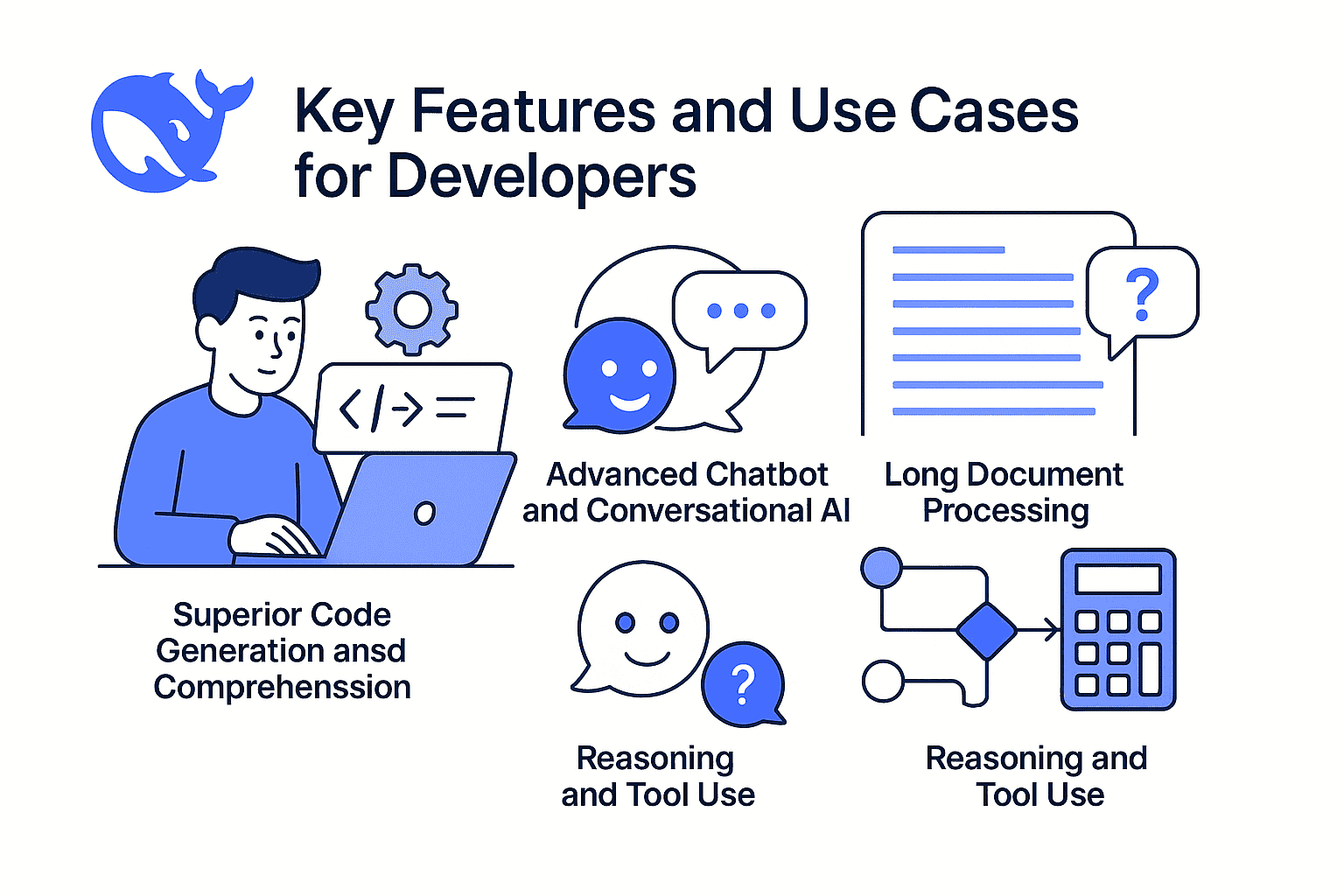
- Superior Code Generation and Comprehension: Thanks to training on extensive programming data and high scores on code benchmarks, DeepSeek V3 is ideal for code-related tasks. Developers can use V3 to build coding assistants that generate functions or classes given a description, help debug code by explaining errors, or even suggest improvements. Its strong performance on HumanEval and competitive programming challenges shows it can handle languages like Python, Java, C++, etc., and solve non-trivial coding problems. This makes it a great engine for AI pair-programming tools, code review automation, or converting requirements to code.
- Advanced Chatbot and Conversational AI: The DeepSeek V3 Chat model (which underwent instruction tuning and RLHF) is optimized for dialogue. It can serve as the brains of a ChatGPT-style assistant, engaging in multi-turn conversations with coherency and adherence to user instructions. It has been trained to be helpful and harmless, meaning it tries to follow user requests while avoiding toxic or disallowed content. Developers can integrate V3-Chat into customer support bots, virtual advisors, or any interactive application requiring natural conversation. Notably, the model supports function calling and tool usage via the DeepSeek API (similar to OpenAI’s function calling), enabling it to execute actions or retrieve information as part of a conversation. It also supports features like system messages and multi-round dialogue management, making it flexible for complex chatbot flows.
- Long Document Processing: With its 128K token context window, DeepSeek V3 unlocks use cases involving very long texts. For example, you could feed an entire software repository or large codebase into the model and ask it to document the code, find bugs, or generate summaries of each module. Or, provide hundreds of pages of literature or technical documentation and have the model answer questions that require synthesizing information across the whole text. This is extremely valuable for enterprise scenarios (analyzing financial reports, legal contracts, research papers in one go) and for building AI agents that maintain a long memory of past interactions or documents. V3’s ability to perform well even with maximal context (it was tested up to 128K and maintained strong accuracy) means developers can trust it for tasks that were previously infeasible due to context length limitations.
- Reasoning and Tool Use: DeepSeek V3 has been enhanced with chain-of-thought reasoning capabilities via distillation from the R1 model This means it’s adept at step-by-step logical reasoning, mathematical derivations, and complex decision making. Developers can leverage this for applications requiring planning or multi-step solutions (e.g. solving a math word problem by breaking it down into steps, or performing a data analysis pipeline through reasoning). Coupling V3 with external tools (databases, calculators, web search) is also a promising approach – given its OpenAI-compatible API, one can integrate it into existing agent frameworks that were designed for GPT-4 or similar. It can follow formats like “Thought -> Action -> Observation” chains, making it suitable for use in agentic frameworks and autonomous AI assistants.
- Multi-Lingual Applications: Since DeepSeek V3 was trained on both English and Chinese data extensively, it can be used for bilingual or multi-lingual applications. For instance, developers can create translation systems, or chatbots that seamlessly switch between English and Chinese (and potentially other languages included in the training set). Its high performance on Chinese benchmarks (C-Eval, CLUE) suggests native-level understanding, which is particularly useful for businesses operating in Chinese markets or researchers working with Chinese texts. Unlike some Western models, V3 does not treat Chinese as an afterthought – it’s a core competency.
- OpenAI-Compatible API and Integration: A very practical benefit for developers is that DeepSeek offers an API that is compatible with OpenAI’s. This means if you have code that currently calls the OpenAI GPT-3/4 API, you can switch to DeepSeek’s API with minimal changes, and get similar results. The request/response format, rate limiting, and even features like system/user/assistant message roles are supported on DeepSeek’s platform. Additionally, DeepSeek’s API includes some advanced features such as function calling, Fill-In-the-Middle (FIM) completion for code, and conversation context caching as per their documentation. This lowers the barrier to adoption significantly – developers can try out DeepSeek V3 as a drop-in replacement or supplement to other AI services, potentially reducing costs (DeepSeek recently cut API prices by over 50%) while maintaining high quality.
- Throughput and Efficiency: DeepSeek V3 is not just powerful, it’s also relatively fast. It can generate text at around 60 tokens per second (roughly 3× faster than its predecessor V2) under the right hardware conditions. This is an attractive feature for real-time applications or high-volume services. The model’s design (FP8 inference and optimized MoE routing) means that given adequate hardware, you can achieve fast response times even with the model’s large size. For developers, this translates to the ability to deploy V3 in production systems without unacceptable latency, as long as the model is properly optimized on your inference stack.
- Potential for Multimodal Extensions: While DeepSeek V3 itself is a text-only model, the team has signaled that multimodal support is on the horizon. This forward compatibility means that investing in DeepSeek’s ecosystem now could pay off when future versions (V4 or beyond) integrate vision or audio capabilities. Developers interested in multimodal AI (combining language with image understanding, for example) should watch DeepSeek’s progress. Even now, creative developers can pair V3 with separate vision models (for image captioning or understanding) using the long context to feed in image descriptions, thereby building rudimentary multimodal pipelines.
In essence, DeepSeek V3 provides developers with a versatile AI foundation: you can build anything from an intelligent coding assistant, to a multilingual chatbot, to a document analysis system on top of it.
Its combination of a long context window, high raw IQ (benchmark performance), and fine-tuned chat capabilities make it a strong candidate for next-gen AI applications.
And since it’s open-source, you have the freedom to customize and integrate it deeply into your own products without vendor lock-in.
Access and Deployment
Another major advantage of DeepSeek V3 is the flexibility in how you can access and deploy the model. Here’s how developers can start using DeepSeek V3:

- Open-Source Model Availability: Both the DeepSeek-V3 Base and Chat models are openly released. They are available on Hugging Face Hub and GitHub, complete with model weights, code, and documentation. The model weights (in FP8 format) total about 685B bytes (671B for the MoE model + 14B for the MTP module), so downloading and handling them is non-trivial – you’ll need substantial disk space and memory. The fact that it’s open-source (and under a permissive license for commercial use) means you can self-host it, fine-tune it on your own data, or integrate it into your stack without worrying about strict usage terms. Many companies and researchers have already started building on V3, given this freedom.
- Hardware Requirements: Deploying a model of this magnitude does require serious hardware. DeepSeek V3’s active working size is 37B parameters per token, which might occupy around 70–100 GB of memory (depending on precision and optimizations). Multi-GPU setups are almost certainly required. DeepSeek’s team used H800 GPUs for training; for inference, NVIDIA A100 or H100 GPUs with large memory are recommended (or equivalent like AMD MI250s, etc.). The model’s support for FP8 means using GPUs that can leverage 8-bit matrix operations for speed. Running on commodity hardware is not feasible, but cloud GPU instances or on-premise accelerators with sufficient memory can host V3. Developers should plan for distributed inference if needed – splitting the model across GPUs or using model parallelism.
- Optimized Inference Solutions: To make deployment easier, DeepSeek partnered with open-source inference frameworks. There are multiple ways to run the model with optimized performance:
- DeepSeek-Infer Demo: A lightweight reference implementation supporting FP8/BF16 inference.SGLang: An inference engine that fully supports DeepSeek-V3 in BF16 and FP8 modes, useful for running on single or multiple GPUs.LMDeploy: An efficient deployment toolkit (open-sourced by NVIDIA) that can serve DeepSeek V3 with FP8 and BF16 optimizations, suitable for both local and cloud deployment.TensorRT-LLM: NVIDIA’s TensorRT for language models supports DeepSeek V3 (BF16 and planned FP8), allowing high-throughput inference with hardware acceleration.vLLM: A highly optimized transformer inference library that now supports DeepSeek V3 in 8-bit and 16-bit modes for parallel and streaming inference. In fact, the DeepSeek team has demonstrated V3 serving using vLLM with impressive throughput.Support for AMD and Huawei Ascend: The model can even run on AMD GPUs or Huawei NPUs via compatible frameworks, as noted by the developers, showing a commitment to broad hardware support beyond just NVIDIA.
- Using the DeepSeek API: For those who don’t want to host the model themselves, DeepSeek offers a hosted API service. You can access DeepSeek V3 via chat.deepseek.com for an interactive web experience, or use their developer API at platform.deepseek.com which follows a format similar to OpenAI’s API With an API key, you can send prompts and receive model completions or chat responses just as you would with GPT-4’s API. The pricing of DeepSeek’s API has been touted as highly competitive – as of early 2025 they cut prices by over 50%, making it one of the most cost-effective high-end AI APIs. This is appealing for startups or projects that need top-tier model performance without breaking the bank. The API also supports fine-grained control like setting temperature, max tokens, and system instructions, and it provides enterprise features such as data privacy options for business users.
- Fine-Tuning and Customization: If the base model doesn’t perfectly fit your domain, you can fine-tune DeepSeek V3 on your own dataset. Given the model’s size, full fine-tuning is expensive, but techniques like LoRA (Low-Rank Adaptation) or adapter modules can be used to adapt the model with relatively less compute. Since the model weights are provided, developers and researchers can perform domain adaptation – e.g., training it further on medical text to create a medical chatbot, or on a proprietary codebase to improve its familiarity with a particular framework. The open model license allows such derivative use (including commercial uses), which is a major benefit over closed models.
- Community and Support: DeepSeek’s release has an active community on forums and Discord. Their official documentation (including an arXiv technical report and a detailed model card on Hugging Face) is comprehensive. The company provides some support channels and is continuously updating the model (as seen with minor version updates like V3.1 and V3.2-Exp in 2025). For deployment help, communities around frameworks like BentoML (which wrote a guide on DeepSeek models) are valuable resources. In short, while running a 671B-parameter model is non-trivial, you’re not on your own – plenty of tools and community expertise are available to assist.
Conclusion
DeepSeek V3 stands out as a milestone in the LLM world – a model that delivers frontier-level performance in an open package.
With its MoE architecture and 671B parameters, it pushed the boundaries of scale while introducing efficiencies that keep it practical.
For developers, V3 offers a tantalizing combination of power, flexibility, and (relative) affordability.
You can use it to build everything from advanced coding copilots to intelligent chatbots and long-document analysis tools, without needing to rely on closed AI providers.
The model’s benchmarks speak to its strengths: it’s at GPT-4’s heels, and even ahead in areas like coding and math, which opens up competitive advantages for those who adopt it.
Crucially, DeepSeek V3 is a harbinger of a broader trend – the rise of open large-scale AI that competes with the traditionally closed, big-tech models.
Its success has shown that with clever engineering (like MoE and FP8) and sufficient compute, the open community can produce systems on par with the best of Silicon Valley.
This is encouraging for the AI ecosystem, as it fosters competition and democratization.
The DeepSeek team’s commitment to openness (releasing code, models, and even sharing future plans like multimodal support) means developers are not just getting a static model, but joining an evolving platform.
In summary, DeepSeek V3 is a powerful tool for developers looking to leverage state-of-the-art AI in their products or research.
Whether you access it through the convenient API or run it on your own hardware, it unlocks capabilities that were until recently limited to a few tech giants.
As you plan your next AI project – be it a smart coding assistant, a domain-specific expert system, or a global conversational agent – DeepSeek V3 is definitely worth considering.
It represents the cutting edge of what the open-source AI movement has achieved, combining technical innovation with practical developer-friendly features.
With DeepSeek V3, the gap between open models and the likes of GPT-4 has never been smaller, and that’s great news for developers and the industry at large.