
DeepSeek V2 introduced the efficient attention and mixture-of-experts design that shaped the next generations. V3 scaled that foundation, V3.1 combined thinking and non-thinking modes, and V3.2 brought sparse attention together with reasoning during tool use. The main releases covered here run from May 2024 to December 2025.
If you are comparing an old checkpoint, checking a release date, or trying to understand what changed between V3 and V3.2, this history explains those differences. For choosing a model to use now, start with the DeepSeek models guide. A downloadable checkpoint and the model once served behind an API name are separate things; that distinction matters throughout this timeline.
Table of Contents
DeepSeek release dates: V2 through V3.2
The table separates major generations from smaller updates. Dates refer to the release or service update identified by DeepSeek, rather than a later revision of a research paper. The V3-0324 row shows both the API update date and the announcement date because the official records distinguish them.
| Release | Date | Main change |
|---|---|---|
| DeepSeek V2 | May 6, 2024 | MLA attention and DeepSeekMoE in a 236B model with 21B parameters active per token. |
| V2-Lite | May 16, 2024 | A smaller 16B model, with 2.4B active parameters and a 32K context window. |
| V2.5 | September 5, 2024 | Combined the general chat and coding lines. |
| V2.5-1210 | December 10, 2024 | An update within V2.5, with reported improvements in mathematics, coding, writing, and reasoning. |
| DeepSeek V3 | December 26, 2024 | A larger MoE model with FP8 training and multi-token prediction. |
| V3-0324 | March 24, 2025 API update; March 25 announcement | Improved capabilities within V3; the released weights use MIT licensing. |
| V3.1 | August 21, 2025 | One model with thinking and non-thinking modes, plus stronger tool use. |
| V3.1-Terminus | September 22, 2025 | Refinements to language consistency and agent behavior. |
| V3.2-Exp | September 29, 2025 | An experimental release introducing DeepSeek Sparse Attention. |
| V3.2 | December 1, 2025 | The full release, including thinking during tool use. |
| V3.2-Speciale | December 1, 2025 | A variant focused on deep reasoning, without tool calling; weights were also released. |
This is the V-series history for this period, rather than a catalog of everything DeepSeek released. Coder and R1 intersect with the story, so they appear where they explain a change in the main line. Later generations are covered separately in the DeepSeek V4 guide.
DeepSeek V2: the efficiency foundation
V2 was a large model designed to make training and inference more economical. Its official repository lists 236 billion total parameters, 21 billion activated for each token, and a 128K context window. DeepSeek pretrained it on 8.1 trillion tokens, then used supervised fine-tuning and reinforcement learning for its chat models.
Two ideas explain why V2 matters in this history. Multi-head Latent Attention, or MLA, compresses the key-value information retained during attention. That cache grows as a conversation becomes longer, so reducing it helps with the memory cost of serving long sequences. DeepSeekMoE routes each token through selected experts, allowing a model to have a large total capacity while using only part of it for each token. The V2 technical report explains these two components.
These solve different problems: MLA reduces the attention cache, while sparse expert activation reduces the amount of model computation used for each token. Neither means that a 236B model needs storage for only 21B parameters. When comparing a full model with a smaller one, keep total size, active parameters, and runtime memory separate.
Where V2-Lite fits
V2-Lite followed on May 16 with 16B total parameters and 2.4B active parameters. Its documented context window is 32K, compared with 128K for the full V2 checkpoints. DeepSeek released both base and chat versions. Lite offers a smaller starting point for studying the design, but it should not inherit the full model’s context specification or evaluation results.
V2.5 brought chat and coding together
The V2 period included the V2-0628 chat update and Coder-V2-0724 coding update. V2.5 combined their general and coding capabilities. The V2.5 model card identifies the two predecessor checkpoints and compares them with the combined release.
For someone reading an old coding guide, this explains why deepseek-coder and deepseek-chat could lead to the same hosted model in September 2024. It was a service transition, not a renaming of every downloadable Coder checkpoint. The combined model also did not win every evaluation in its own comparison table; better general and coding coverage is more precise than saying it was universally better.
On December 10, the hosted chat model moved to V2.5-1210. DeepSeek’s dated changelog entry describes further capability improvements. This belongs between V2.5 and V3 in the timeline: it was a revision of the existing generation, not the V3 launch.
DeepSeek V3: a larger model and changes to training
V3 arrived on December 26, 2024. It retained MLA and DeepSeekMoE while increasing the main model to 671B total parameters, with 37B activated per token. Both the base and chat checkpoints are listed with 128K context in the official V3 repository. Its pretraining corpus contained 14.8 trillion tokens.
The size increase was only part of the change. DeepSeek also revised how it trained the model, including FP8 mixed-precision training, a new expert load-balancing strategy, and multi-token prediction. These details help explain V3’s place in the lineage without reducing its significance to a benchmark headline.
What the training changes mean
FP8 mixed precision uses lower precision for much of the expensive computation, with higher precision where needed for stability. Auxiliary-loss-free load balancing addresses how work is distributed among experts without relying on the same balancing objective used in earlier designs. Multi-token prediction, or MTP, adds a training objective for predicting further tokens, rather than training only on the immediate next token. These methods are documented in the V3 technical report.
MTP does not mean that every application automatically generates several tokens at once. The report says the main model can run without its MTP modules; those modules can also be used for speculative decoding. Whether a deployment uses that acceleration depends on its inference implementation.
There is also a naming detail worth knowing when browsing downloads. The V3 repository explains that its 685B total weight package includes the 671B main model plus 14B MTP-module weights. A file listing with the larger figure is therefore not necessarily describing a different main model.
V3-0324: an updated checkpoint, not a new generation
The official changelog records the API update on March 24, 2025, while the release announcement is dated March 25. Keeping both dates explains the apparent discrepancy without inventing a second launch.
DeepSeek reported gains in reasoning, front-end code generation, Chinese writing, rewriting, translation, and function calling. The V3-0324 model card describes these changes and provides the checkpoint. They are provider-reported improvements; they do not establish that every task or local deployment improves by the same amount.
This update also matters for licensing. The original V3 repository distinguishes MIT-licensed code from weights covered by a separate model license. V3-0324 explicitly places both the repository and weights under MIT. If you are downloading an older release, check the license attached to that exact checkpoint instead of treating every model called “V3” as identical.
Where R1 fits alongside V3
R1 is a related reasoning line, rather than another name for V3-0324. DeepSeek’s R1 repository states that R1 and R1-Zero were trained from V3-Base. This is why they share an architectural foundation while differing in post-training and behavior.
That relationship also explains the later move to hybrid models: the history is not simply V3 being replaced by R1 and then returning as V3.1. General chat and explicit reasoning existed as different hosted choices before V3.1 brought thinking and non-thinking operation into one model family.
DeepSeek V3.1: one model, two modes
Released on August 21, 2025, V3.1 kept the 671B/37B scale and 128K context, but changed the interaction model. Its model card describes a single hybrid model whose thinking and non-thinking modes are selected through the chat template. It also documents further long-context training on top of V3-Base: 630B tokens in the 32K extension phase and 209B in the 128K phase, summarized as about 840B in the announcement.
For the reader, the useful distinction is between generating a direct answer and allowing a more extended reasoning process. A simple rewrite and a difficult multi-step problem need not use the same mode, even though the underlying model belongs to the same family.
The launch announcement mapped deepseek-chat to non-thinking mode and deepseek-reasoner to thinking mode. DeepSeek also reported faster thinking than R1-0528 and improved agent performance. These describe the provider’s release claims, not a guarantee about response time for every prompt.
For local use, the template change is significant. Supplying an old V3 prompt format to a V3.1 checkpoint is not the same as deliberately selecting a mode with its own tokenizer and template. A version number can therefore affect integration behavior even when the broad parameter count stays unchanged.
V3.1-Terminus refined the experience
On September 22, DeepSeek introduced V3.1-Terminus. The announced changes addressed unwanted Chinese-English mixing and unusual characters, alongside improvements to Code Agent and Search Agent behavior. It was a refinement within V3.1, with downloadable weights as well as a hosted release.
Terminus is useful when interpreting results labeled only “V3.1.” A result from the August launch and one from the September refinement are not necessarily measurements of the same checkpoint. Retaining the full version name is more informative than assuming the shorter family label captures every change.
DeepSeek V3.2: sparse attention and thinking with tools
V3.2-Exp introduced the attention change
DeepSeek released V3.2-Exp on September 29, 2025, building on V3.1-Terminus. Its focus was DeepSeek Sparse Attention, or DSA: reducing the work needed for long-context attention while maintaining model quality. The announcement describes an experimental step and reports performance broadly comparable with Terminus.
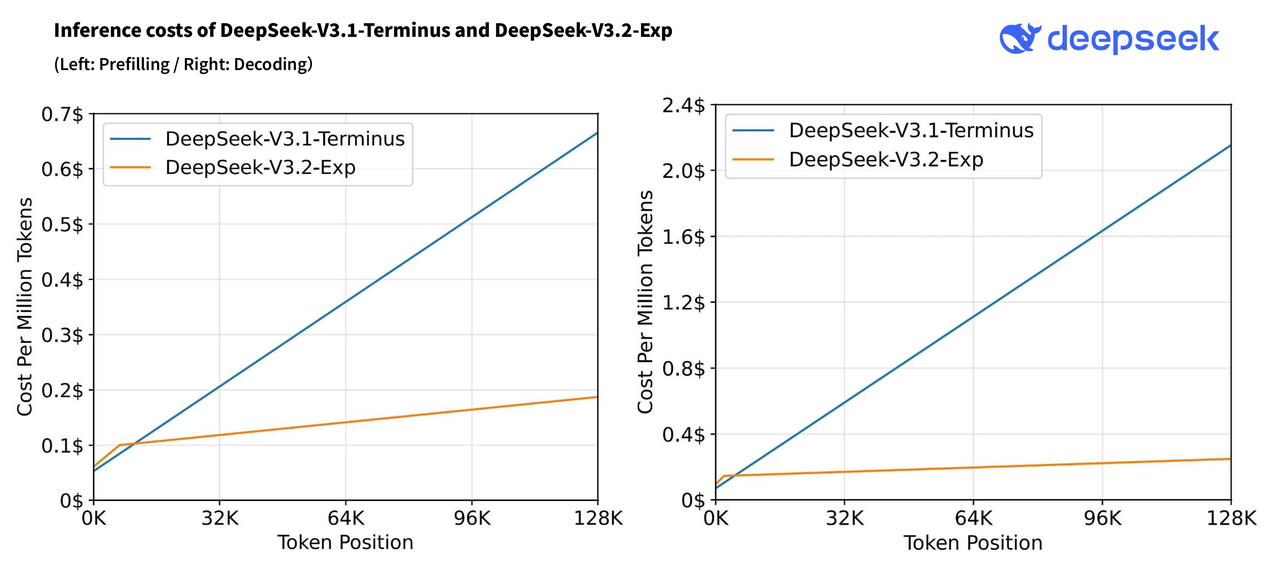
MLA and DSA are related but different. MLA compresses the information retained for attention. DSA introduces a way to select which earlier token entries receive attention, using an indexer and token selection. The V3.2 report explains that the final V3.2 model uses the same architecture as V3.2-Exp. The later release added more than a new date to that experimental checkpoint.
Reproduction work should also account for corrections to the implementation. The experimental repository records a November 17 fix to positional encoding in the inference demo’s indexer. Someone investigating old results should identify the code revision as well as the model name; that note is not a claim that every deployment had the same issue.
The full V3.2 release connected reasoning and tool use
V3.2 launched on December 1, 2025. DeepSeek’s announcement identifies it as the successor to V3.2-Exp and its first model to integrate thinking directly into tool use. Tool use was supported in both thinking and non-thinking modes.
The practical difference is easiest to see in a task that needs several operations: inspect a file, call a tool, examine its result, and decide what to do next. Hybrid thinking alone describes a choice of mode. Thinking with tools describes how reasoning participates in that sequence of actions.
The report explains a related context rule: reasoning can be retained while tool results are being added, rather than discarded after every tool response. A new user message marks a different boundary. This helps explain the design; it is not a substitute for the integration rules of the particular runtime you use.
The V3.2 model card also documents a revised encoding and parsing format. Its reference release supplies Python encoding code rather than a Jinja chat template, and cautions that the sample parser needs stronger error handling for production. These are concrete reasons to read the release’s own integration material rather than reuse a V3.1 setup unchanged.
Speciale was a separate reasoning variant
V3.2-Speciale was released alongside V3.2 for deeper reasoning. Its official model card explicitly excludes tool calling. It should not be treated as the automatic choice for an agent merely because DeepSeek reported stronger reasoning results.
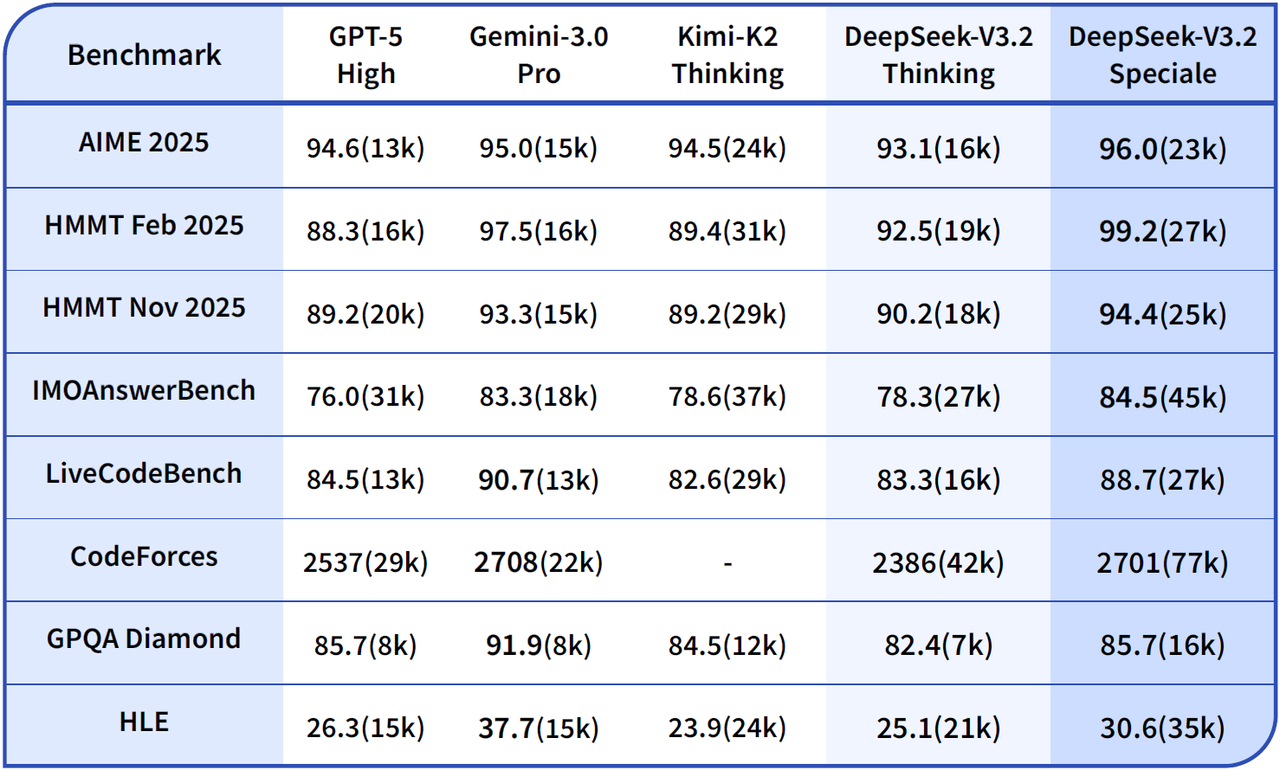
The temporary official Speciale API was scheduled to remain available until December 15, 2025, at 15:59 UTC. That deadline concerned the hosted endpoint. The downloadable weights are a separate release and remain listed on the model card. Describing the entire model as “expired” would confuse the service with the checkpoint.
DeepSeek’s competition and benchmark claims for Speciale also belong to their evaluation setup. They are not evidence that a normal single chat response, a different serving configuration, or a quantized copy will produce the same outcome.
V2 vs V3 vs V3.1 vs V3.2: what actually changed?
| Generation | Change to understand | Why you might study it |
|---|---|---|
| V2 | MLA plus sparse expert activation. | Understand the attention-memory and compute foundations used in the later line. |
| V3 | Greater scale, FP8 training, revised load balancing, and MTP. | Study how DeepSeek scaled and trained a large general model. |
| V3.1 | Thinking and non-thinking operation in one family, with updated templates. | Understand hybrid inference and how mode selection affects integration. |
| V3.2 | Sparse attention plus further post-training and thinking with tools. | Study long-context efficiency and multi-step tool interactions. |
A larger version number does not tell you which change produced a result. A comparison might involve a different attention mechanism, a new checkpoint, more reasoning tokens, another tool framework, or several of these at once. Read the conditions before attributing a performance gain to architecture alone.
The same applies to context length. The original V2 and V3 model tables both list 128K for their full checkpoints, even though the models differ substantially. That figure describes the documented context capacity; it does not establish equal accuracy across a long document, equal speed, or an identical output allowance from a hosted service.
Why old DeepSeek API names can be misleading
An API alias is a service name. A checkpoint identifies a particular set of weights. During this period, DeepSeek repeatedly changed the model behind an alias while preserving a compatible calling interface. Its official changelog records those transitions.
| Historical point | What the service names meant then |
|---|---|
| September 2024 | deepseek-chat and deepseek-coder both provided access to V2.5. |
| December 2024 | deepseek-chat moved to V3. |
| March 2025 | deepseek-chat moved to V3-0324. |
| August–December 2025 | deepseek-chat and deepseek-reasoner selected non-thinking and thinking modes as the hosted line progressed through V3.1, Terminus, V3.2-Exp, and V3.2. |
For example, a saved request containing "model": "deepseek-chat" does not, by itself, prove that V3 answered it. You also need the request date and provider. A third-party service may use its own routing and identifiers, so DeepSeek’s historical mapping cannot automatically be applied to it.
Use these records to interpret old code and results. For a new implementation, use the current API setup guide and the model names supported by your chosen provider. The model names reference explains labels, API identifiers, and checkpoint names in more detail.
How to use this history when choosing an older checkpoint
An older model can be the right choice when your goal is to reproduce a paper, compare a historical system, or study a particular design. Start with that purpose. “I need the model used in this experiment” is a more useful selection criterion than “I want something from the V3 family.”
Identify the exact release. Record the full checkpoint name, including suffixes such as 0324, Terminus, or Exp. Then follow the official repository or model card linked in the relevant section above. For V2 and V3, also distinguish the base checkpoint from the post-trained chat version.
Check the files and license. Confirm that the weights, tokenizer, template or encoding files, and configuration belong to the same release. Read the license included with those files. An updated checkpoint can have different terms even when it shares a family name with an earlier one.
Check the runtime before downloading large weights. Look for explicit support for the checkpoint’s architecture, precision, and chat format. Do not estimate the required memory from active parameters alone. An implementation correction, different quantization, or incompatible template can change behavior independently of the model’s published capabilities.
Keep the comparison reproducible. Note the model revision, serving software, precision, prompt, reasoning mode, and generation settings. If you are reproducing reported results, use the paper’s evaluation conditions. The objective is to know what you compared, rather than attach a family name to results from an unspecified setup.
Frequently asked questions
When were DeepSeek V2 and V3 released?
V2 was released on May 6, 2024, followed by V2-Lite on May 16. V3 launched on December 26, 2024. V2.5 and its December 10 update sit between the two main generations.
Why do sources give March 24 and March 25 for V3-0324?
DeepSeek’s changelog dates the API upgrade to March 24, 2025. Its release announcement is dated March 25. Specify which event you mean instead of assuming one of those dates must be wrong.
Is V3.1 the same model as R1?
No. R1 and R1-Zero were trained from V3-Base, while V3.1 is a later hybrid family with thinking and non-thinking modes. Shared ancestry does not make their checkpoints, prompting formats, or behaviors interchangeable.
What is the difference between V3.2-Exp and V3.2?
The September experimental release introduced DSA on top of Terminus. The December release retained that architecture while developing the reasoning and agent capabilities, including thinking during tool use. Use the exact checkpoint named by a paper or application.
Can V3.2-Speciale call tools?
No. Its model card says it is intended for deep reasoning without tool calling. Standard V3.2 is the release in this pair documented for tool use in both thinking and non-thinking modes.
Did the Speciale model disappear when its API expired?
No. The December 15, 2025 deadline applied to the temporary official API endpoint. Speciale’s downloadable model files are separate from that service and are listed on its official model page.
Does a 128K checkpoint guarantee a 128K answer?
No. Context capacity and maximum output are different specifications. A runtime or hosted provider can also impose its own limits. Check the limits for the exact model and access method rather than carrying an old context figure into a new API integration.
Start with the release that matches your question
If you are tracing the architecture, begin with V2 and follow the attention and training changes through V3.2. If you are reproducing a result, start with the exact checkpoint and its accompanying code. That gives you a defensible comparison instead of relying on a familiar model name.
For everyday use or a new application, the historical timeline is background. Move to the models guide, choose an available model for your task, and follow its own setup instructions. Keep this page as the reference for understanding what an older release introduced and what an older result actually describes.