DeepSeek Developer Guides

Start With the DeepSeek API Guide

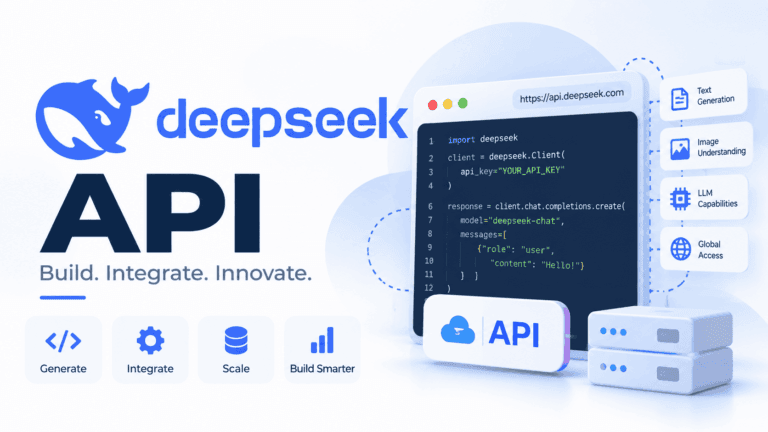
Start with the DeepSeek API guide for setup, current model IDs, pricing, Responses API support, runnable code examples, and dated live verification. Then use the specialist guides below for SDKs, features, integrations, testing, and production operations.

Choose a Developer Path

SDKs and direct clients

Model features

  • Thinking mode explains effort controls, reasoning content, streaming, tool-call history, and token budgets.
  • JSON output covers response formatting, validation, truncation, and empty-content handling.
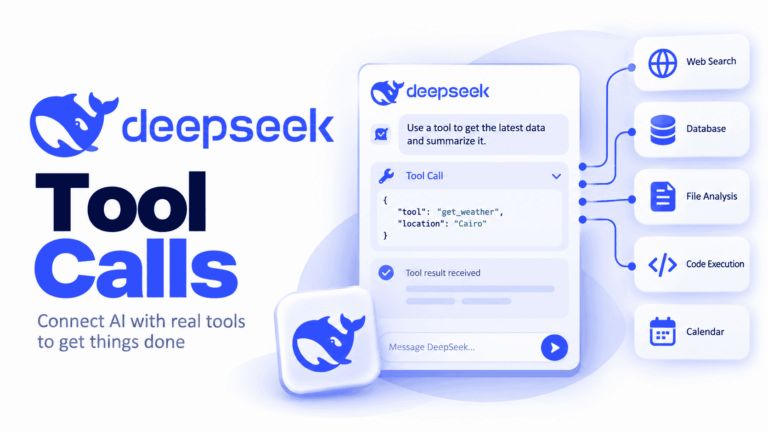
  • Tool calls and function calling covers tool definitions, argument validation, multiple calls, and execution safety.
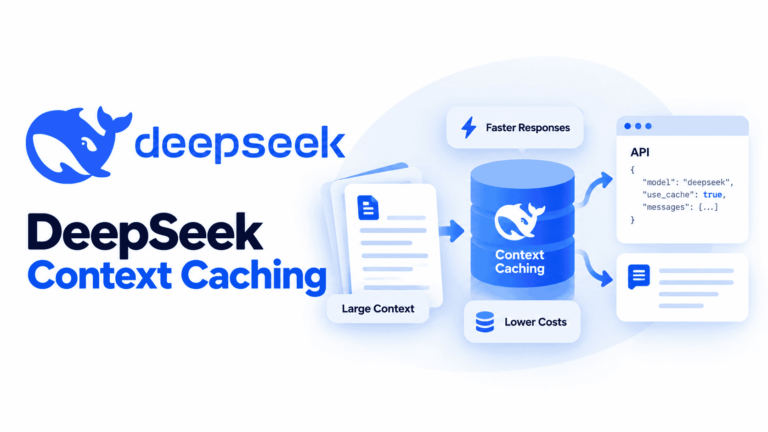
  • Context caching explains repeated prefixes, cache-hit fields, cost interpretation, and isolation.

Testing and production operations

How These Guides Are Verified

The guides prioritize first-party documentation and distinguish documented behavior from dated, account-specific observations. When a page includes original testing, credentials, balances, identifiers, and sensitive response data are removed or masked. A successful example demonstrates the tested request under stated conditions; it does not guarantee future availability, identical latency, or the same account limits.

Keep API keys on trusted servers, validate model output and tool arguments, control retries and spending, and test against your own requirements before deployment. Chat-Deep.ai is independent and is not affiliated with or endorsed by DeepSeek.

DeepSeek finish_reason Values and Troubleshooting

DeepSeek finish_reason

DeepSeek finish_reason tells an application why a Chat Completions response stopped and what it should do next. The official OpenAI-compatible API documents five terminal values: stop, length, content_filter, tool_calls,…

DeepSeek V4 Context and Output Limits: A Token Planning Guide

DeepSeek V4 Context

DeepSeek’s three current hosted V4 model IDs—deepseek-v4-flash, deepseek-v4-pro, and the experimental multimodal deepseek-v4-flash-vision-exp—each list a 1,000,000-token context length and a 384,000-token maximum output. Prompt and generated completion share that…

Does the DeepSeek API Support Images and Vision Input?

DeepSeek vision API

The DeepSeek API now accepts image input through the experimental deepseek-v4-flash-vision-exp model. It can analyze screenshots, charts, photographs, scanned pages, and other supported images supplied by public URL, Base64…

Does the DeepSeek API Support File Uploads?

DeepSeek API Support File Uploads

The DeepSeek Files API is now live for image uploads. You can upload JPEG, PNG, GIF, or WebP, receive a reusable file_id, and reference it with the experimental deepseek-v4-flash-vision-exp…

How to Read DeepSeek Token Usage and Cache Fields

Comparison of DeepSeek token usage fields across Chat Completions, Responses, Anthropic-compatible messages, and Vision Exp image inputs.

DeepSeek token usage is returned in different field shapes across Chat Completions, the Responses API, and the Anthropic-compatible Messages API. This guide separates those contracts, shows how automatic context-cache…

DeepSeek LlamaIndex Integration: Python RAG Setup

DeepSeek LlamaIndex integration architecture from documents and application input through indexing, retrieval, response synthesis, and the DeepSeek API boundary

Current package and provider review: August 24, 2026. A current DeepSeek LlamaIndex integration uses the Python package llama-index-llms-deepseek and the class DeepSeek. Keep DEEPSEEK_API_KEY on the server, use an…

DeepSeek API Guide: Setup, V4 Models and Working Examples

DeepSeek API Docs

The DeepSeek API uses the OpenAI-compatible base URL Its current V4 API catalog has three IDs: text-only deepseek-v4-flash and deepseek-v4-pro, plus the experimental multimodal deepseek-v4-flash-vision-exp for image understanding.…

Privacy and cookie settings