Category Docs

DeepSeek API Token Usage Explained
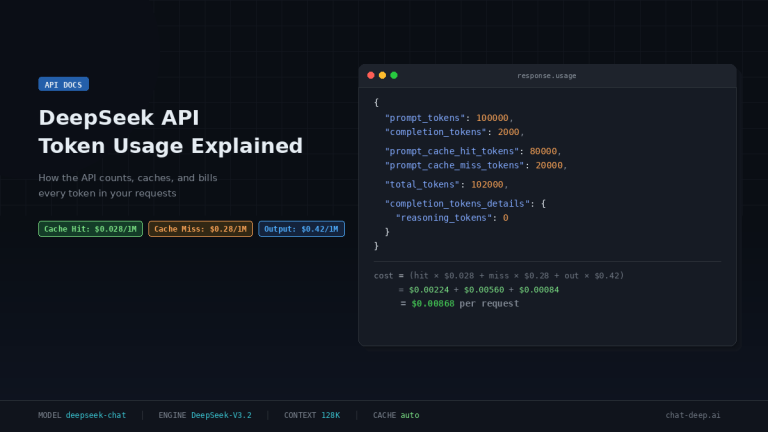
DeepSeek API Token Usage Explained — How the API counts, caches, and bills every token in your requests

DeepSeek token usage refers to the actual input and output tokens recorded by the API for each request, and these values are the only source of truth for billing. Unlike rough character-based estimates, real cost is calculated directly from the…
DeepSeek Tool Calls Guide

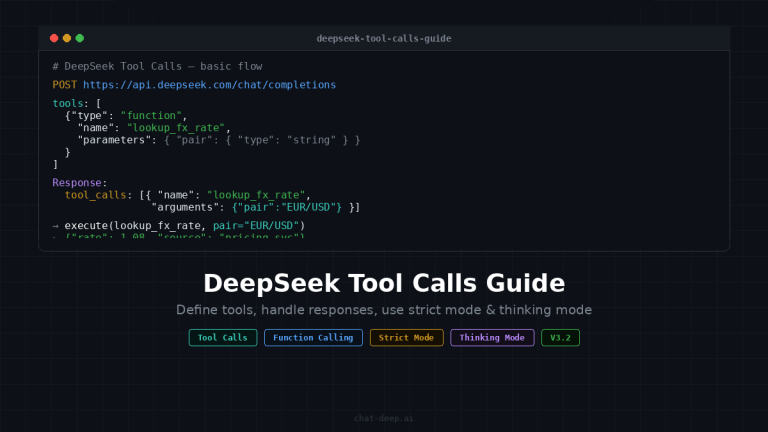
DeepSeek Tool Calls Guide — terminal showing tool definition, API response with tool_calls, and function execution flow

Quick answer: DeepSeek Tool Calls let the model request external functions during a chat workflow, but your application executes them. As of April 5, 2026, both deepseek-chat and deepseek-reasoner support Tool Calls on DeepSeek-V3.2 with a 128K context window. In…

DeepSeek Context Caching Explained

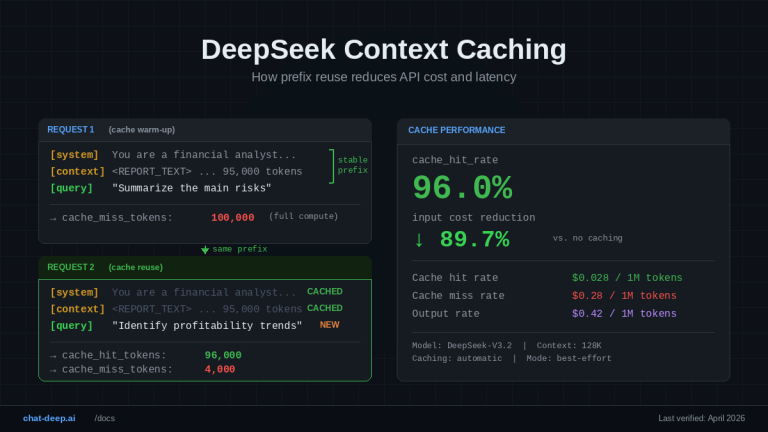
DeepSeek Context Caching Explained — How prefix reuse reduces API cost and latency

DeepSeek Context Caching is a built-in API feature that automatically reuses repeated prompt prefixes across requests. It does not store memory or conversations. Instead, it reduces input cost and latency when you resend the same front-loaded context. Last verified: April…

DeepSeek Thinking Mode

Last verified: April 4, 2026 DeepSeek Thinking Mode is not just a prompt style. In the current API, it is a distinct execution mode that changes output structure, feature support, and some parameter behavior. You can enable it either by…

DeepSeek API Guide

DeepSeek API Guide

Quickstart (5–10 Minutes) The DeepSeek API is largely compatible with OpenAI’s API format. This means you can use familiar tools and libraries (like OpenAI’s SDK) by pointing them to DeepSeek’s endpoints. To get started, you will need to obtain an…