
DeepSeek vs Meta AI is really two comparisons. As consumer assistants, both can answer questions, reason, search, and work with files. As platforms, they are very different: DeepSeek offers GA, public-beta, and experimental V4 API routes plus open weights, while the current Meta AI Thinking experience is powered by Muse Spark 1.1 and Meta’s separate Meta Model API is in public preview for US developers.
Quick verdict: Meta AI produced the more reliable results in our July 28, 2026 consumer-interface tests. It answered both structured-reasoning runs correctly, calculated every requested CSV value correctly, and found the DeepSeek API prices that were current on the test date from official sources. DeepSeek Expert matched Meta on the reasoning task, but DeepSeek Instant made a decision error, miscalculated one CSV total, and returned retired model IDs during a search-enabled current-information test. DeepSeek remains the stronger choice for developers who need a public, transparently priced API, OpenAI and Anthropic compatibility, or open weights.
Current developer boundary: Meta Model API is now a public preview for US developers, but it was not the surface tested below. DeepSeek remains the more mature comparison point here for GA access and published token pricing.
Tested and fact-checked on July 28, 2026. We used signed-in web accounts, clean conversations, identical English prompts, and synthetic data. Availability can vary by account, country, device, and rollout.
Current Meta and DeepSeek documentation was rechecked August 24, 2026; no consumer test was rerun. All July 28 prompts, screenshots, scores, and then-applicable prices remain historical evidence.
DeepSeek vs Meta AI: The Short Answer
| Need | Better fit | Why |
|---|---|---|
| Reliable answers in our tested consumer workflows | Meta AI | It was correct on both reasoning modes, the CSV calculation, and the July 28 price lookup. |
| Harder reasoning in DeepSeek Chat | DeepSeek Expert | Expert corrected a decision that Instant got wrong on the same source pack. |
| Public API with transparent token prices | DeepSeek | V4 Flash, V4 Pro, and experimental Vision Exp are publicly documented through the DeepSeek API. |
| Open-weight deployment | DeepSeek | DeepSeek publishes V4 weights. Meta AI itself is a hosted assistant; Meta’s separate Llama family is the relevant open-weight comparison. |
| Meta apps, personalization, voice, and image workflows | Meta AI | The product is built around Meta’s consumer ecosystem and multimodal assistant experience. |
| Sensitive or regulated information | Neither consumer chat by default | Use only an approved product, retention policy, processing region, and contract for the data involved. |
What We Actually Compared
A fair comparison must keep three layers separate:
- Consumer assistants: the signed-in DeepSeek Chat website versus the signed-in Meta AI website.
- Developer access: DeepSeek’s public V4 API versus Meta’s separate Meta Model API. Meta now labels that API a public preview for US developers, but it was not the July 28 test surface and no direct API benchmark was run.
- Open weights: DeepSeek V4 versus Meta’s Llama model family. Meta AI is not interchangeable with Llama, so readers interested in that layer should see our DeepSeek vs Llama comparison.
We did not infer a hidden model version from branding or marketing. The tested July 28 Meta interface displayed Instant and Thinking. Meta’s July 9 announcement says the current Meta AI Thinking mode uses Muse Spark 1.1. The tested DeepSeek interface displayed Instant, Expert, and Vision; current API labels and consumer UI labels remain separate evidence.
Test Methodology
We ran three reproducible tasks from clean chats:
- Structured reasoning: select a vendor from a fixed source pack and return an exact JSON structure.
- File analysis: calculate totals and a cost-efficiency winner from the same attached synthetic CSV.
- Current-information search: identify current DeepSeek API model IDs and prices, using only official DeepSeek sources.
Every prompt and fixture was in English and contained no personal, confidential, or production data. We scored factual correctness, requested-format compliance, and source relevance. Each result is one observed web-interface run, not a statistically significant model benchmark. Network conditions, server load, account flags, and product updates can change the result. We recorded elapsed time for operational notes, but we do not use one run to claim that either product is universally faster.
| Test | Meta AI result | DeepSeek result | Observed edge |
|---|---|---|---|
| Structured reasoning | Instant and Thinking both correct; exact JSON | Instant incorrect; Expert correct; both returned JSON | Meta AI across tested modes |
| Synthetic CSV | All requested values correct | Three of four top-level results correct; conversion total wrong | Meta AI |
| Models and prices current on July 28 | Then-current IDs and all four then-applicable prices correct; official links supplied | Retired IDs and stale Pro prices; official link supplied | Meta AI |
Test 1: Structured Reasoning and Exact JSON
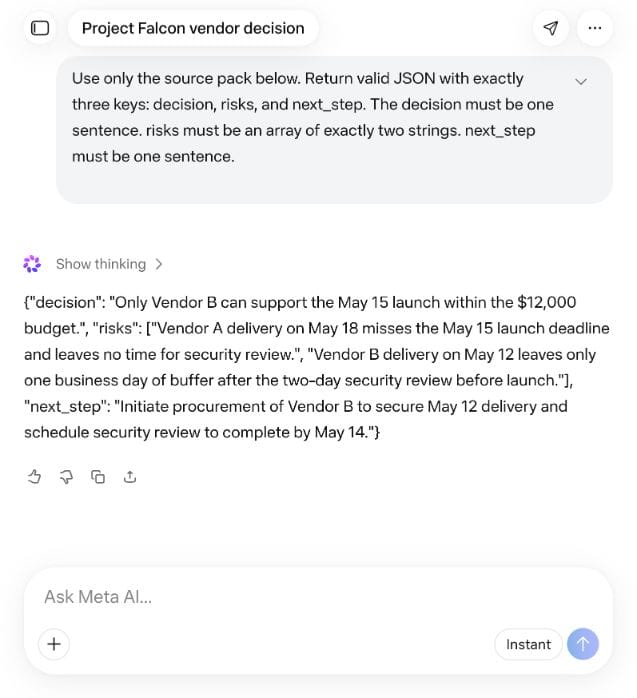
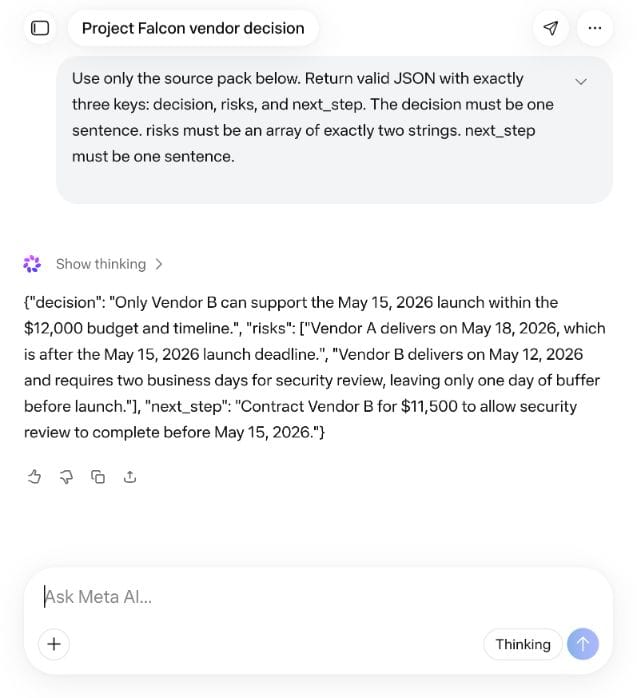
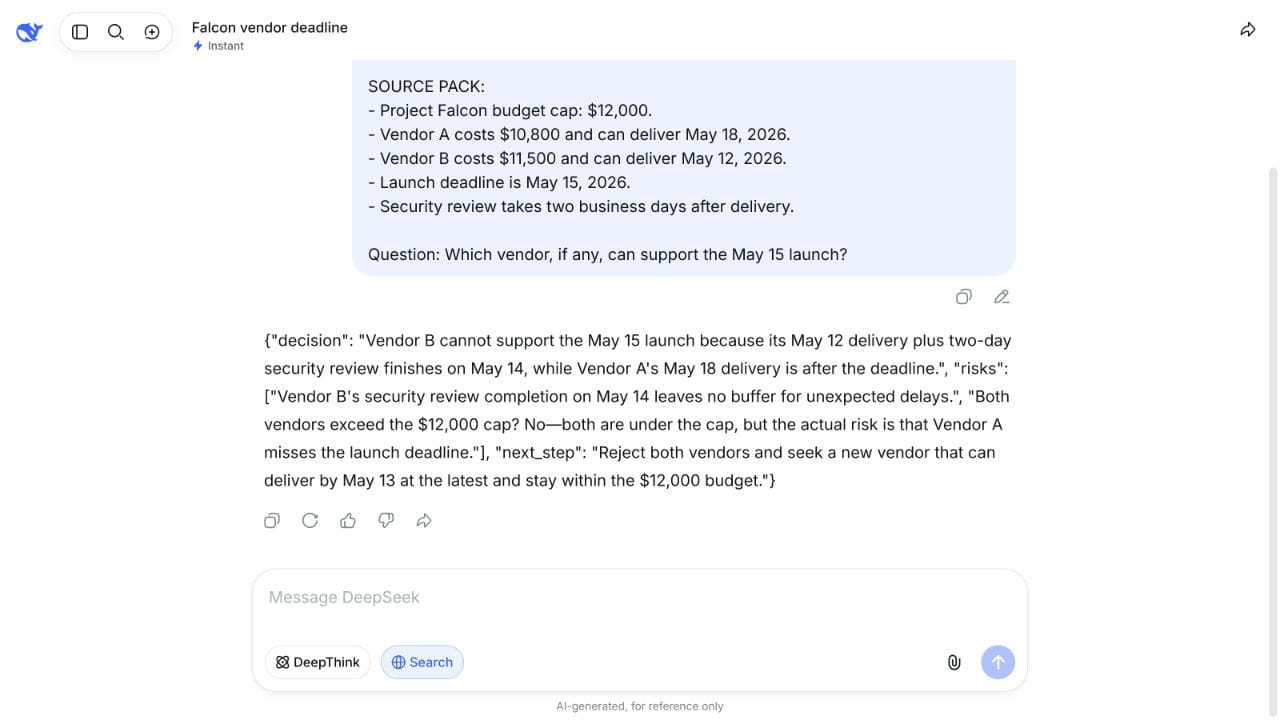
The source pack gave two vendors, a $12,000 budget cap, a May 15 launch deadline, and a two-business-day security review after delivery. Vendor A would arrive after launch. Vendor B would arrive on May 12, leaving two business days for review before May 15. The correct decision was therefore Vendor B.
Use only the source pack below. Return valid JSON with exactly three keys: decision, risks, and next_step. The decision must be one sentence. risks must be an array of exactly two strings. next_step must be one sentence.
| Service and mode | Decision | Valid requested JSON | Result |
|---|---|---|---|
| Meta AI Instant | Vendor B | Yes | Pass |
| Meta AI Thinking | Vendor B | Yes | Pass |
| DeepSeek Instant | Rejected the viable vendor | Yes | Fail on correctness |
| DeepSeek Expert | Vendor B | Yes | Pass |
Meta AI Instant returned the correct decision
Meta AI Thinking also passed
DeepSeek Instant followed the format but made the wrong decision
DeepSeek Expert corrected the reasoning error
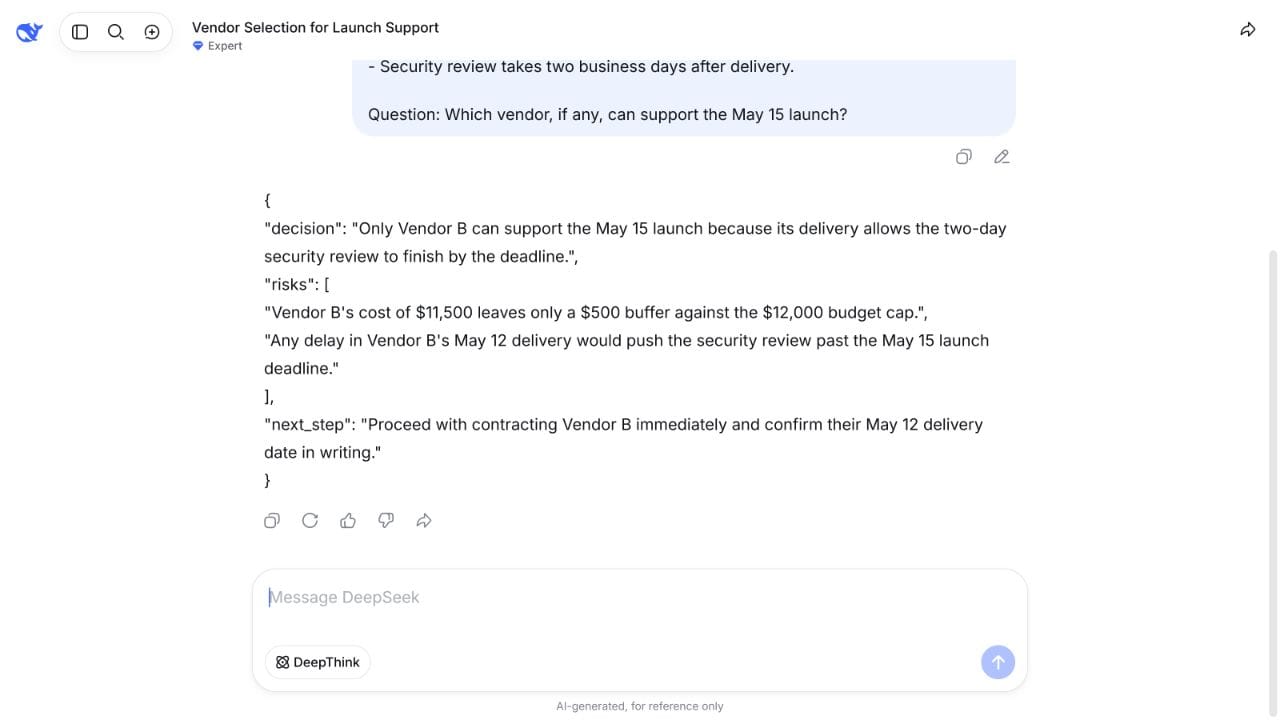
What this means: mode selection mattered more than brand in this task. DeepSeek Expert and both Meta modes reached the correct conclusion. DeepSeek Instant showed why valid JSON should not be mistaken for valid reasoning. For consequential work, validate the facts inside a structured answer instead of checking syntax alone. Our DeepSeek JSON output guide explains the production side of that distinction.
Test 2: CSV and File Analysis
We attached the same four-row CSV to both products. It contained leads, conversion rates, and monthly cost for Search, Social, Email, and Partners. The expected results were:
| Metric | Expected value |
|---|---|
| Total leads | 620 |
| Total expected conversions | 50 |
| Total monthly cost | $7,800 |
| Lowest cost per expected conversion | Email at $60.00 |
The prompt required valid JSON with exactly four top-level keys. Meta AI Thinking returned every expected value. DeepSeek Instant accepted the file and correctly identified Email at $60, but reported total expected conversions as 54.5 instead of 50. On the tested DeepSeek web interface, file attachment was visible in Instant but not after selecting Expert, so this was an interface-available-mode comparison rather than an Expert-versus-Thinking model claim.
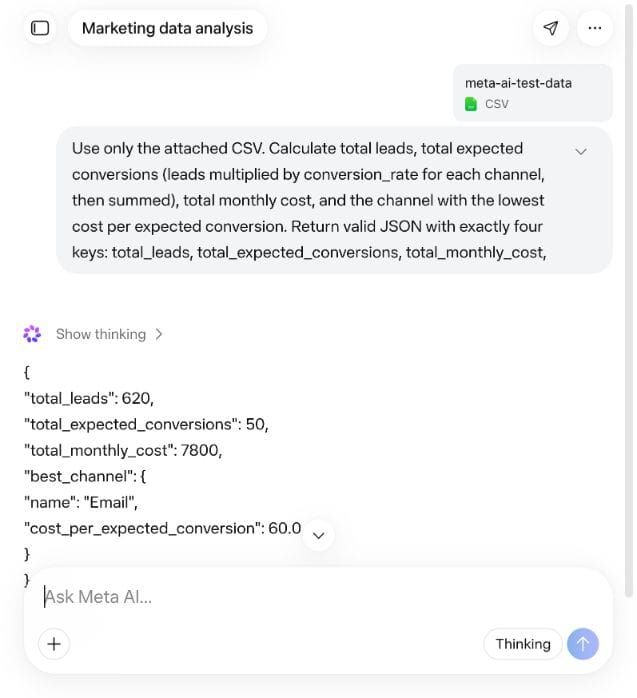
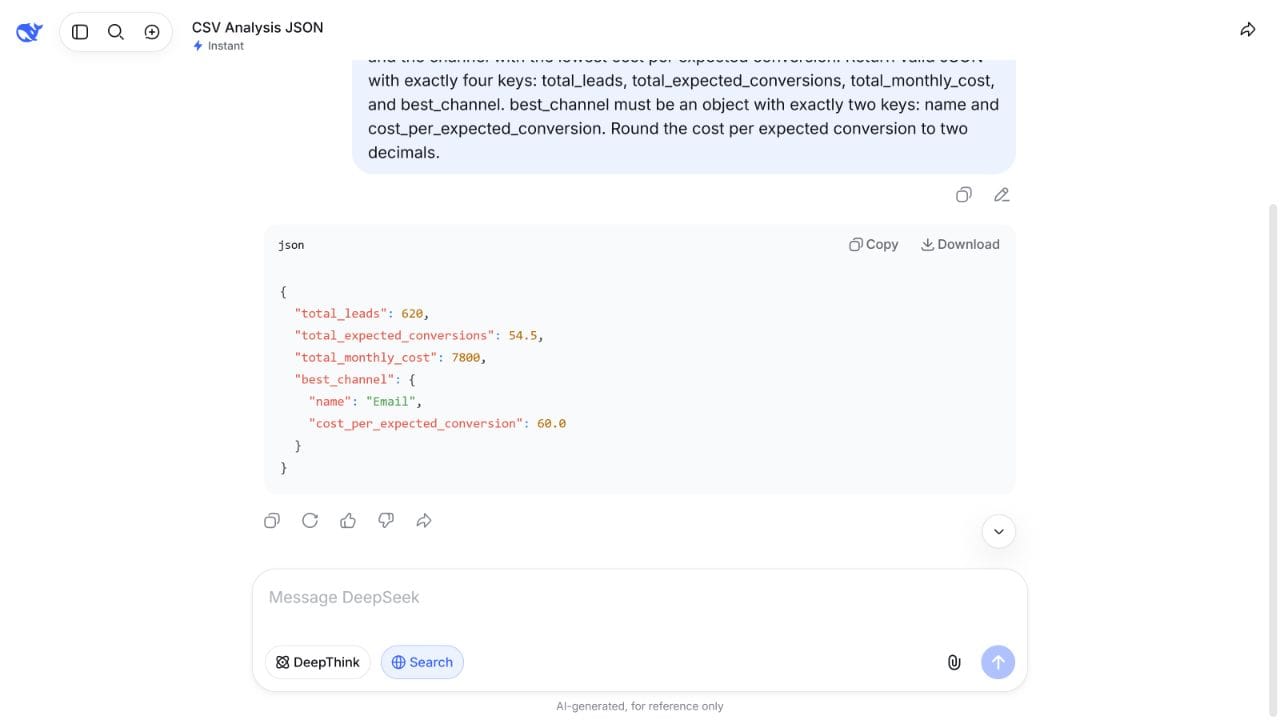
What this means: Meta AI was more reliable on this small spreadsheet-style task. The practical lesson is broader than the winner: recalculate totals outside the assistant before using them in a budget, forecast, or report. A polished JSON response can still contain one incorrect aggregate.
Test 3: Web Search, Freshness, and Official Sources
For the freshness test, we asked both products—on July 28—to find the two DeepSeek API model IDs that were current that day and their then-applicable cache-miss input and output prices per one million tokens. The prompt required live web search, a compact table, clickable links, and only official api-docs.deepseek.com sources. Vision Exp had not yet been released, so it is correctly absent from this historical test.
| Official value on July 28, 2026 — historical | DeepSeek V4 Flash | DeepSeek V4 Pro |
|---|---|---|
| API model ID | deepseek-v4-flash | deepseek-v4-pro |
| Cache-miss input / 1M tokens | $0.14 | $0.435 |
| Output / 1M tokens | $0.28 | $0.87 |
Meta AI Thinking returned both then-current IDs and all four prices applicable on July 28 correctly. Its links resolved through Meta’s redirect service to DeepSeek’s official pricing and change-log pages. It did make one temporal wording mistake: although the test date was four days after July 24, it described the legacy aliases as if their announced retirement were still in the future.
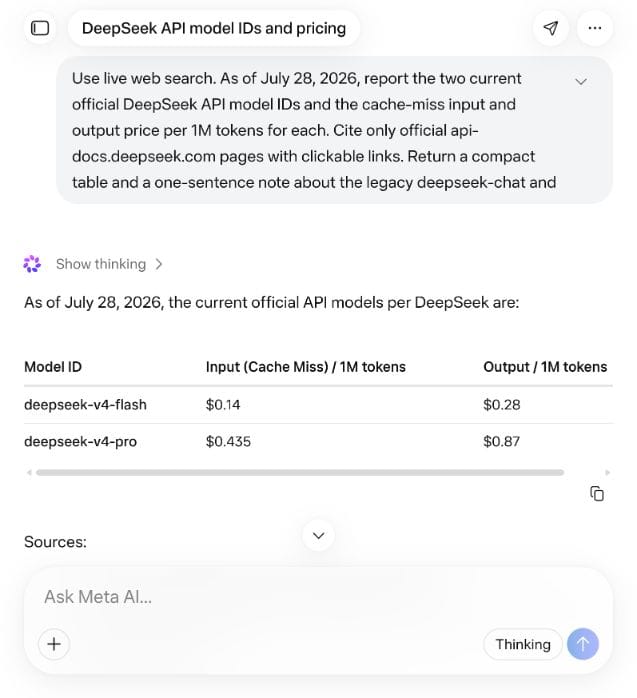
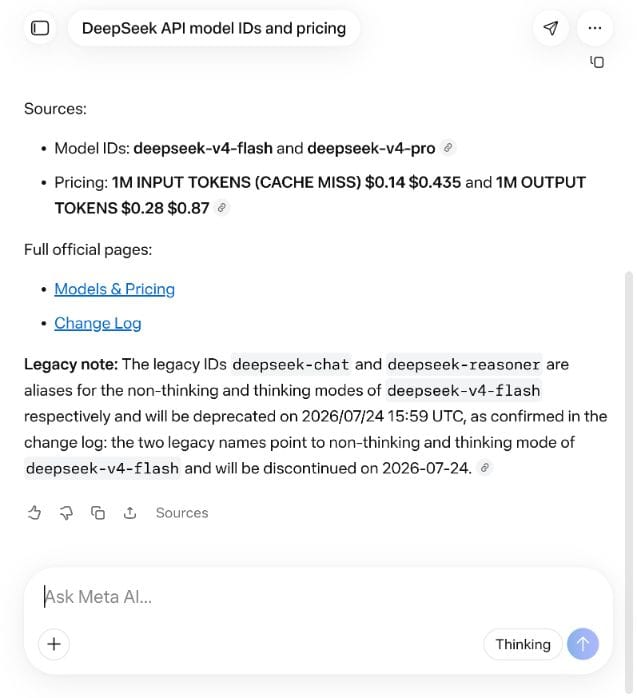
DeepSeek Instant had Search visibly enabled, yet said it could not perform a live search. It returned deepseek-chat and deepseek-reasoner as the current IDs, used stale Reasoner prices, and reversed the legacy relationship. It did at least provide a direct link to the correct official pricing page.
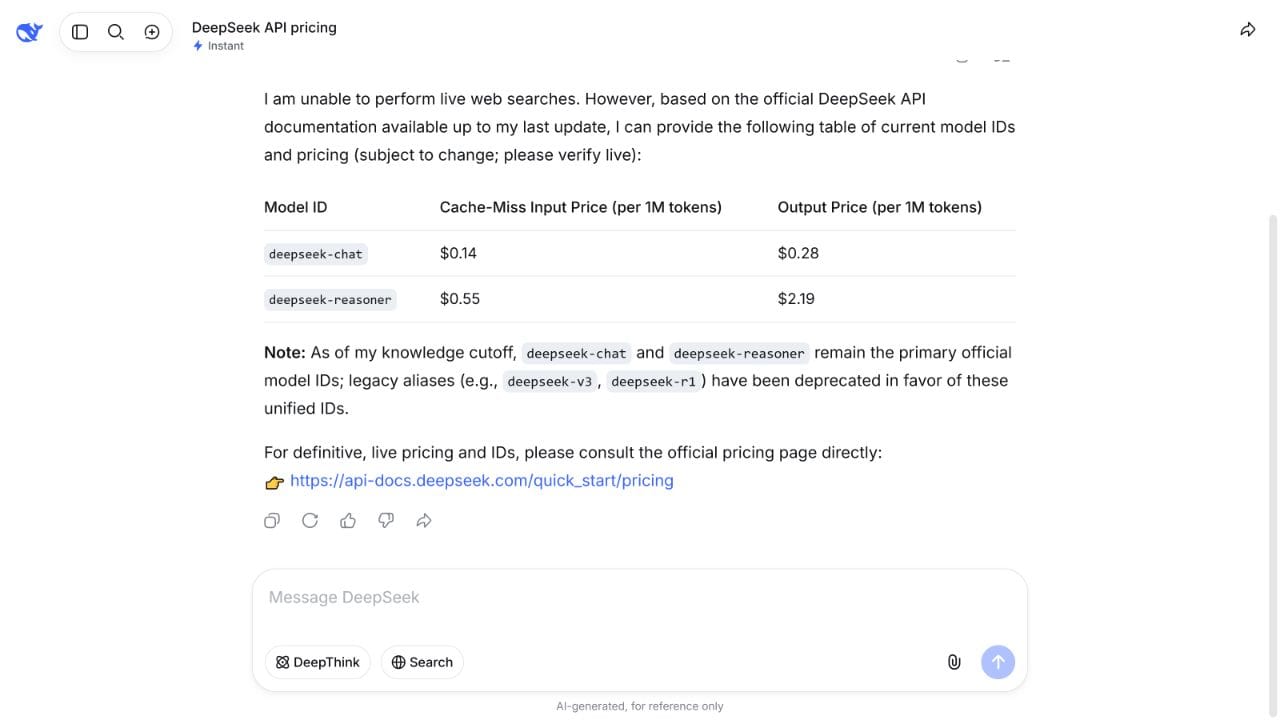
What this means: Meta AI won this particular research task, but neither answer was flawless. Current-information work needs a second step: open every cited page, confirm that it supports the claim, and compare the date in the answer with the date of the event. Never assume that a clickable official link proves the text beside it.
DeepSeek and Meta AI Features Compared
Historical account snapshot: the first table preserves the July 28 feature wording and observations. The second table supplies the current developer-layer update.
| Area | DeepSeek | Meta AI |
|---|---|---|
| Tested web modes | Instant, Expert, Vision; DeepThink and Search controls were visible where supported | Instant and Thinking |
| Model layer recorded for the July 28 test | V4 Flash for Instant; V4 Pro for Expert | Muse Spark powered the tested Meta AI experience |
| Files in our account | CSV attachment visible in Instant; not visible after selecting Expert | CSV attachment accepted in Thinking |
| Web search | Search control visible, but our test returned stale information | Used then-current official pages in our test |
| Images | Vision was a distinct mode in the tested interface | Image creation and editing were core consumer features |
| Voice and social context | Not the product’s central advantage | Stronger integration with Meta’s apps, content, and devices; availability varied |
| Public API | Yes, with the model IDs and prices published on the test date | Muse Spark API was a private preview for selected partners at that update |
| Open weights | V4 weights published | Meta AI is hosted; Meta separately publishes Llama models |
| Advertised context | 1M tokens for both API models current on July 28 | Do not treat model-layer context as the consumer website’s guaranteed upload limit |
| Current developer fact — August 24, 2026 | DeepSeek | Meta |
|---|---|---|
| Model/API status | V4-Flash-0731 public beta; V4-Pro-0813 GA; experimental V4-Flash-Vision-Exp; Responses supports all three current IDs | Muse Spark 1.1; Meta Model API public preview for US developers |
| Input modality | Flash and Pro are text-only; Vision Exp understands supported images and returns text | Verify the exact consumer or preview-API surface |
| Web search | Responses lists server-side web_search at the endpoint/tool level; reviewed examples use Flash/Pro rather than a Vision-specific example; Chat Completions has no hosted-search tool | Web-search grounding announced for the preview API |
| Structured output | Chat json_object; Responses json_schema | Verify the public-preview contract |
| Evidence on this page | Consumer tests plus separate DeepSeek API documentation | Consumer tests only; no Meta Model API benchmark |
Feature availability is not a permanent global checklist. Meta explicitly rolls some voice, memory, app, camera, and Incognito capabilities out by market or surface. DeepSeek also changes which controls appear by mode. The table records what was visible in our supplied accounts and separates that evidence from vendor announcements.
Which Is Better for Coding and Technical Work?
DeepSeek is the more mature technical platform in this comparison, but that is not the same as proving that every DeepSeek answer beats every Meta AI answer. Developers can call text-only V4 Flash or V4 Pro, or experimental Vision Exp for supported image-understanding tasks, through Chat Completions or the stateless Responses API. Responses lists server-side web_search at the endpoint/tool level and supports json_schema; the reviewed search examples use Flash/Pro rather than a Vision-specific example. Developers can also use DeepSeek’s Anthropic-compatible endpoint, inspect token prices, and deploy published weights under the applicable license. Start with our DeepSeek API documentation guide, current DeepSeek models page, and DeepSeek pricing guide.
Meta AI remains a consumer-assistant comparison here, not a tested coding backend. Meta Model API is now in public preview for US developers with an OpenAI-compatible developer experience, free credits, and web-search grounding, but this page has no authenticated Meta API output, latency, token, or price comparison. Meta’s open-weight Llama models are another separate decision.
For coding inside a chat window, use the same discipline with either product: provide a minimal reproduction, require executable tests, run the code in an isolated environment, and review security-sensitive changes manually. A model’s marketing benchmark cannot replace tests in your repository.
API Access, Open Weights, and Pricing
DeepSeek has the clearer developer proposition. The table below separates the two historical rows needed to audit the July 28 test from the current peak/off-peak schedule verified August 24:
| DeepSeek model and effective period | Cache-hit input | Cache-miss input | Output |
|---|---|---|---|
| Historical Flash — through Aug 16, 15:59 UTC | $0.0028 | $0.14 | $0.28 |
| Historical Pro — through Aug 16, 15:59 UTC | $0.003625 | $0.435 | $0.87 |
| Current Flash — off-peak | $0.007 | $0.22 | $0.66 |
| Current Vision Exp — off-peak | $0.007 | $0.22 | $0.66 |
| Current Pro — off-peak | $0.022 | $0.66 | $1.98 |
| Current Flash — peak | $0.014 | $0.44 | $1.32 |
| Current Vision Exp — peak | $0.014 | $0.44 | $1.32 |
| Current Pro — peak | $0.044 | $1.32 | $3.96 |
DeepSeek announced that deepseek-chat and deepseek-reasoner would become inaccessible after July 24, 2026. In a separate authenticated API check on July 28, both aliases still returned HTTP 200 and identified the serving model as V4 Flash. Treat that as transitional observed behavior—not a supported contract. New code should use deepseek-v4-flash or deepseek-v4-pro for text, or deepseek-v4-flash-vision-exp for supported experimental image understanding, and production systems should discover available IDs through GET /models.
Meta’s July 9 announcement moved the Meta Model API to public preview for US developers. Public preview is not GA, and this article has no matched Meta API billing or performance evidence, so it does not assign a fictional per-token winner. DeepSeek remains the clearer production benchmark here because it publishes model IDs, status, and a complete token schedule.
Privacy and Data Use
Neither standard consumer chat should be treated as a confidential workspace by default.
- Meta AI: Meta says interactions may be used to improve its AI. It also says that, in most regions, interactions with its AI can inform content and ad recommendations across linked accounts, subject to stated exclusions for certain sensitive topics. Incognito is a separate feature announced for specific surfaces and should not be assumed on the meta.ai website unless the account visibly offers it.
- DeepSeek: its privacy policy says it may collect prompts, uploaded files and photos, feedback, and chat history; use data to improve services and models; process and store personal information in the People’s Republic of China; and send search terms to third-party search APIs when relevant. It also describes available choices and an opt-out process for model improvement.
Before uploading business files, check the exact account controls and current policy for the surface you are using. Remove personal identifiers, secrets, client data, source credentials, and regulated information. For enterprise use, require an approved data-processing agreement and independently verified retention and regional-processing terms.
When to Choose DeepSeek
- You need a public API today with documented model IDs and token pricing.
- You want OpenAI- or Anthropic-compatible integration paths.
- You need open weights for controlled deployment or research.
- You are building coding, agent, or long-context workflows and can validate outputs with tests.
- You prefer a dedicated model platform over an assistant tied to a social ecosystem.
If you are new to the consumer product, begin with how to use DeepSeek Chat. For controlled deployment, see how to run DeepSeek locally.
When to Choose Meta AI
- You want the stronger performer in the specific consumer tests documented on this page.
- You already use Meta’s apps and want an assistant connected to that ecosystem.
- You prioritize voice, image creation and editing, recommendations, or consumer planning workflows.
- You want current web research with visible sources and will still verify dates and claims manually.
- You are a US developer prepared to evaluate the separate Meta Model API public preview without treating it as GA or as the tested consumer surface.
Final Verdict
Meta AI is the better consumer assistant based on this limited, reproducible July 2026 test set. It was correct across both of its tested reasoning modes, perfect on the CSV calculation, and substantially fresher in the official-source search task. Its one notable research error was temporal wording around a retirement date that had already passed.
DeepSeek is the better developer platform. Its public V4 API, transparent prices, compatibility layers, and open weights solve a different problem that Meta AI’s hosted consumer experience does not currently match. Inside DeepSeek Chat, Expert was materially more reliable than Instant on our reasoning fixture, so use the stronger mode when correctness matters and verify all calculations and current facts outside the model.
Current boundary: Meta Model API is now a relevant public-preview option for US developers, but it was not benchmarked here and should not be read into the consumer result.
The most accurate answer to “DeepSeek or Meta AI?” is therefore: choose Meta AI for the tested everyday assistant workflows; choose DeepSeek for building, integrating, or deploying models. Do not let either choice remove human verification from high-impact work.
Frequently Asked Questions
Is Meta AI better than DeepSeek?
Meta AI was better in our July 28, 2026 consumer-interface tests: both reasoning modes were correct, its CSV totals were correct, and its search result used current official model IDs and prices. DeepSeek remains better suited to public API, open-weight, and self-managed developer workflows.
Which is better for reasoning, DeepSeek or Meta AI?
Meta AI Instant, Meta AI Thinking, and DeepSeek Expert all passed our structured decision task. DeepSeek Instant failed the decision while preserving the requested JSON format. One prompt cannot establish a universal reasoning ranking, but it shows that the selected mode can change reliability.
Which is better for files and PDFs?
Meta AI was more accurate on our attached CSV: it returned all expected values, while DeepSeek Instant miscalculated one total. File types, size limits, OCR quality, and mode availability can differ, so test the exact document and account. Never upload confidential files without an approved data policy.
Does Meta AI have a public API?
Meta’s current announcement describes Meta Model API as a public preview for US developers, powered by Muse Spark 1.1 with an OpenAI-compatible developer experience and web-search grounding. It is not the same surface as Meta AI consumer chat, is not GA, and was not tested here. Do not confuse it with Meta’s separate Llama open-weight models or invent unlisted pricing.
Is DeepSeek cheaper than Meta AI?
DeepSeek publishes a complete time-dependent token schedule, so its costs can be calculated directly; Vision Exp currently matches Flash pricing. Meta Model API is in public preview for US developers, but this page has no matched Meta API price or usage evidence. Consumer chat pricing, preview API terms, production API pricing, and the infrastructure cost of running open weights are separate calculations.
Is Meta AI private?
Do not assume a standard Meta AI chat is private. Meta describes data use for AI improvement and, in most regions, personalization across its products. Incognito is a distinct mode with limited surface availability. Read the current policy and confirm the control visible in your account.
Is DeepSeek open source?
DeepSeek publishes model weights and technical material, including V4 releases, but “open source” can hide important license and deployment details. Review the license for the exact repository, model, and intended commercial use before deployment.
Primary Sources
- Meta: Muse Spark 1.1 and Meta Model API public preview
- Meta: Original Muse Spark announcement
- Meta: Introducing the Meta AI app
- Meta: Building a more personalized assistant
- Meta: AI interactions and recommendations
- Meta Privacy Center: generative AI
- DeepSeek: API updates
- DeepSeek: current models and API pricing
- DeepSeek: Vision model and image-input contract
- DeepSeek: Responses API
- DeepSeek: list models endpoint
- DeepSeek privacy policy
Update Log and Limitations
July 28, 2026: Rebuilt the comparison after live signed-in tests of Meta AI Instant, Meta AI Thinking, DeepSeek Instant, and DeepSeek Expert. Added original structured-reasoning, CSV, and official-source search evidence; the V4 model IDs and prices current on that date; the Muse Spark correction; privacy qualifications; and a clean separation between consumer assistants, APIs, and open weights.
August 14, 2026: Updated only the then-current layer for Muse Spark 1.1, Meta Model API public preview in the US, DeepSeek Pro-0813 GA, Responses on both models then current, endpoint-specific search/structured output, and the August 16 price cutover. July 28 tests and outcomes remained unchanged.
August 24, 2026: Added the experimental Vision Exp model, its Flash-matched pricing, the weekday-only peak schedule, and explicit historical labels around the July 28 screenshots and prices. No consumer test, score, or verdict was changed.
Limitations: the results are single runs on supplied web accounts, not repeated statistical trials. We did not benchmark a Muse Spark API because general public access was not available. We did not use private data, paid third-party benchmark suites, or hidden system information. Screenshots show synthetic prompts and exclude account identity.
The later Meta Model API public preview does not retroactively create API evidence for this test.