
Pricing snapshot notice: Historical results and costs on this page are frozen to the price snapshot used at test time and have not been recalculated. Traffic billed from onward uses DeepSeek’s current peak/off-peak schedule. Check our DeepSeek pricing guide and API cost calculator before estimating new traffic.
For independently retryable DeepSeek batch processing on the official api.deepseek.com service, the practical pattern is still an application-owned queue. We found no documented native asynchronous Batch API in the official materials re-reviewed on August 22, 2026. DeepSeek now has a real Files API, but it stores supported images for deepseek-v4-flash-vision-exp; it does not submit batch jobs, accept PDF or DOCX inputs, or return provider-managed batch results. Queued generation remains a collection of separately dispatched and separately billable model requests.
We tested that alternative with a privacy-safe synthetic workload. The benchmark ran the same four jobs sequentially and with a concurrency cap of three, recorded dispatch and completion order, captured provider-reported token usage, and calculated cost from DeepSeek’s dated V4 Flash prices. It also ran a separate controlled local pre-dispatch retry probe without mislabeling the simulation as a real DeepSeek outage.
This is an independent technical test. Chat-Deep.ai is not affiliated with DeepSeek. The temporary credential was kept out of the saved evidence and revoked after the run. No customer data, personal information, production prompt, or account balance appears in this article.
Key takeaways
- No native asynchronous Batch endpoint, batch-job lifecycle, or batch-specific price was found in the official DeepSeek materials re-reviewed on August 22, 2026.
POST /filesis now official, but it is an image-only asset store for Vision Exp—not a Batch API. Its documented formats are JPEG, PNG, GIF, and WebP; PDF and DOCX are not supported.- A local queue can safely cap concurrency, persist job state, restore input order, classify retries, and measure every ordinary Chat Completion.
- The live benchmark compared one worker with three workers over the same harmless job set; exact results are reported below after evidence validation.
- The injected retry happened before provider dispatch. It tested queue logic and did not represent a real DeepSeek 429, 500, or 503 response.
- Concurrent requests can finish out of input order. Correlate results by a stable job ID, not by completion position.
- Application deduplication can guarantee one stored result, but it cannot prove exactly one provider execution when a network outcome is unknown.
- DeepSeek publishes account-level concurrency limits, regardless of API-key count. Those ceilings are not recommended worker defaults.
- Token cost comes from returned cache-hit input, cache-miss input, and output usage. Concurrency changes wall time, not the per-token price.
On this page
- DeepSeek Batch API status
- What
/filesdoes—and does not do - Native Batch API vs a local queue
- Live DeepSeek batch processing benchmark
- Retry experiment
- Production queue architecture
- Context caching
- Security and multi-tenant controls
- Production monitoring
- Frequently asked questions
Quick answer: Does DeepSeek have a Batch API?
No native asynchronous Batch API is documented for the official DeepSeek host in the public materials we re-reviewed on August 22, 2026.
The current documentation does include image file operations—POST /files, GET /files, GET /files/{file_id}, and DELETE /files/{file_id}. We still found no POST /batches, batch status lookup, batch cancellation operation, provider-generated batch result file, completion-window field, or batch-specific price. A Files API and a Batch API solve different problems.
That is a dated documentation finding, not a permanent prediction. DeepSeek could add a Batch resource later, a third-party gateway could build one, and self-hosted infrastructure can implement its own server-side batching. For the official hosted API today, the defensible pattern is:
persist jobs locally
  -> lease jobs to workers
  -> cap account-wide concurrency
  -> send ordinary Chat Completions or Responses requests
  -> store usage and results by job ID
  -> retry only classified transient failures
  -> dead-letter exhausted work
Do not copy a guessed /batch, /batches, or /async route into production. The real /files route must be used only according to its documented image-file contract. An SDK method such as client.batches.create() proves that the client library contains that method; it does not prove that the configured DeepSeek server implements the corresponding resource.
What DeepSeek /files does—and does not do
DeepSeek launched the Files API with V4 Flash Vision Exp on August 21, 2026. It lets an application upload an image once, receive a file_id, and reuse that image in later Vision requests. Uploads use multipart/form-data with purpose="user_data".
Provider-managed Batch
Not documented
- No
POST /batchescontract - No job polling or cancellation
- No batch result-file workflow
- No batch-specific price
Files API
Images only—not batch
POST /fileswithpurpose=user_data- JPEG, PNG, GIF, and WebP
- Reusable
file_idfor Vision Exp - No PDF, DOCX, or JSONL
Application-owned queue
Runs ordinary API calls
- Persist one job per request
- Use Chat Completions or Responses
- Bound account-wide concurrency
- Retry and correlate by stable job ID
A single Files API image may be up to 64 MiB and must finish uploading within 10 minutes. The documented optional expiry is 1 hour to 30 days; omitting expires_after keeps the image permanently, subject to the account’s file-storage limits.
The practical boundary is simple: use /files to manage reusable image assets, then reference the returned file_id in a Vision request. Use your own durable queue to schedule many independent model calls. Do not upload a PDF, DOCX, or batch manifest and expect DeepSeek to process it asynchronously.
from openai import OpenAI

client = OpenAI(
    api_key="<DeepSeek API Key>",
    base_url="https://api.deepseek.com",
)

with open("diagram.png", "rb") as image:
    uploaded = client.files.create(file=image, purpose="user_data")

try:
    response = client.chat.completions.create(
        model="deepseek-v4-flash-vision-exp",
        messages=[{
            "role": "user",
            "content": [
                {"type": "text", "text": "Summarize this diagram."},
                {"type": "file", "file_id": uploaded.id},
            ],
        }],
    )
    print(response.choices[0].message.content)
finally:
    client.files.delete(uploaded.id)
This example is a Files-to-Vision lifecycle, not batch processing. It sends one ordinary model request and should run only on a trusted server where the API key is protected. See our DeepSeek file upload guide and Vision input guide for complete limits and alternatives such as URL and Base64 image input.
Native Batch API vs a local queue
“Batch processing” can describe several architectures with different contracts. Mixing them produces brittle integrations and misleading cost claims.
| Pattern | What it does | State owner | Failure isolation | DeepSeek status in this review |
|---|---|---|---|---|
| Native asynchronous Batch API | Submits many requests as one provider-managed job, then polls and downloads results | Provider | Usually per input row | No documented resource found |
| Image Files API | Stores supported images for reuse by file_id in Vision requests | Provider stores the image; your app owns the request | Per file and per ordinary model request | Documented; not a Batch API |
| Application-owned queue | Stores local jobs and sends one ordinary Chat Completions or Responses request per job | Your application | Per queued job | Works with documented model endpoints |
| Concurrent ordinary requests | Keeps several independent requests in flight | Your application plus HTTP transport | Per request | Possible within account limits |
| Provider-side inference batching | Internally groups inference work for hardware utilization | Provider implementation | Not a customer contract | Not exposed as a public Batch API |
| One prompt containing many items | Sends a list of tasks inside one model request | One request | Whole prompt or application parser | Possible, but not equivalent to a batch |
A local queue gives you control over priorities, retries, cancellation, retention, and tenant fairness. It also makes you responsible for durable state, worker leases, concurrency, duplicate delivery, and observability. A provider-managed Batch API would move some of that state to the provider, but no such public DeepSeek workflow was documented in our review.
The DeepSeek API guide covers the request and response contract used by each worker. The broader DeepSeek API guide covers current base URLs, model discovery, authentication, and production considerations. Both internal pages were verified live before linking from this article.
Live DeepSeek batch processing benchmark
The benchmark was designed to answer a narrow engineering question: what changes when the same small workload is dispatched with one worker and with a maximum of three workers?
It was not designed to establish an SLA, saturate an account, provoke a 429, compare model quality, or estimate performance for long documents. Small generation calls are sensitive to network conditions, provider scheduling, cache state, and regional routing. Treat the measurements as reproducible evidence for this run, not a universal scaling curve.
Fixed test conditions
The runner used these controls:
- one temporary DeepSeek API key, held in memory and revoked after testing;
GET /modelsbefore generation, which returneddeepseek-v4-flashanddeepseek-v4-pro; the runner selecteddeepseek-v4-flashfrom its preregistered preference list;- four harmless synthetic jobs per comparison lane;
- the same four prompt fixtures and expected outputs for sequential and concurrent runs;
- thinking disabled, streaming disabled, and a small output cap;
- sequential dispatch with concurrency one;
- bounded dispatch with concurrency three;
- automatic client retries disabled so every visible attempt belonged to the harness;
- one separate retry-safety probe with a locally injected failure before
fetch, a 125 ms configured backoff, and one real provider dispatch; - sanitized persistence with no credential, authorization header, cookie, raw private payload, response ID, account identifier, or system fingerprint.
Historical test boundary: This benchmark ran on July 25, before the August 21 release of
deepseek-v4-flash-vision-expand the Files API. The two-modelGET /modelsresult below is preserved as dated evidence, not presented as today’s complete catalog.
The local fault injection ran before fetch. That distinction is important: the scheduled retry exercised delay and attempt counting, but the failed local attempt did not reach api.deepseek.com and could not consume model tokens. The probe then made exactly one authenticated generation request.
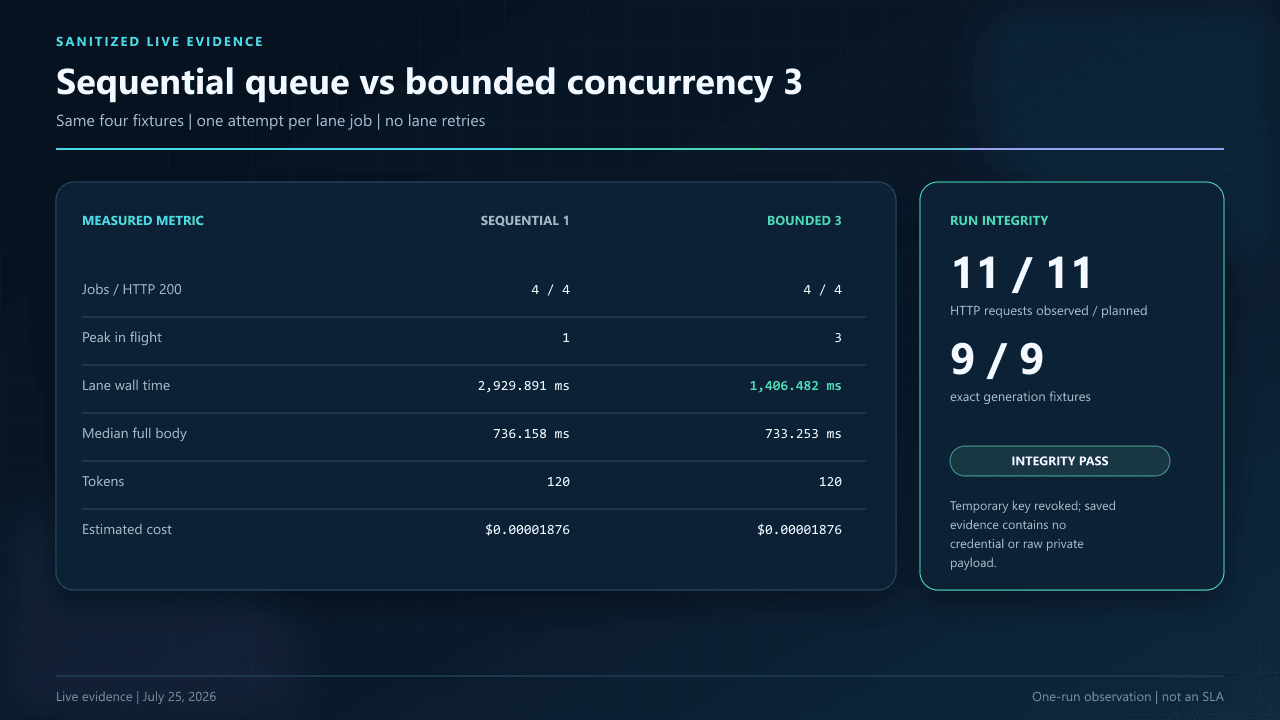
Measured result
| Metric | Sequential, concurrency 1 | Bounded queue, concurrency 3 |
|---|---|---|
| Jobs submitted | 4 | 4 |
| Successful final jobs | 4 | 4 |
| Visible attempts | 4 | 4 |
| Locally injected pre-dispatch retries | 0 | 0 |
| Real provider failures | 0 | 0 |
| Maximum requests in flight | 1 | 3 |
| Scenario wall time | 2,929.891 ms | 1,406.482 ms |
| Median full-body request duration | 736.158 ms | 733.253 ms |
| Completion order differed from submission order | No | Yes |
| Cache-hit input tokens | 0 | 0 |
| Cache-miss input tokens | 106 | 106 |
| Output tokens | 14 | 14 |
| Total tokens | 120 | 120 |
| Throughput | 1.3652 tasks/s | 2.8440 tasks/s |
| Estimated cost at July 25 rates | $0.00001876 | $0.00001876 |
The concurrency-three lane completed in 1,406.482 ms versus 2,929.891 ms for sequential dispatch. Sequential wall time was 2.0831 times the bounded-pool wall time, equivalent to a 52.00% reduction measured against the sequential lane in this particular run. This is not a universal speedup claim. The bounded pool ran first, and network conditions, provider scheduling, account state, cache warmth, and short-job variation were not controlled as they would be in a multi-run capacity study.
All eight comparison requests returned HTTP 200 and the exact expected harmless marker. The bounded lane reached three active workers and three in-flight HTTP requests; the sequential lane peaked at one. Both lanes reported exactly 106 input tokens, all as cache misses, plus 14 output tokens, so each produced the same 120-token total and the same usage-derived cost estimate. The completion sequence changed under concurrency even though the fixtures and final saved row order did not.
Dispatch order, completion order, and restored input order
The runner assigned every fixture a stable task_id and submission_order before scheduling. It separately recorded:
- submission order, which represented the caller’s original task sequence;
- dispatch order, which represented when a provider call started;
- completion order, which represented when the complete response body had been read and validated;
- saved result order, reconstructed from
submission_order.
Sequential completion order was queue-task-a, queue-task-b, queue-task-c, then queue-task-d. Concurrency-three completion order was queue-task-a, queue-task-c, queue-task-b, then queue-task-d. The saved task rows were sorted by original submission order, and every row retained its task_id, so each answer remained attached to the correct task even when completion order changed.
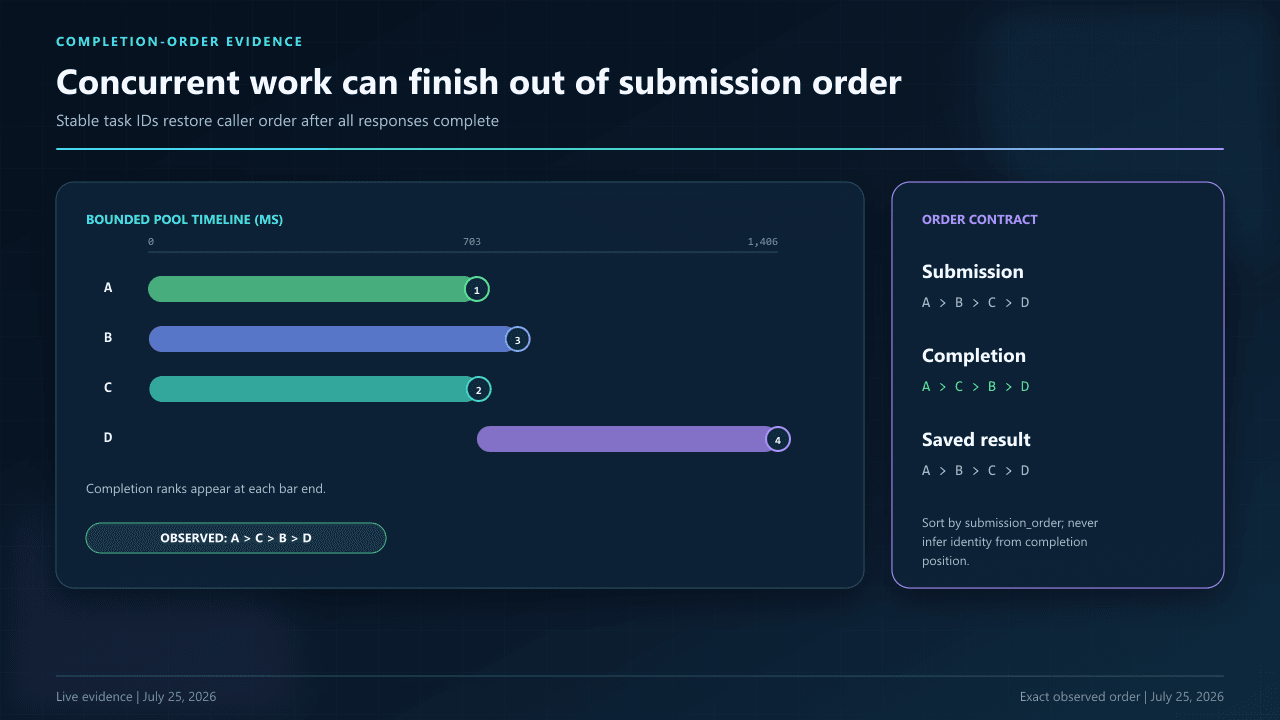
Never recover order by pushing outputs into a shared array and assuming position zero belongs to input zero. That assumption survives a one-worker test and then fails under realistic concurrency. Store the identifiers at dispatch time and make correlation part of the result schema.
Token usage and cost
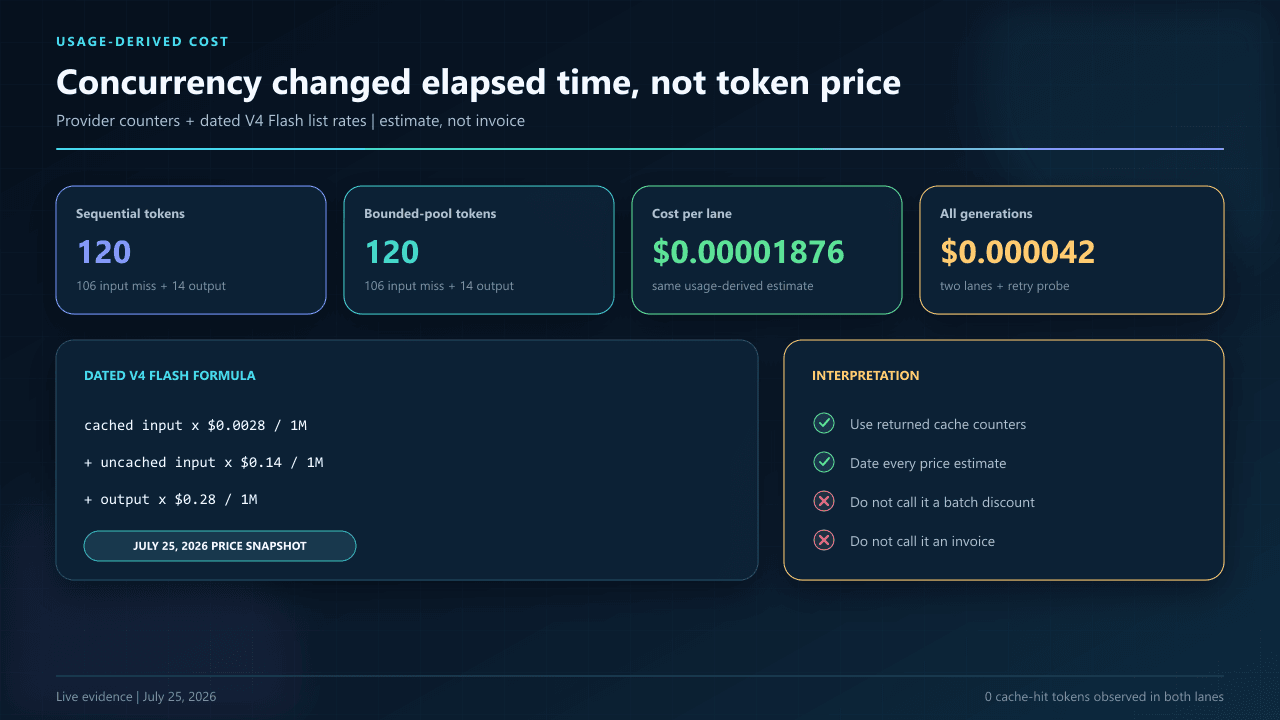
DeepSeek’s Chat response exposes prompt_cache_hit_tokens, prompt_cache_miss_tokens, and completion_tokens. The benchmark aggregated those returned counters rather than estimating tokens from characters.
The dated calculation was:
estimated cost =
  cache-hit input tokens / 1,000,000 x cache-hit input rate
  + cache-miss input tokens / 1,000,000 x cache-miss input rate
  + output tokens / 1,000,000 x output rate
On July 25, 2026, the official DeepSeek pricing page listed deepseek-v4-flash at $0.0028 per million cache-hit input tokens, $0.14 per million cache-miss input tokens, and $0.28 per million output tokens. The benchmark estimated $0.00001876 for the sequential lane and $0.00001876 for the concurrent lane.
Those values are arithmetic estimates from the returned usage and dated public rates. They are not invoices, balance debits, tax calculations, or permanent prices. The independent DeepSeek pricing guide explains the same three-part formula, but production billing decisions should always recheck the current official table.
Concurrency itself does not create a token discount. If equivalent successful calls report different usage, investigate cache fields, output length, model behavior, retry dispatches, and fixture equivalence. Do not attribute every cost difference to the worker count.
What the retry experiment proved
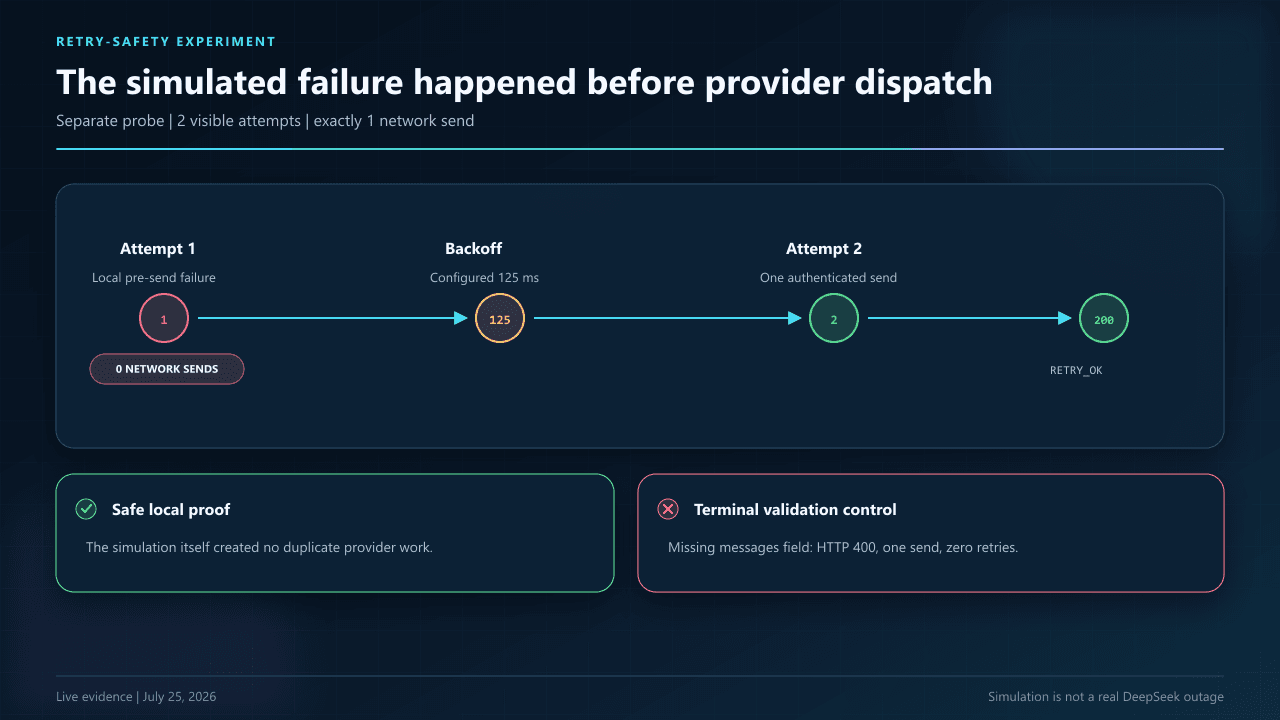
After the two comparison lanes, a separate probe simulated exactly one retryable local failure before fetch. The harness recorded attempt one as unsent, applied its preregistered 125 ms backoff, and made one authenticated HTTP request on attempt two. That request returned HTTP 200 with the exact RETRY_OK marker. The phase took 812.926 ms, and only one network send occurred, so the simulation did not duplicate provider work.
The simulation proved these local properties:
- attempt one was recorded as a simulated retryable pre-send event with
request_sent: false; - retry state remained visible instead of being hidden inside an SDK;
- the configured retry count was one and the total attempt count was two;
- the network tracker counted exactly one send and a peak of one in-flight request;
- the retried task preserved its original
task_idandsubmission_order; - the single real response returned HTTP 200 and matched the expected fixture.
It did not prove how often DeepSeek returns 429, 500, or 503. It did not reproduce a provider outage. It did not prove that a request lost after dispatch would be free, and it did not prove provider-side exactly-once execution.
All nine generation requests in the complete run returned HTTP 200 and matched their expected harmless markers. The separately preregistered terminal control intentionally omitted the required messages field; it received HTTP 400 with the allowlisted type and code invalid_request_error, made one network send, and was not retried. This is useful integrity evidence for the classifier, not evidence that production requests never fail.
Which failures should be retried?
The official DeepSeek error-code page distinguishes failures that need repair from failures that may be transient.
| Status or event | Queue action | Why |
|---|---|---|
| 400 invalid body | Fail permanently unless the payload is changed | Repeating the same malformed request does not repair it |
| 401 authentication failure | Stop or pause workers and repair credentials | Repeated calls can create noise and hide a key incident |
| 402 insufficient balance | Pause paid dispatch and restore balance | Backoff alone cannot add credits |
| 422 invalid parameters | Fail permanently unless parameters are changed | The same invalid fields should not loop |
| 429 account limit reached | Retry with bounded backoff and jitter; reduce pressure | Immediate retries can amplify the limit |
| 500 server error | Bounded retry after a delay | The condition can be transient |
| 503 server overloaded | Bounded retry after a delay; consider a circuit breaker | Continuing at full pressure can worsen recovery |
| Connection reset before any bytes | Retry cautiously within an attempt budget | Delivery may still be ambiguous |
| Client timeout after dispatch | Reconcile or retry cautiously | The provider may have performed work even if the client missed the response |
| Local validation or cancellation | Do not dispatch | These are application decisions, not provider failures |
Honor Retry-After if an actual response supplies it. Do not claim that every DeepSeek error includes that header. Use exponential backoff with full jitter, a maximum attempt count, a maximum job age, and a dead-letter state. Avoid identical retry timing across workers, which creates synchronized retry storms.
A production queue architecture
A robust DeepSeek queue has two independent boundaries: durable job state and bounded provider dispatch.
producer
  -> validate and normalize input
  -> calculate an application idempotency key
  -> insert one durable queued job

worker
  -> atomically lease one available job
  -> acquire a shared DeepSeek account permit
  -> recheck cancellation
  -> POST /chat/completions
  -> validate the full response
  -> persist result and usage transactionally
  -> release permit
  -> acknowledge queue delivery
On a transient failure:
classify
  -> increment visible attempt
  -> calculate backoff plus jitter
  -> set available_at
  -> release worker and provider permit
  -> retry later
  -> dead-letter when the budget is exhausted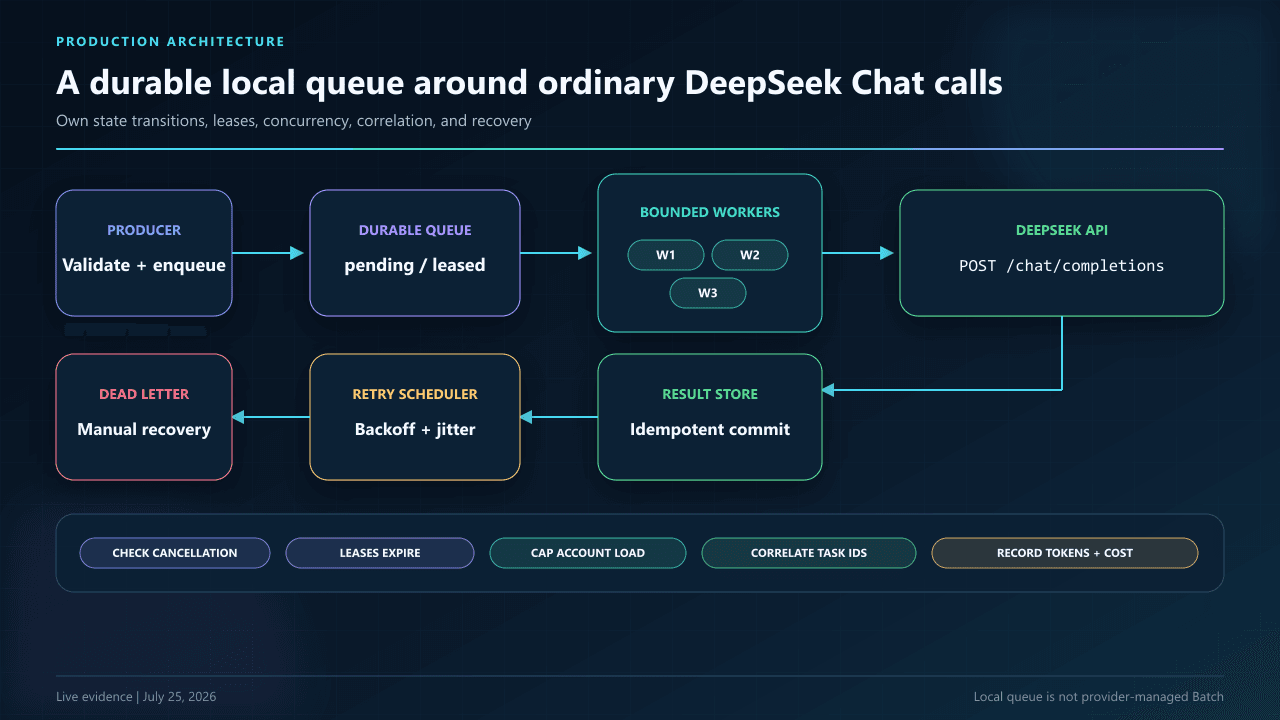
1. Validate before enqueueing
Reject unsupported models, empty messages, unsafe roles, excessive payloads, invalid output caps, and prohibited tenant data at the producer boundary. Normalize fields before hashing so semantically identical jobs produce the same application idempotency key.
Do not place the API key in the job. The DeepSeek API-key guide explains server-side storage, rotation, and revocation. Workers should receive the credential through a secret manager or process environment, while producers should have no ability to read it.
2. Persist explicit job states
A useful minimal state machine is:
queued
leased
running
retry_scheduled
succeeded
failed_permanent
dead_letter
cancelled
Each transition should be atomic and timestamped. Leases need an expiration so another worker can recover work after a process crash. A permanent processing=true flag creates invisible orphaned jobs.
Suggested fields include:
{
  "job_id": "job_0007",
  "idempotency_key": "sha256:application-generated-value",
  "tenant_id": "tenant_demo_a",
  "input_index": 6,
  "model": "deepseek-v4-flash",
  "prompt_version": "extract-v3",
  "payload_ref": "access-controlled-reference",
  "state": "queued",
  "attempt": 0,
  "max_attempts": 4,
  "priority": 20,
  "available_at": "2026-07-25T12:00:00Z",
  "lease_expires_at": null,
  "cancel_requested_at": null
}
Use an access-controlled payload reference when prompts are sensitive. Queue dashboards, dead-letter tools, and support logs often have broader access than the primary application database.
3. Claim jobs atomically
For PostgreSQL, one common pattern is FOR UPDATE SKIP LOCKED inside a short transaction:
WITH candidate AS (
  SELECT job_id
  FROM deepseek_jobs
  WHERE state IN ('queued', 'retry_scheduled')
    AND available_at <= NOW()
  ORDER BY priority DESC, available_at ASC, created_at ASC
  FOR UPDATE SKIP LOCKED
  LIMIT 1
)
UPDATE deepseek_jobs AS j
SET state = 'leased',
    lease_expires_at = NOW() + INTERVAL '90 seconds',
    leased_by = $1,
    updated_at = NOW()
FROM candidate
WHERE j.job_id = candidate.job_id
RETURNING j.*;
The transaction claims one job without letting two workers lease it simultaneously. A recovery process moves an expired lease back to an eligible state after checking whether a terminal result already exists.
4. Cap concurrency across the account
DeepSeek’s Rate Limit and Isolation page, rechecked on August 22, 2026, publishes account-level concurrency limits of 2,500 for deepseek-v4-flash, 500 for deepseek-v4-pro, and 2,500 for deepseek-v4-flash-vision-exp. The calculation is account-level regardless of which API key is used, and a request counts from dispatch until its response is complete.
Those numbers are ceilings, not good starting values. Begin far lower, then watch 429 and 503 rates, full-body latency, queue age, in-flight calls, token throughput, cost, and downstream database pressure. Reserve capacity for interactive traffic if background work shares the same account.
A semaphore inside one Node.js process is insufficient when multiple hosts run workers. Use a shared permit service, a queue system with a global consumer cap, or a distributed semaphore. Separate pools can protect short non-thinking work from long Pro reasoning jobs, but their combined dispatch still has to respect the same account.
5. Send one ordinary Chat Completion per job
This compact worker function shows the transport boundary. It intentionally leaves persistence to the repository layer:
const TRANSIENT = new Set([429, 500, 503]);

function parseRetryAfterMs(value) {
  if (!value) return null;
  const seconds = Number(value);
  if (Number.isFinite(seconds) && seconds >= 0) {
    return seconds * 1000;
  }
  const date = Date.parse(value);
  return Number.isFinite(date) ? Math.max(0, date - Date.now()) : null;
}

function retryDelayMs(attempt, retryAfterMs) {
  if (Number.isFinite(retryAfterMs)) {
    return Math.min(retryAfterMs, 60_000);
  }
  const ceiling = Math.min(30_000, 500 * 2 ** attempt);
  return Math.floor(Math.random() * ceiling);
}

async function callDeepSeek(job, signal) {
  const response = await fetch(
    "https://api.deepseek.com/chat/completions",
    {
      method: "POST",
      headers: {
        "content-type": "application/json",
        authorization: `Bearer ${process.env.DEEPSEEK_API_KEY}`,
      },
      body: JSON.stringify({
        model: job.model,
        messages: job.messages,
        thinking: { type: "disabled" },
        max_tokens: job.maxTokens,
        stream: false,
      }),
      signal,
    },
  );

  const text = await response.text();
  let body = null;
  if (text) {
    try {
      body = JSON.parse(text);
    } catch {
      body = null;
    }
  }

  if (!response.ok) {
    const retryAfterMs = parseRetryAfterMs(
      response.headers.get("retry-after"),
    );
    const error = new Error(`DeepSeek returned HTTP ${response.status}`);
    error.status = response.status;
    error.retryable = TRANSIENT.has(response.status);
    error.retryAfterMs = retryAfterMs;
    throw error;
  }

  if (body?.object !== "chat.completion") {
    throw new Error("Unexpected DeepSeek response contract");
  }

  return {
    model: body.model,
    text: body.choices?.[0]?.message?.content ?? "",
    finishReason: body.choices?.[0]?.finish_reason ?? null,
    usage: {
      cacheHit: body.usage?.prompt_cache_hit_tokens ?? 0,
      cacheMiss: body.usage?.prompt_cache_miss_tokens ?? 0,
      output: body.usage?.completion_tokens ?? 0,
      total: body.usage?.total_tokens ?? 0,
    },
  };
}
Do not log job.messages, the authorization header, or the full error response by default. Error bodies can contain submitted values. Store an allowlisted status, classification, attempt, duration, and safe provider request identifier only if your privacy policy permits it.
6. Make result writes idempotent
Create a unique constraint on idempotency_key at enqueue time and a conditional terminal update at completion time. The success transaction should:
- verify the job is not already terminal;
- persist the validated result, usage, returned model, attempt, and completion time;
- mark the job
succeeded; - commit once;
- acknowledge the queue message only after the commit.
If the queue redelivers a message, the existing terminal row wins. This prevents duplicate application results. It does not prevent a second model call if the first provider response was lost after the provider performed the work.
We found no documented request-idempotency header in the DeepSeek Chat reference reviewed on July 25, 2026. Therefore, do not promise exactly-once provider execution or exactly-once billing. Design for at-least-once delivery and idempotent local effects.
7. Check cancellation twice
Cancellation has two useful boundaries:
- before acquiring a provider permit, mark the job cancelled without a model call;
- immediately after acquiring the permit but before dispatch, recheck the cancellation flag.
After dispatch, cancellation is best effort. Aborting the client connection does not prove that provider inference stopped or that the request incurred no charge. Record cancel_requested_at, dispatch_started_at, and the final outcome separately.
8. Handle completion order explicitly
Persist input_index, dispatch_sequence, and completion_sequence. A callback can stream completed jobs to an operator, while a caller that requires original order can sort by input_index after all terminal results arrive.
For very large jobs, avoid keeping every result in process memory. Store results as they complete and expose a paginated export keyed by job_id and input_index.
Context caching for queued workloads
DeepSeek Context Caching is enabled by default and works on reusable prompt prefixes. The official guide describes it as best effort, not guaranteed. A queue can improve the chance of useful reuse by making templates deterministic:
- put stable system instructions and shared reference material first;
- put job-specific content later;
- keep example and field order stable;
- avoid timestamps, random IDs, or volatile metadata before the shared prefix;
- record actual cache-hit and cache-miss tokens;
- do not violate tenant fairness or priority just to chase a possible hit.
The DeepSeek Context Caching guide explains prefix reuse and usage counters in detail. A cache hit lowers only the billed input portion that actually hit. It does not reuse the output, guarantee lower latency, make duplicate dispatch safe, or turn ordinary requests into a native Batch job.
Security and multi-tenant controls
Queues retain data longer than synchronous request handlers, so their security boundary deserves explicit design.
- Keep the DeepSeek key in a server-side secret store, never in a message or browser bundle.
- Give producers, workers, dashboards, export tools, and dead-letter tools separate permissions.
- Encrypt sensitive payloads at rest and minimize prompt retention.
- Use opaque tenant IDs and exclude personal information from
user_id. - Apply per-tenant quotas before the global account semaphore.
- Validate roles, models, thinking settings, output limits, and total payload size before enqueueing.
- Separate development, staging, and production queues and credentials.
- Treat dead-letter payload access as privileged.
- Record a prompt-template version without logging unnecessary prompt content.
- Redact authorization values, response IDs, account identifiers, and private text from screenshots.
- Rotate and revoke temporary benchmark credentials.
- Alert on unusual queue age, attempt count, token use, cost, and tenant concentration.
DeepSeek documents user_id for safety, cache, and scheduling isolation, but ordinary requests still share account-level concurrency. Do not create more API keys as a quota-bypass strategy.
Local queue vs one large multi-item prompt
Packing many rows into one prompt can be useful for very small, uniform classifications, but it changes the reliability model.
| Decision | One item per queued request | Many items in one prompt |
|---|---|---|
| Retry granularity | One failed job | Entire prompt or custom partial retry |
| Cost attribution | Per request from returned usage | Shared across all items |
| Output validation | One result contract | Must parse and correlate a collection |
| Context limit risk | Isolated | Combined input and output can grow quickly |
| Priority and cancellation | Per job | Whole prompt |
| Blast radius | One item | Every packed item |
| Cache behavior | Shared prefixes may hit across calls | One larger request |
| Provider calls | More | Fewer |
Use a multi-item prompt only when you can cap size, enforce an indexed output schema, detect missing or duplicate rows, and safely retry partial failures. Do not call that a native DeepSeek Batch API.
Monitoring the queue in production
A useful dashboard separates queue behavior from provider behavior.
Queue metrics:
- queued, leased, running, retry-scheduled, dead-letter, and cancelled counts;
- oldest queued-job age and percentile wait time;
- lease expirations and recoveries;
- retry count by classification;
- deduplication conflicts;
- input-order restoration failures;
- per-tenant depth and quota rejections.
Provider-call metrics:
- in-flight requests by model;
- 2xx, 400, 401, 402, 422, 429, 500, and 503 counts;
- headers-observed and full-body-read durations;
- finish reasons;
- cache-hit, cache-miss, completion, and total tokens;
- dated estimated cost;
- returned model mismatches;
- response-contract validation failures.
Alert on a rising 429 or 503 ratio, but also on a growing queue with no errors. The latter can indicate insufficient workers, stuck leases, a paused credential, database contention, or excessively long jobs.
Limitations of this benchmark
The live evidence is intentionally small and bounded.
- It used one DeepSeek account, one temporary key, one model, one region from the client perspective, and one test window.
- It compared concurrency one with concurrency three, far below the published account ceiling.
- It used short synthetic prompts with thinking disabled and cannot represent long-context, streaming, tool-call, or Pro workloads.
- It injected a local pre-dispatch failure instead of deliberately causing a real provider outage or exceeding the concurrency limit.
- It measured client-observed full-response duration, not time to first token, backend inference time, network-only latency, or an SLA.
- It calculated cost from returned usage and dated list prices; it did not inspect account balance or invoices.
- It demonstrated one final stored result per job in the harness; it did not establish provider exactly-once execution.
- Context caching is best effort, so one run cannot establish a future hit rate.
- The July 25 documentation audit predates the August 21 launch of Vision Exp and its image-only Files API. The benchmark remains historical; the current endpoint boundary was re-reviewed on August 22.
Recheck the official API reference, change log, pricing, model list, and concurrency page before copying the architecture into a production launch.
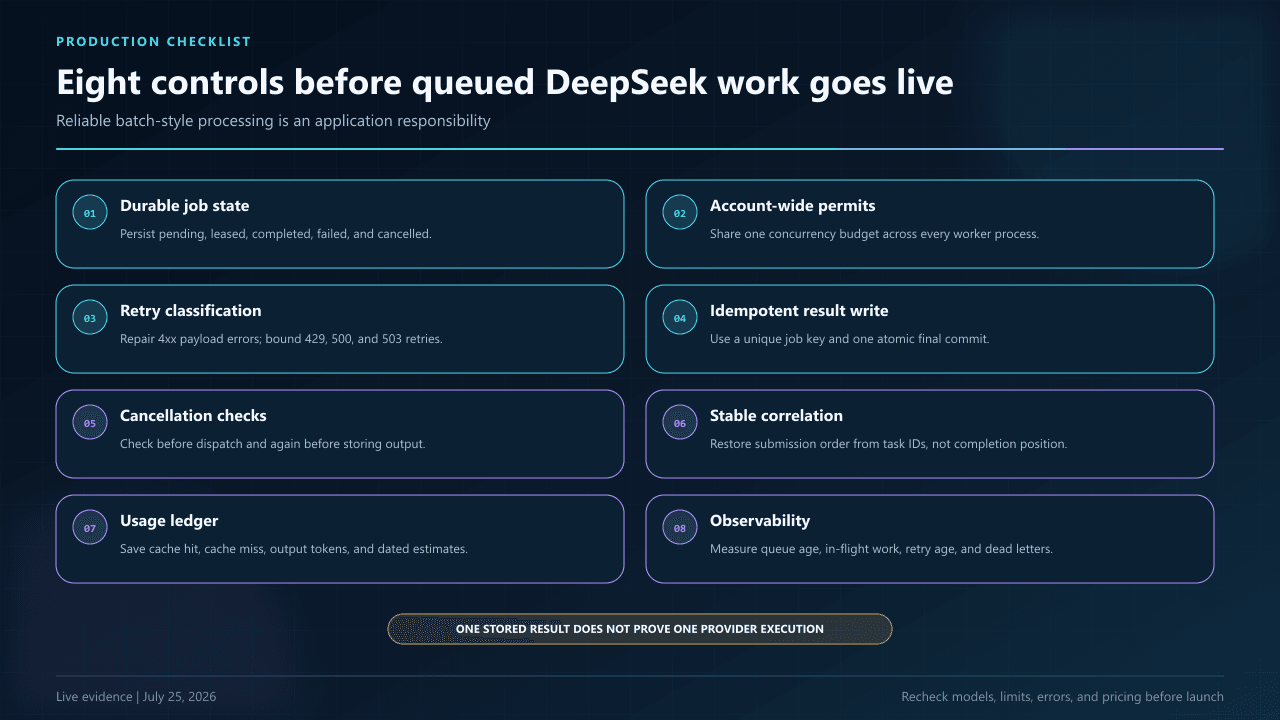
Production checklist
Before enabling background DeepSeek processing:
- Verify the current model with
GET /models. - Confirm the official endpoint surface; do not assume SDK-wide compatibility.
- Store the API key server-side and test revocation.
- Validate and normalize jobs before enqueueing.
- Add a unique application idempotency key.
- Persist explicit states, timestamps, and lease expiration.
- Enforce one account-wide concurrency budget across every worker host.
- Reserve capacity for interactive traffic.
- Disable hidden retries or make their attempts observable.
- Retry only classified transient failures with jitter and strict budgets.
- Dead-letter exhausted jobs without exposing payloads.
- Correlate output by
job_idandinput_index. - Make terminal result writes idempotent.
- Treat cancellation after dispatch as best effort.
- Record provider-returned cache and output token counters.
- Snapshot the price date used for estimates.
- Separate queue metrics from provider-call metrics.
- Test lease recovery and worker crashes.
- Load-test your database and result exporter before raising concurrency.
- Recheck DeepSeek documentation before each significant release.
Frequently asked questions
Does DeepSeek have a native Batch API?
No native asynchronous Batch API was documented in the official DeepSeek materials we re-reviewed on August 22, 2026. DeepSeek does have an image-only Files API, but it does not create, schedule, poll, cancel, or return batch jobs.
Is DeepSeek /files a Batch API?
No. /files uploads, lists, retrieves metadata for, and deletes supported images so they can be reused by file_id with Vision Exp. It has no batch-job lifecycle, completion window, or batch result file.
Can I upload PDF or DOCX to DeepSeek Files API?
No. The documented Files API formats are JPEG, PNG, GIF, and WebP. PDF, DOCX, JSONL, and other general documents are not supported by this image-only endpoint.
Can I use client.batches.create() with DeepSeek?
Do not assume so. A method in an OpenAI client library does not prove that api.deepseek.com implements the corresponding server resource, and we found no official DeepSeek example or Batch endpoint contract for that method.
What does DeepSeek batch processing mean in this guide?
In this guide, DeepSeek batch processing means an application-owned queue that stores many jobs and sends one ordinary DeepSeek Chat Completions or Responses request per job with bounded concurrency, retries, correlation, usage accounting, and durable results.
How many DeepSeek requests can run concurrently?
The official page rechecked on August 22, 2026 publishes account-level limits of 2,500 for deepseek-v4-flash, 500 for deepseek-v4-pro, and 2,500 for deepseek-v4-flash-vision-exp. Start far below those ceilings and tune from measured errors, latency, queue age, cost, and downstream capacity.
Are DeepSeek concurrency limits per API key?
No. DeepSeek states that concurrency is calculated at the account level regardless of which API key is used, so creating more keys does not create independent concurrency budgets.
Which DeepSeek model should a queue use?
Start with a current model returned by GET /models. V4 Flash is a sensible low-cost text benchmark default, V4 Pro should be evaluated for harder reasoning or coding, and V4 Flash Vision Exp is the model for mixed text-and-image jobs or images referenced by file_id.
Does concurrency reduce DeepSeek token cost?
No per-token discount is created by concurrency. Cost still depends on provider-reported cache-hit input, cache-miss input, and output tokens multiplied by the current rates, although cache behavior or output variation can make two runs differ.
Can concurrent DeepSeek jobs finish out of order?
Yes. Independent requests can take different amounts of time, so a concurrent queue must correlate every result by job_id and restore caller order from input_index when ordered output is required.
Which DeepSeek errors should a queue retry?
Use bounded retries for 429, 500, 503, and carefully classified network failures. Do not loop unchanged 400, 401, 402, or 422 failures because they require payload, credential, balance, or parameter repair.
How do I prevent duplicate queue results?
Create a unique application idempotency key, make terminal result writes conditional and transactional, and acknowledge a queue message only after the result commit. A repeated delivery should return the already stored terminal result.
Does a local idempotency key guarantee exactly-once DeepSeek execution?
No. It can guarantee one application result, but without a documented provider idempotency contract it cannot prove that an ambiguous timed-out request was executed or billed only once.
How should cancellation work?
Check cancellation before acquiring a provider permit and again immediately before dispatch. After dispatch, aborting the client is best effort and does not prove that provider inference stopped or incurred no cost.
How should I calculate DeepSeek queue cost?
Aggregate returned prompt_cache_hit_tokens, prompt_cache_miss_tokens, and completion_tokens, multiply each by the matching dated per-million-token rate, and label the result an estimate rather than an invoice.
Can DeepSeek Context Caching help queued jobs?
It can reduce the billed input portion when stable prompt prefixes receive best-effort cache hits. Put shared instructions first, keep templates deterministic, and record actual hit and miss counters instead of assuming a hit.
When is one multi-item prompt better than a queue?
It can fit small uniform tasks when you can cap context size, enforce indexed structured output, detect missing rows, and tolerate retrying the combined request. It is not equivalent to a native Batch API and has a larger failure blast radius.
Conclusion
DeepSeek batch processing is an application architecture today, not a documented provider-managed Batch resource on the official host. The image-only Files API can reduce repeated image-upload bandwidth, but it does not own queue state or process PDF, DOCX, or batch manifests. The reliable pattern is to persist each job, discover a current model, cap account-wide concurrency, call ordinary model endpoints, classify retries, store usage and results transactionally, and reconstruct output order from stable identifiers.
The live benchmark makes the trade-off concrete: four bounded-pool jobs completed in 1,406.482 ms, while the same four sequential jobs completed in 2,929.891 ms; the concurrent lane finished tasks A, C, B, D instead of submission order A, B, C, D. Both lanes reported 120 tokens and an estimated $0.00001876 in usage cost, so the observed wall-time difference did not change token count or derived cost for these fixtures. Its simulated pre-dispatch retry exercised local attempt logic without pretending that DeepSeek produced an outage, and its usage-derived cost avoided character-count guesses.
Build the queue for at-least-once delivery and idempotent local effects. Do not promise provider exactly-once execution, do not turn SDK surface area into endpoint claims, and do not treat published concurrency ceilings as worker defaults. Then recheck the official documentation before scaling, because the absence of a native Batch resource is a dated finding rather than a permanent guarantee.
Sources and evidence
First-party DeepSeek sources:
- DeepSeek API quick start
- DeepSeek API introduction
- Create Chat Completion
- List Models
- Rate Limit and Isolation
- Error Codes
- Models and Pricing
- Token and Token Usage
- Context Caching
- Files API
- Vision input guide
- Responses API guide
- V4 Flash Vision Exp and Files API release
- DeepSeek V4 release
- DeepSeek change log
Verified internal guides:
- DeepSeek API documentation guide
- DeepSeek Chat Completions guide
- DeepSeek API key guide
- DeepSeek Context Caching guide
- DeepSeek pricing guide
The sanitized local evidence package contains the preregistered plan, live result JSON, matching CSV, methodology, analysis, and benchmark source. It contains no API key, authorization value, cookie, account identifier, response ID, raw private payload, or unredacted arbitrary model output.