Chat Deep AI

Chat Deep AI

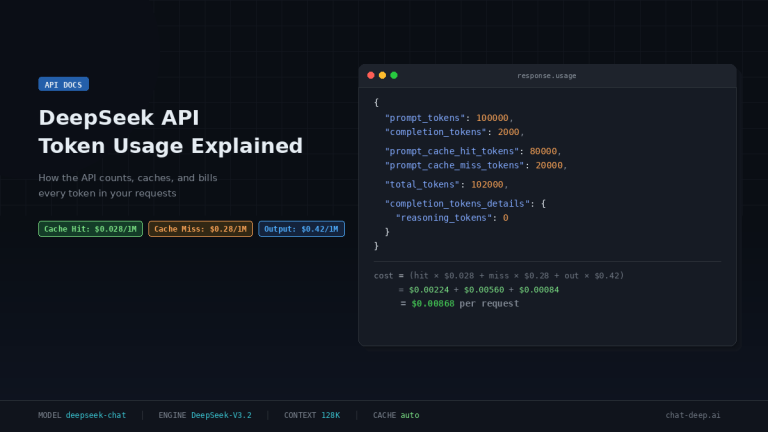
DeepSeek API Token Usage Explained

DeepSeek API Token Usage Explained — How the API counts, caches, and bills every token in your requests

DeepSeek token usage refers to the actual input and output tokens recorded by the API for each request, and these values are the only source of truth for billing. Unlike rough character-based estimates, real cost is calculated directly from the…

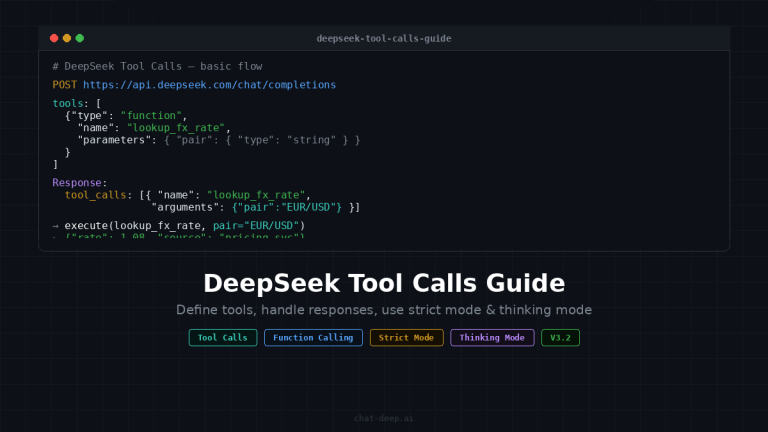
DeepSeek Tool Calls Guide

DeepSeek Tool Calls Guide — terminal showing tool definition, API response with tool_calls, and function execution flow

Quick answer: DeepSeek Tool Calls let the model request external functions during a chat workflow, but your application executes them. As of April 5, 2026, both deepseek-chat and deepseek-reasoner support Tool Calls on DeepSeek-V3.2 with a 128K context window. In…

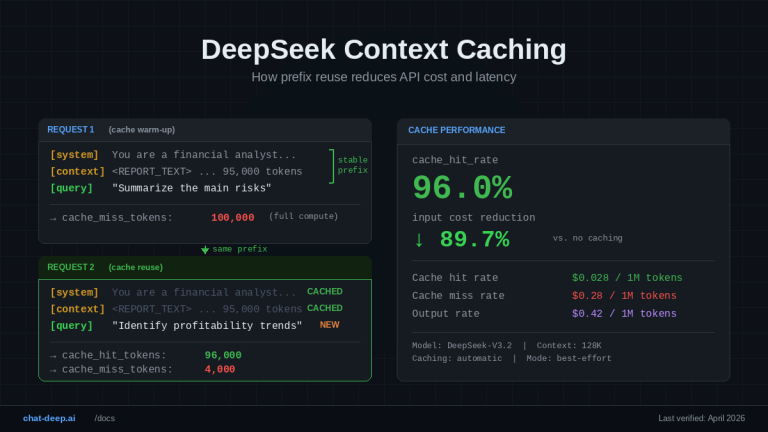
DeepSeek Context Caching Explained

DeepSeek Context Caching Explained — How prefix reuse reduces API cost and latency

DeepSeek Context Caching is a built-in API feature that automatically reuses repeated prompt prefixes across requests. It does not store memory or conversations. Instead, it reduces input cost and latency when you resend the same front-loaded context. Last verified: April…

DeepSeek Thinking Mode

Last verified: April 4, 2026 DeepSeek Thinking Mode is not just a prompt style. In the current API, it is a distinct execution mode that changes output structure, feature support, and some parameter behavior. You can enable it either by…

DeepSeek Chat Completions API

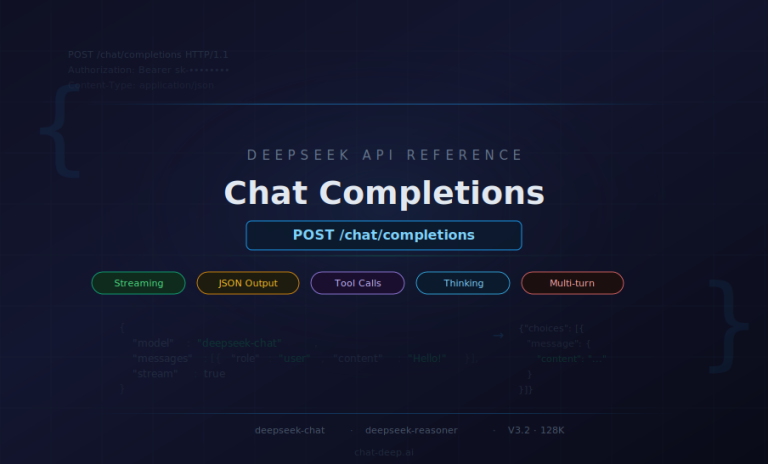
DeepSeek Chat Completions API — POST /chat/completions endpoint guide covering streaming, JSON output, tool calls, and thinking mode

Last verified: April 1, 2026 POST /chat/completions is the main DeepSeek endpoint for conversational generation. It takes a model plus a messages array, returns either a normal chat completion object or streamed SSE chunks, and supports structured JSON output, tool…

DeepSeek Anthropic API in Claude Code

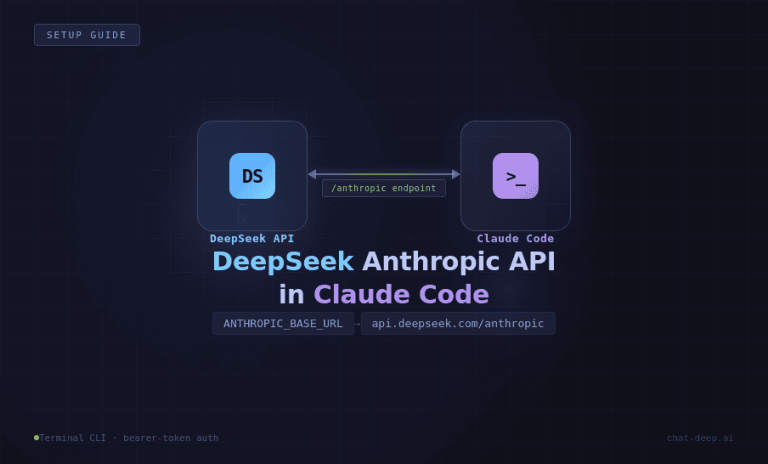
DeepSeek Anthropic API in Claude Code — setup diagram showing DeepSeek API connected to Claude Code terminal via the Anthropic-compatible endpoint

This guide explains how to route Claude Code’s terminal client through DeepSeek’s Anthropic-compatible API endpoint — step by step. You will learn how to install Claude Code using Anthropic’s recommended native method, configure the right environment variables for DeepSeek’s gateway,…

Integrating DeepSeek into Web Apps and SaaS Platforms

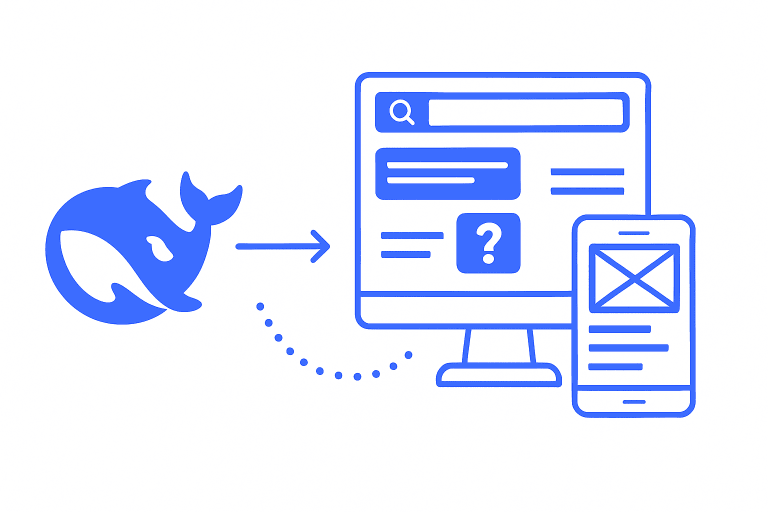
Integrating DeepSeek into Web Apps and SaaS Platforms

Modern SaaS applications are increasingly embedding AI capabilities to enhance user experience and automation. Integrating a large language model (LLM) like DeepSeek can make a web app more intuitive, conversational, and powerful. Instead of rigid interfaces and static forms, users get natural…

Using DeepSeek in Business Intelligence Dashboards

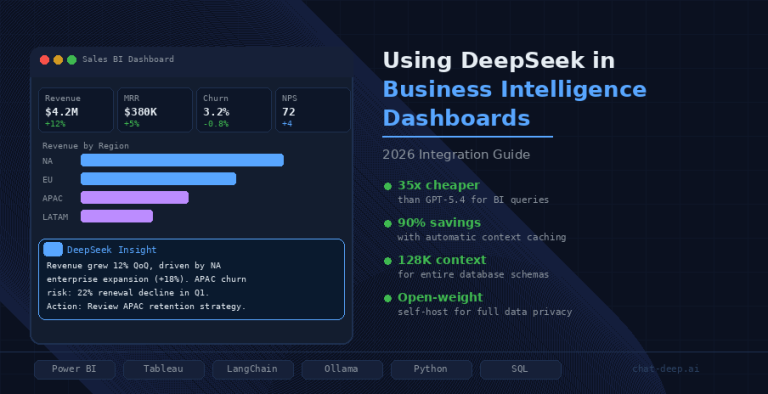
Using DeepSeek in Business Intelligence Dashboards — 2026 integration guide showing AI-powered BI dashboard with DeepSeek insights, 35x cheaper than GPT-5.4

Business intelligence dashboards are no longer just static charts waiting for someone to interpret them. With large language models, dashboards can now answer questions in plain English, generate executive summaries automatically, and flag anomalies before anyone notices. DeepSeek, an open-weight…

Is DeepSeek Safe?

DeepSeek is an AI company based in China and the name of a family of large language models (LLMs). As of early 2026, its publicly released models include the DeepSeek-V3 series for general tasks and the DeepSeek-R1 series for reasoning-focused…

Getting Started with DeepSeek R1 on Azure AI Foundry

DeepSeek R1 on Azure AI Foundry

DeepSeek R1 is a state-of-the-art reasoning large language model (LLM) designed to tackle complex tasks using step-by-step logic. It excels at multi-step reasoning in domains like natural language, scientific problem solving, and coding. Under the hood, DeepSeek R1 features an…

How to Deploy DeepSeek on Google Cloud or AWS

How to Deploy DeepSeek on Google Cloud or AWS

Deploying DeepSeek models on cloud platforms can unlock powerful AI capabilities for advanced applications. DeepSeek Chat and DeepSeek Coder are state-of-the-art large language models from DeepSeek AI, designed for general conversational reasoning and code generation respectively. They are open-source (free…

Fine-Tuning DeepSeek V3 with LoRA for Custom Applications

Fine-Tuning DeepSeek V3 with LoRA for Custom Applications

Fine-tuning large language models like DeepSeek V3 can unlock new capabilities, allowing developers to tailor these powerful models to domain-specific tasks and vocabularies. In this comprehensive guide, we’ll explore how to fine-tune DeepSeek V3 – one of 2025’s most advanced…

How to Use DeepSeek for Document Summarization and QA

How to Use DeepSeek for Document Summarization and QA

In an era of information overload, automatically summarizing documents and extracting answers to questions has become critical. Modern enterprises generate massive reports, logs, and knowledge bases, making it impractical to manually digest everything. Document summarization with large language models (LLMs)…

How to Build Your Own App with DeepSeek

How to Build Your Own App with DeepSeek

DeepSeek has earned its place as one of the most capable open-source AI model families available to developers. With the release of DeepSeek-V3.2 in December 2025, the platform now offers GPT-5-level performance through a unified model that handles both general conversation and…

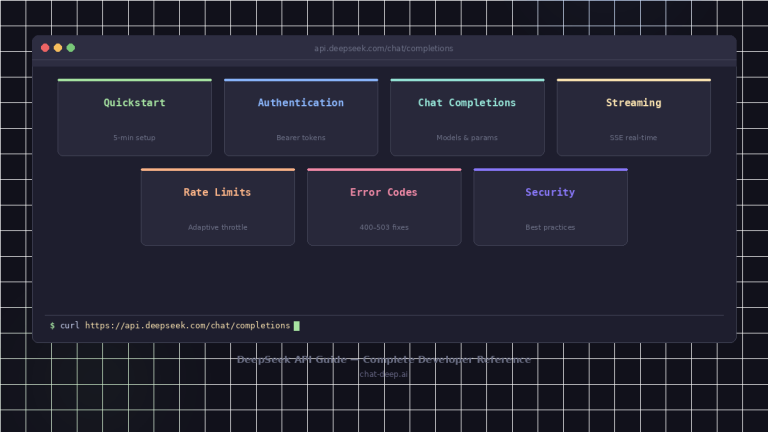
DeepSeek API Guide

DeepSeek API Guide

Quickstart (5–10 Minutes) The DeepSeek API is largely compatible with OpenAI’s API format. This means you can use familiar tools and libraries (like OpenAI’s SDK) by pointing them to DeepSeek’s endpoints. To get started, you will need to obtain an…

DeepSeek vs ChatGPT

DeepDeek-vs-Chatgpt

DeepSeek and ChatGPT are two of the most capable AI chatbots available today. ChatGPT, developed by OpenAI, became a household name after its launch in late 2022. DeepSeek, developed by the Chinese AI research company DeepSeek AI, has emerged as…